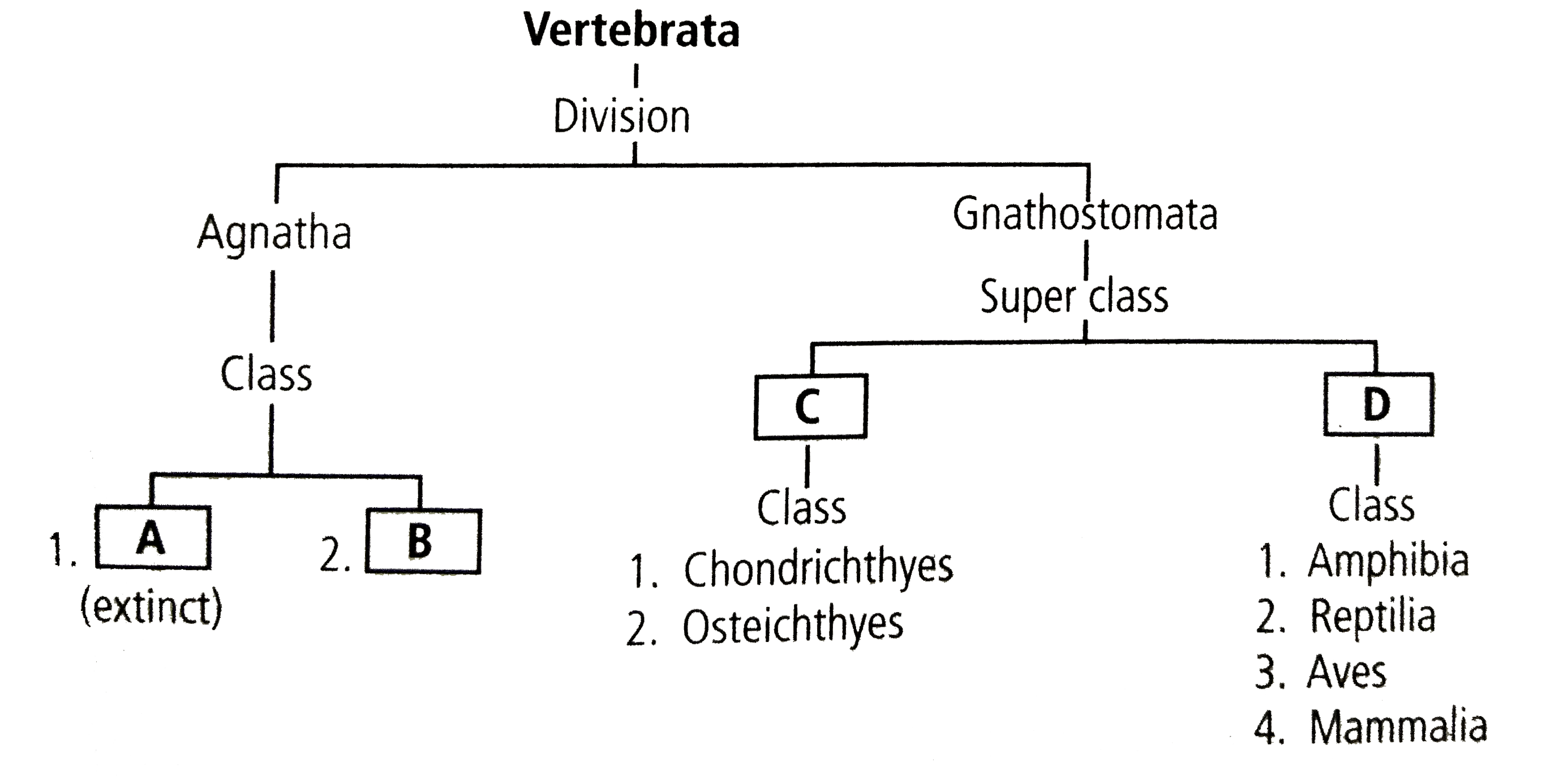
A
B
C
D
Text Solution
Verified by Experts
The correct Answer is:



Topper's Solved these Questions
ANIMAL KINGDOM
NCERT FINGERTIPS ENGLISH|Exercise Hots|5 VideosANIMAL KINGDOM
NCERT FINGERTIPS ENGLISH|Exercise NCERT examples problems|13 VideosANIMAL KINGDOM
NCERT FINGERTIPS ENGLISH|Exercise Classification of non-chordates|41 VideosANATOMY OF FLOWERING PLANTS
NCERT FINGERTIPS ENGLISH|Exercise Anatomy Of Flowering Plants|143 VideosBIOLOGICAL CLASSIFICATION
NCERT FINGERTIPS ENGLISH|Exercise Biological Classification|132 Videos
Similar Questions
Explore conceptually related problems
NCERT FINGERTIPS ENGLISH-ANIMAL KINGDOM-Classification of chordates
- In some chordates, the notochord is modified as the vertebral column. ...
Text Solution
|
- A common characteristic of all vertebrates without exception is
Text Solution
|
- Go through the following flow chart for division of subphylum vertebra...
Text Solution
|
- Match column I with column II and select the correct option from the g...
Text Solution
|
- Match the excretory organs listed under column I with the animals give...
Text Solution
|
- To which classes do the following animals belong? A-Petromyzon, B-Scol...
Text Solution
|
- Which of the following is/are not the characteristics of the Class Ost...
Text Solution
|
- Select the correct option in respect of characteristics of each group....
Text Solution
|
- Match column I with column II and select the correct option from the g...
Text Solution
|
- The figure of Labeo rohita is given below. Identify the parts labelled...
Text Solution
|
- Which of the following is a correct match?
Text Solution
|
- Which of the following group is formed of only the hermaphordite organ...
Text Solution
|
- Which of the following statements is/are correct or incorrect regardin...
Text Solution
|
- Read the give statements and select the correct option. Statement 1 ...
Text Solution
|
- The limbless amphibian is
Text Solution
|
- Identify the given animal.
Text Solution
|
- Identify the following animals and the classes to which they belong.
Text Solution
|
- Match the columns and select the correct option. {:(Column I,Column ...
Text Solution
|
- Amphibians share with reptiles all of the following characters except
Text Solution
|
- Which of the following is a true nut?
Text Solution
|