Home
Class 11
PHYSICS
Figure shows (x,t) (y,t) diagram of a p...

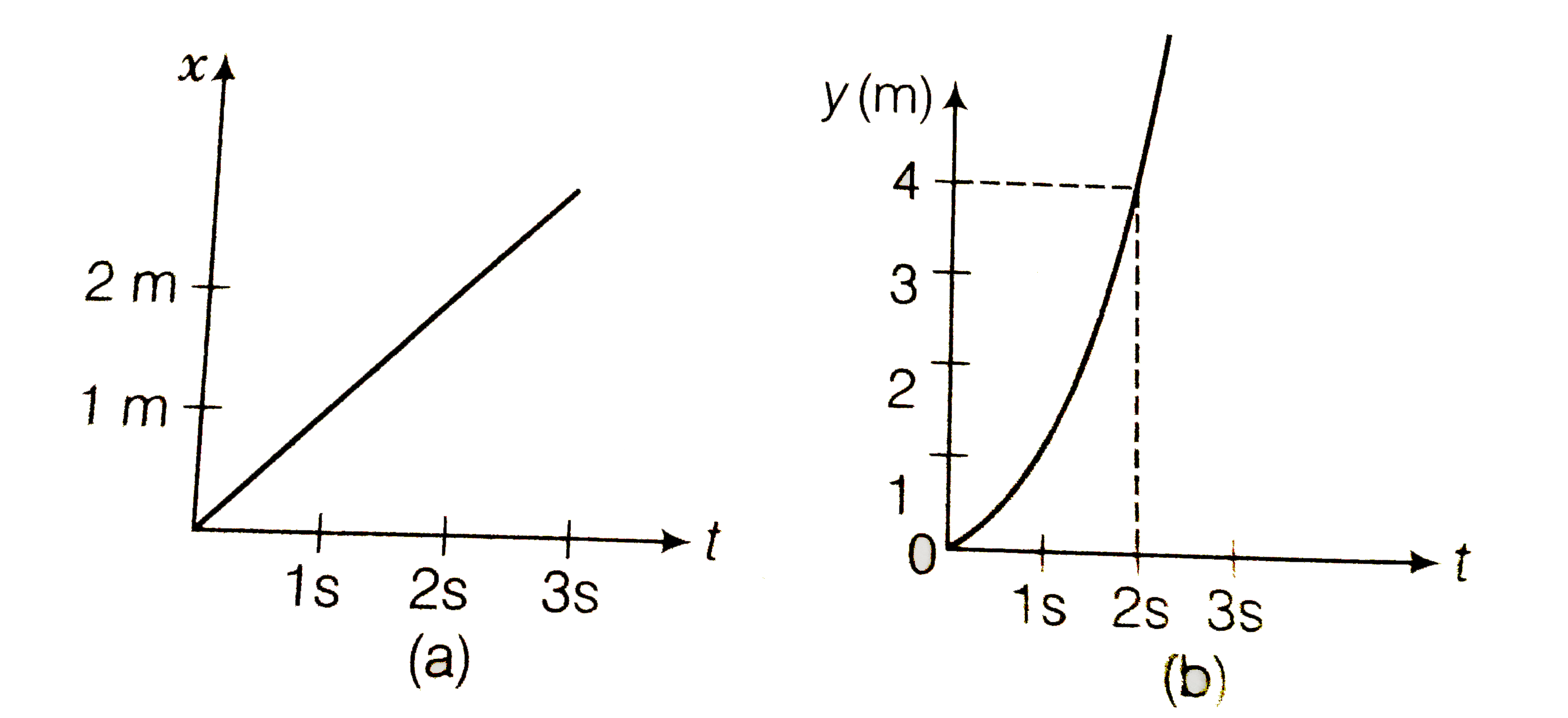
Figure shows (x,t) (y,t) diagram of a particle moving in 2-dimensions.

If the particle has a mass of 500 g , find the force (direction and magnitude) acting on the particle .

A

1N along y-axis

B

1N along x-axis

C

0.5N along x-axis

D

0.5N along y-axis

Text Solution

Verified by Experts

The correct Answer is:

A

Since the graph between x and t is a strainght line and passing through the origin.
`therefore x=t`
Since the graph between y and t is a parabola.
`therefore y=t^(2)`
`therefore v_(x)=(dx)/(dt)=1 and a_(x)=(dv_(x))/(dt)=0`
`and v_(y)=(dy)/(dt)=2t and a_(y)=2ms^(-2)`
The force acting on the partical is
`F=ma_(y)=(0.5kg)(2ms^(-2))=1N "along y-axis"`
Promotional Banner

Topper's Solved these Questions

  • LAWS OF MOTION

    NCERT FINGERTIPS ENGLISH|Exercise HOTS|8 Videos
  • LAWS OF MOTION

    NCERT FINGERTIPS ENGLISH|Exercise Exemplar Problems|9 Videos
  • KINETIC THEORY

    NCERT FINGERTIPS ENGLISH|Exercise Assertion And Reason|10 Videos
  • MECHANICAL PROPERTIES OF FLUIDS

    NCERT FINGERTIPS ENGLISH|Exercise NCERT Exemplar|5 Videos

Similar Questions

Explore conceptually related problems

Figure shows (v_x ,t) and (v_y ,t) diagram for a body of unit mass. Find the force as a function of time.

Figure shows (v_x ,t) and (v_y ,t) diagram for a body of unit mass. Find the force as a function of time.

The motion of a particle of mass m is described by y =ut + (1)/(2) g t^(2) . Find the force acting on the particale .

The motion of a particle of mass m is described by y =ut + (1)/(2) g t^(2) . Find the force acting on the particale .

The velocity-time graph of a particle moving in a straight line is shown in figure. The mass of the particle is 2kg . Work done by all the forces acting on the particle in time interval between t=0 to t=10s is

Figure shows the displacement of a particle going along the X-axis as a function of time. The force acting on the particle is zero in the region

The fig. shows the v-t graph of a particle moving in straight line. Find the time when particle returns to the starting point.

Kinetic energy of a particle moving in a straight line is proportional to the time t. The magnitude of the force acting on the particle is :

The figure shows the position time graph of a particle of mass 40 kg. What is the force acting on the particle of 0lttlt4 s

The acceleration-time graph of a particle moving along x-axis is shown in the figure. If the particle starts with velocity 3 m/s at t = 0, find the velocity of particle at t = 4 s.

NCERT FINGERTIPS ENGLISH-LAWS OF MOTION-Assertion And Reason
  1. Figure shows (x,t) (y,t) diagram of a particle moving in 2-dimensions...

    Text Solution

    |

  2. Assertion : An external force is required to keep a body in motion. ...

    Text Solution

    |

  3. Assertion: For applying the second law of motion, there is no conceptu...

    Text Solution

    |

  4. Assertion: If a body is momentarily at rest, it means that force or ac...

    Text Solution

    |

  5. Assertion: If external force on a body is zero, its acceleration is ze...

    Text Solution

    |

  6. Assertion: There is no apprecible change in the position of the body d...

    Text Solution

    |

  7. Assertion:On a merry-go-around, all parts of our body are subjected to...

    Text Solution

    |

  8. Assertion : The moment after a stone is released out of an accelerated...

    Text Solution

    |

  9. Assertion: Force on a body A by body B is equal and opposite to the fo...

    Text Solution

    |

  10. Assertion: There is no cause-effect relation between action and reacti...

    Text Solution

    |

  11. Assertion: The terms action and reaction in the third law of motion st...

    Text Solution

    |

  12. Assertion : The total momentum of an isolated system of particles is c...

    Text Solution

    |

  13. Assertion: Friction opposes relative motion and thereby dissipates pow...

    Text Solution

    |

  14. Assertion: On a rainy day, it is difficult to drive a car or bus at h...

    Text Solution

    |

  15. Assertion : Static friction is a self-adjusting force upto its limit m...

    Text Solution

    |

  16. Assertion: The familiar equation mg=R for a body on a table is true on...

    Text Solution

    |
