Home
Class 11
PHYSICS
Figure shows the position-time graph of ...

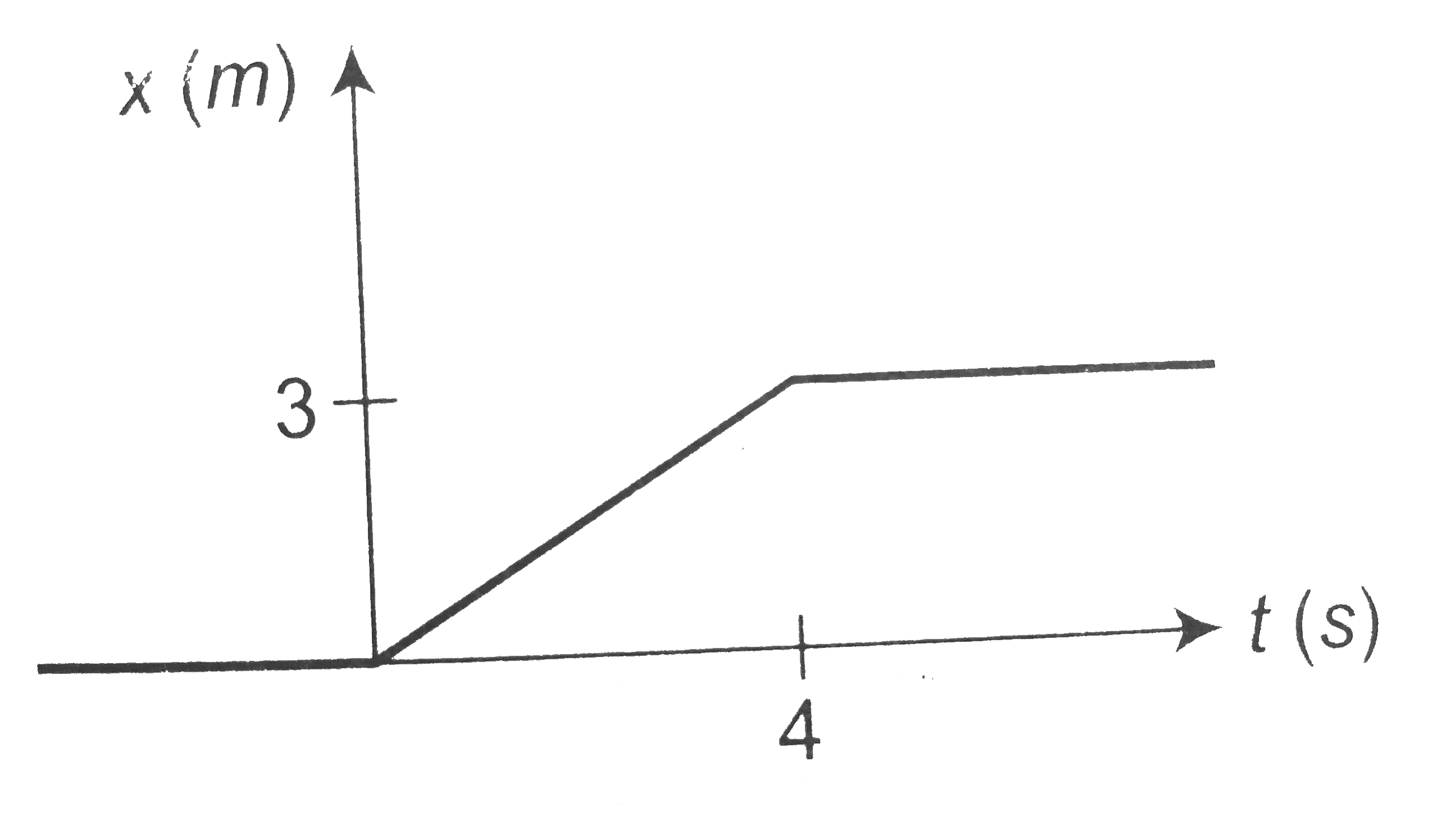
Figure shows the position-time graph of a particle of mass 4kg. Let the force on the particle for `tlt0` , `0ltt`lt,`4s` , `tgt4s` be `F_(1) , F_(2)` and `F_(3)` respectively. Then

A

`F_(1)=F_(2)=F_(3)=0`

B

`F_(1)gtF_(2)=F_(3)`

C

`F_(1)gtF_(2)gtF_(3)`

D

`F_(1)ltF_(2)ltF_(3)`

Text Solution

Verified by Experts

The correct Answer is:

A

For `t lt 0 and t ge 4s`, the position of the particle is not changing i.e. the particle is at rest. So no force is acting on the particle at these intevals. For `0 lt t lt 4s`. The position of the particle is continuously changing. As the position time graph is a straight line, the motion of the particle is uniform, so acceleration, a=0, Hence no force acts on the particle during the interval also.
Promotional Banner

Topper's Solved these Questions

  • LAWS OF MOTION

    NCERT FINGERTIPS ENGLISH|Exercise HOTS|8 Videos
  • LAWS OF MOTION

    NCERT FINGERTIPS ENGLISH|Exercise Exemplar Problems|9 Videos
  • KINETIC THEORY

    NCERT FINGERTIPS ENGLISH|Exercise Assertion And Reason|10 Videos
  • MECHANICAL PROPERTIES OF FLUIDS

    NCERT FINGERTIPS ENGLISH|Exercise NCERT Exemplar|5 Videos

Similar Questions

Explore conceptually related problems

The figure shows the position time graph of a particle of mass 40 kg. What is the force acting on the particle of 0lttlt4 s

Fig. shows the position-time graph of a particle of mass 4 kg. What is the (i) force acting on the particle for t lt 0, t lt 4 s, 0 lt t lt 4 s ? (ii) impulse at t = 0 and t = 4 s? Assume that the motion is one dimensional.

Position time graph of a particle of mass 2 kg is shown in figrure. Total work done on the particle from t=0 to t=4s is

In the figure, the position time graph of a particle of mass 0.1 kg is shown. The impulse at t=2 second is :

In the figure given below, the position-time graph of a particle of mass 0.1kg is shown. The impuslse at t=2 sec is

In the figure given below, the position time graph of a particle of mass 0.1kg is shown. The impulse at t=2 sec is

Figure shows the position-time graph of a particle moving on the X--axis. Which of these option correctly describes the particle 's motion?

Figure shows the speed versus time graph for a particle. Find the distance travelled by the particle during the time t=0 to t=3s.

Figure shows the position-time graph of a particle of mass 0.04kg . Suggest a suitable physical context for this motion. What is the time between two consecutive impulses received by the particle? What is the magnitude of each impulse?

Figure shows the position-time graph of a particle of mass 0.04kg . Suggest a suitable physical context for this motion. What is the time between two consecutive impulses received by the particle? What is the magnitude of each impluse?

NCERT FINGERTIPS ENGLISH-LAWS OF MOTION-Assertion And Reason
  1. Figure shows the position-time graph of a particle of mass 4kg. Let th...

    Text Solution

    |

  2. Assertion : An external force is required to keep a body in motion. ...

    Text Solution

    |

  3. Assertion: For applying the second law of motion, there is no conceptu...

    Text Solution

    |

  4. Assertion: If a body is momentarily at rest, it means that force or ac...

    Text Solution

    |

  5. Assertion: If external force on a body is zero, its acceleration is ze...

    Text Solution

    |

  6. Assertion: There is no apprecible change in the position of the body d...

    Text Solution

    |

  7. Assertion:On a merry-go-around, all parts of our body are subjected to...

    Text Solution

    |

  8. Assertion : The moment after a stone is released out of an accelerated...

    Text Solution

    |

  9. Assertion: Force on a body A by body B is equal and opposite to the fo...

    Text Solution

    |

  10. Assertion: There is no cause-effect relation between action and reacti...

    Text Solution

    |

  11. Assertion: The terms action and reaction in the third law of motion st...

    Text Solution

    |

  12. Assertion : The total momentum of an isolated system of particles is c...

    Text Solution

    |

  13. Assertion: Friction opposes relative motion and thereby dissipates pow...

    Text Solution

    |

  14. Assertion: On a rainy day, it is difficult to drive a car or bus at h...

    Text Solution

    |

  15. Assertion : Static friction is a self-adjusting force upto its limit m...

    Text Solution

    |

  16. Assertion: The familiar equation mg=R for a body on a table is true on...

    Text Solution

    |
