Home
Class 11
PHYSICS
Figure shows the position-time (x-t) gra...

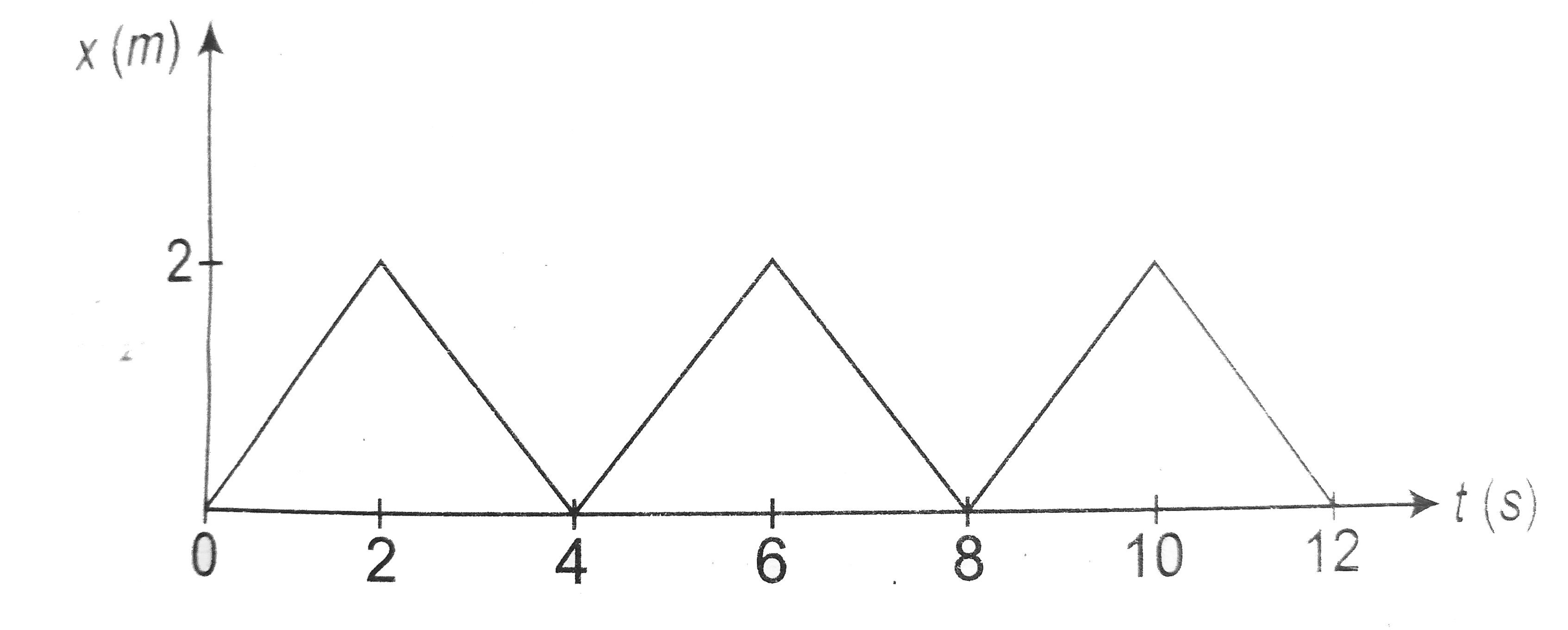
Figure shows the position-time (x-t) graph of one dimensional motion of a mass 500g. What is the time interval between two consecutive impulses received by the body?

A

2s

B

4s

C

6s

D

8s

Text Solution

Verified by Experts

The correct Answer is:

A

Figure shows that slope of x-t graph changes from positive to negative at t=2s, and it changes from negative to positive at t=4 and so on. Thus direction of velocity is reversed after every tow seconds. Hence, the body must be receing consecutinve impulses after every two seconds.
Promotional Banner

Topper's Solved these Questions

  • LAWS OF MOTION

    NCERT FINGERTIPS ENGLISH|Exercise HOTS|8 Videos
  • LAWS OF MOTION

    NCERT FINGERTIPS ENGLISH|Exercise Exemplar Problems|9 Videos
  • KINETIC THEORY

    NCERT FINGERTIPS ENGLISH|Exercise Assertion And Reason|10 Videos
  • MECHANICAL PROPERTIES OF FLUIDS

    NCERT FINGERTIPS ENGLISH|Exercise NCERT Exemplar|5 Videos

Similar Questions

Explore conceptually related problems

The figure shows the position - time (x - t) graph of one-dimensional motion of a body of mass 0.4 kg. The magnetic of each impulse is

The figure shows the position time graph of a particle of mass 40 kg. What is the force acting on the particle of 0lttlt4 s

Figure shows the position-time graph of a particle of mass 0.04kg . Suggest a suitable physical context for this motion. What is the time between two consecutive impulses received by the particle? What is the magnitude of each impulse?

Figure shows the position-time graph of a particle of mass 0.04kg . Suggest a suitable physical context for this motion. What is the time between two consecutive impulses received by the particle? What is the magnitude of each impluse?

Figure below shows the velocity-time graph of a one dimensional motion. Which of the following characteristic of the particle is represented by the shaded area?

The position - time (x-t) graph of an object in uniform motion is shown below, the velocity of object is

Figure shows the displacement-time graph of a particle moving on the X-axis

Figure shows the displacement time graph of a particle moving on the X-axis

Figure shows the position -time graph of an object in SHM. The correct equation representing this motion is

Figure given shows the distance - time graph of the motion of a car. It follows from the graph that the car is

NCERT FINGERTIPS ENGLISH-LAWS OF MOTION-Assertion And Reason
  1. Figure shows the position-time (x-t) graph of one dimensional motion o...

    Text Solution

    |

  2. Assertion : An external force is required to keep a body in motion. ...

    Text Solution

    |

  3. Assertion: For applying the second law of motion, there is no conceptu...

    Text Solution

    |

  4. Assertion: If a body is momentarily at rest, it means that force or ac...

    Text Solution

    |

  5. Assertion: If external force on a body is zero, its acceleration is ze...

    Text Solution

    |

  6. Assertion: There is no apprecible change in the position of the body d...

    Text Solution

    |

  7. Assertion:On a merry-go-around, all parts of our body are subjected to...

    Text Solution

    |

  8. Assertion : The moment after a stone is released out of an accelerated...

    Text Solution

    |

  9. Assertion: Force on a body A by body B is equal and opposite to the fo...

    Text Solution

    |

  10. Assertion: There is no cause-effect relation between action and reacti...

    Text Solution

    |

  11. Assertion: The terms action and reaction in the third law of motion st...

    Text Solution

    |

  12. Assertion : The total momentum of an isolated system of particles is c...

    Text Solution

    |

  13. Assertion: Friction opposes relative motion and thereby dissipates pow...

    Text Solution

    |

  14. Assertion: On a rainy day, it is difficult to drive a car or bus at h...

    Text Solution

    |

  15. Assertion : Static friction is a self-adjusting force upto its limit m...

    Text Solution

    |

  16. Assertion: The familiar equation mg=R for a body on a table is true on...

    Text Solution

    |
