Home
Class 11
PHYSICS
Block A of weight 100N rests on a fricti...

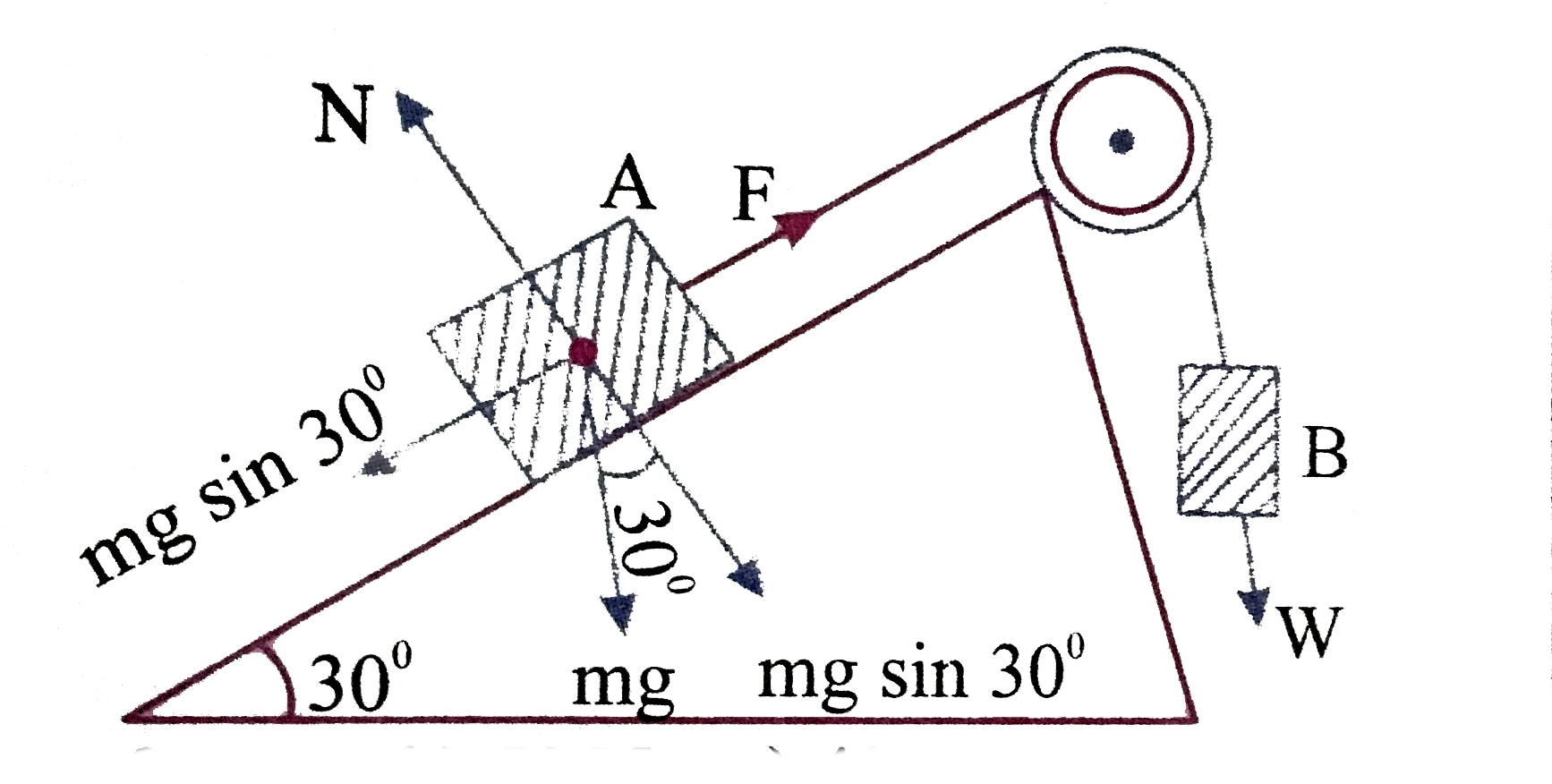
Block `A` of weight `100N` rests on a frictionless inclined plane of slope angle `30^(@)`(Fig. 5.7). `A` flexible cord attached to `A` passes over a frictonless pulled and is connected to block `B` of weight `W`. Find the weight `W` for which the system in equilibrium.

A

25N

B

50N

C

75N

D

100N

Text Solution

Verified by Experts

The correct Answer is:
B

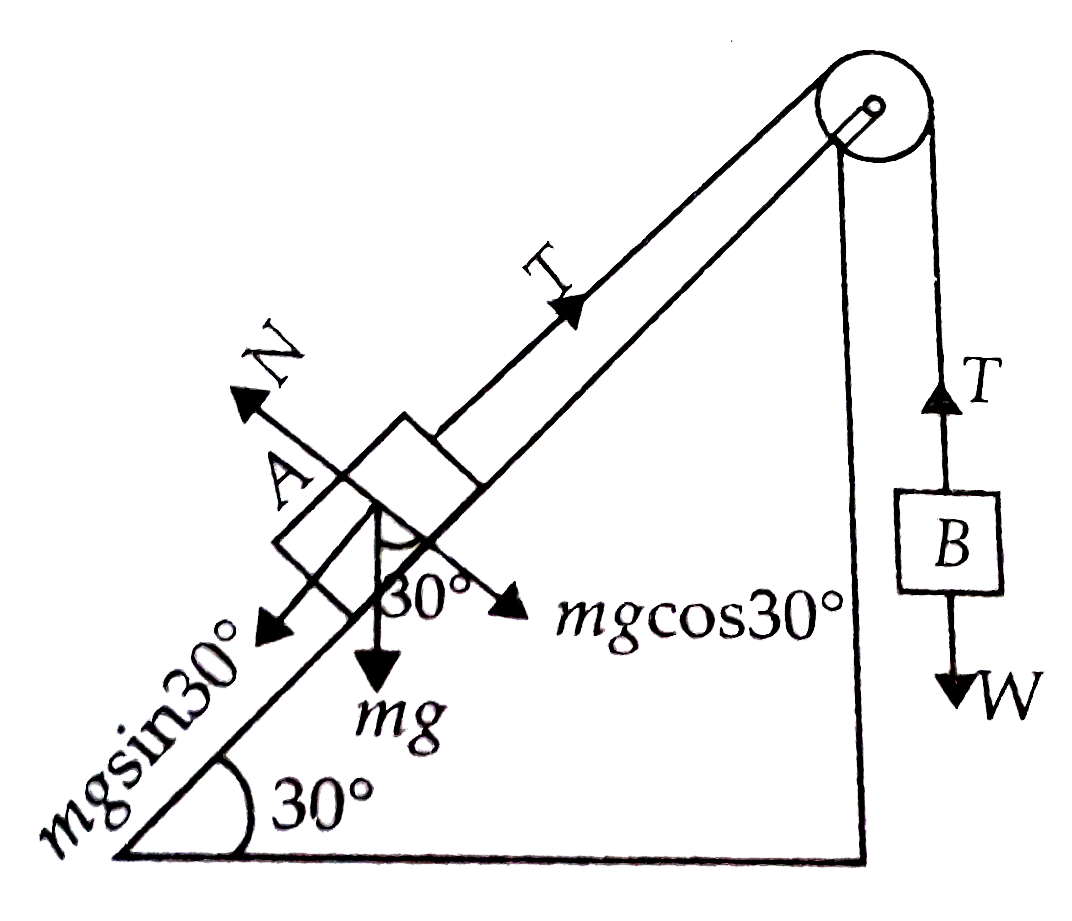
As the system is in equilibrium
`therefore T=W….(i)`
and `T=mg sin 30^(@) …(ii)`
From (i) and (ii), we get
`W=mg sin 30^(@)=(100N)xx(1)/(2)=50N`
Promotional Banner

Topper's Solved these Questions

  • LAWS OF MOTION

    NCERT FINGERTIPS ENGLISH|Exercise HOTS|8 Videos
  • LAWS OF MOTION

    NCERT FINGERTIPS ENGLISH|Exercise Exemplar Problems|9 Videos
  • KINETIC THEORY

    NCERT FINGERTIPS ENGLISH|Exercise Assertion And Reason|10 Videos
  • MECHANICAL PROPERTIES OF FLUIDS

    NCERT FINGERTIPS ENGLISH|Exercise NCERT Exemplar|5 Videos

Similar Questions

Explore conceptually related problems

A mass m_(1) lies on fixed, smooth cylinder . An ideal cord attached to m_(1) passes over the cylinder and is connected to mass m_(2) as shown in the figure. (a) Find the value of theta ( shown in diagram ) for which the system is in equilibrium. (b) Given m_(1)=5 kg, m_(2)=4kg . The system is released from rest when theta =30^(@) . Find the magnitude of acceleration of mass m_(1) just after the system is released.

A block A of mass 5 sqrt( 3) m rests on a rough horizontal plane relative to which its coefficient of friction is mu A light string attached to this block passes over a light frictionless pulley and another block B of mass m hangs from it. It is observed that the block A just slips when the string makes an angle of 60^(@) with the horizontal . Find the coefficient of static friction between the block A and the plane. If the same force acting through the sting is applied to the block A in the horizontal direction, find the acceleration of the block A.

a. Block A , as shown in figure weight 60.0 N The coefficient of static friction between the block and the surface on which it rest is 0.25 .The waight w is 12N The system is in equlibrium .Find the friction for excerted on block A b. Find the maximum weight w for which the system will remain in equlibrium

A weight W is tied to two strings passing over tha frictionless pulleys A and B as shown in the figure. If weights P and Q move downwards with speed v, the weight W at any instant rises with the speed :

Two identical blocks A and B each of weight 20N are placed on a frictionless horizontal plane. The portion of the string connected to B is vertical and that connected to A makes an angle of 53^(@) with the plane . The minimum horizontal force F required to lift the blocks B is

A block A of weight W slide down an inclined plane S of slope 37^(@) at a contact velocity,while the plane B also of weight W rests on top of A The plank B is atteched by a cord to the top of plane .The coefficient of kinetic friction mu is the same between the surface A and B and between S and A Determine the value of 1//mu

Two blocks are connected by a cord passing over a small frictionless pulley and resting on frictionless planes as shown in the figure. The acceleration of the blocks is :

The blocks are on frictionless inclined ramp and connected by a massless cord. The cord passes over an ideal pully. [g=10m//s^(2)] What value of M would keep the system rest.

A block of mass M_(1)=3kg on a smooth fixed inclined plane of angle 30^(@) is connected by a cord over a small frictionless pulley to a second block mass 2kg hanging vertically. The tension in the cord and the acceleration of each block are ………............. and ...................... respectively.

Block B of mass m_(B) = 0.5 kg rests on block A, with mass m_(A) = 1.5kg which in turn is on a horizontal tabletop (as shown in figure) .The coefficient of kinetic friction between block A and the tabletop is mu_(k) = 0.4 and the coefficient of static friction between block A and blockB is mu_(s) = 0.6 A light string attached block A passes over a frictionless, massless pulley and block C is suspeneded from the other end of the string. What is the largest mass m_(c) (in kg) that block C can have so that block A and B still slide together when the system is relaced from rest?

NCERT FINGERTIPS ENGLISH-LAWS OF MOTION-Assertion And Reason
  1. Block A of weight 100N rests on a frictionless inclined plane of slope...

    Text Solution

    |

  2. Assertion : An external force is required to keep a body in motion. ...

    Text Solution

    |

  3. Assertion: For applying the second law of motion, there is no conceptu...

    Text Solution

    |

  4. Assertion: If a body is momentarily at rest, it means that force or ac...

    Text Solution

    |

  5. Assertion: If external force on a body is zero, its acceleration is ze...

    Text Solution

    |

  6. Assertion: There is no apprecible change in the position of the body d...

    Text Solution

    |

  7. Assertion:On a merry-go-around, all parts of our body are subjected to...

    Text Solution

    |

  8. Assertion : The moment after a stone is released out of an accelerated...

    Text Solution

    |

  9. Assertion: Force on a body A by body B is equal and opposite to the fo...

    Text Solution

    |

  10. Assertion: There is no cause-effect relation between action and reacti...

    Text Solution

    |

  11. Assertion: The terms action and reaction in the third law of motion st...

    Text Solution

    |

  12. Assertion : The total momentum of an isolated system of particles is c...

    Text Solution

    |

  13. Assertion: Friction opposes relative motion and thereby dissipates pow...

    Text Solution

    |

  14. Assertion: On a rainy day, it is difficult to drive a car or bus at h...

    Text Solution

    |

  15. Assertion : Static friction is a self-adjusting force upto its limit m...

    Text Solution

    |

  16. Assertion: The familiar equation mg=R for a body on a table is true on...

    Text Solution

    |

