Home
Class 11
PHYSICS
In the system shown in the figure, the a...

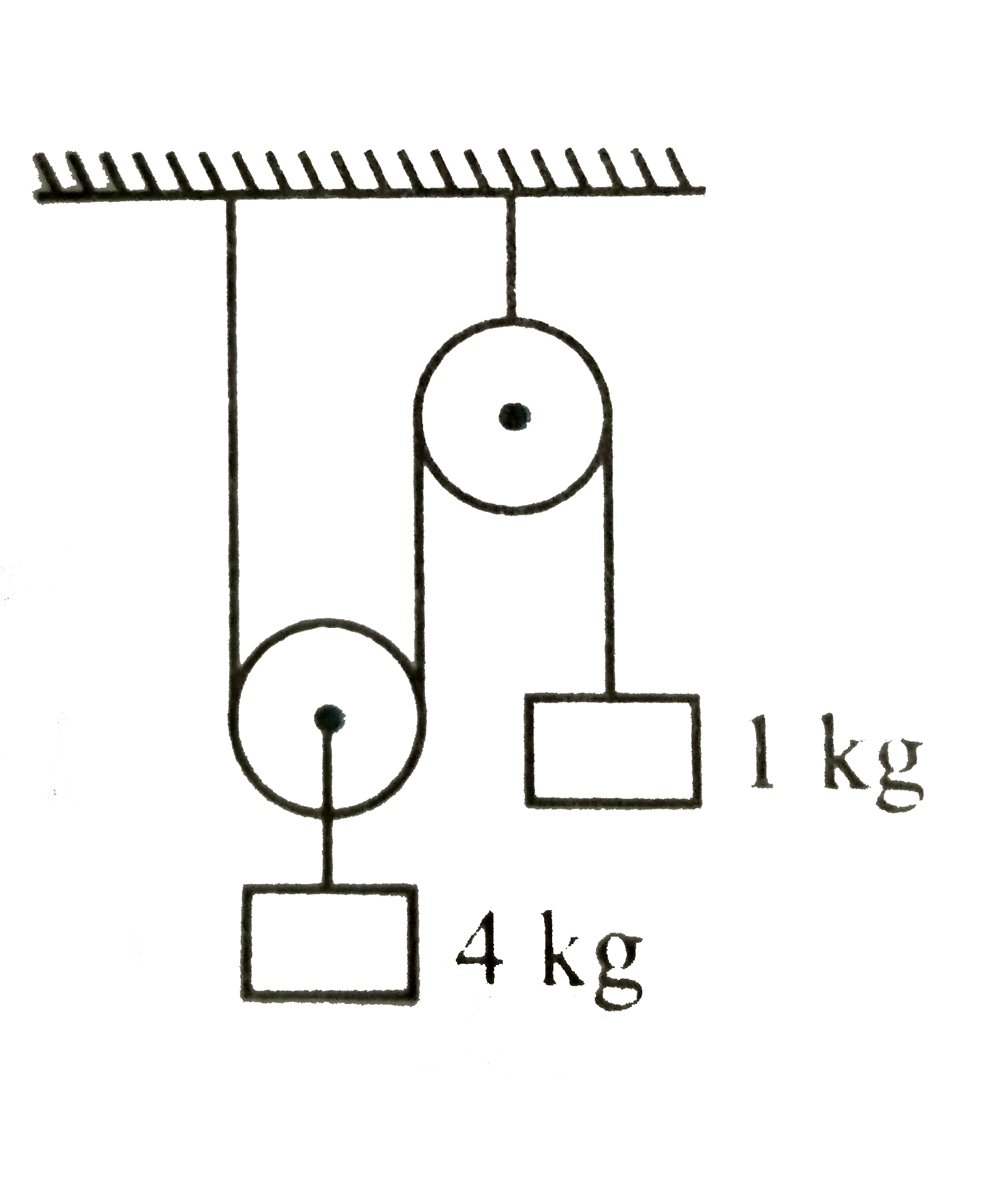
In the system shown in the figure, the acceleration of 1 kg mass is

A

`(g)/(4)"downwards"`

B

`(g)/(2)"downwards"`

C

`(g)/(2)"upwards"`

D

`(g)/(4)"upwards`

Text Solution

Verified by Experts

The correct Answer is:
C

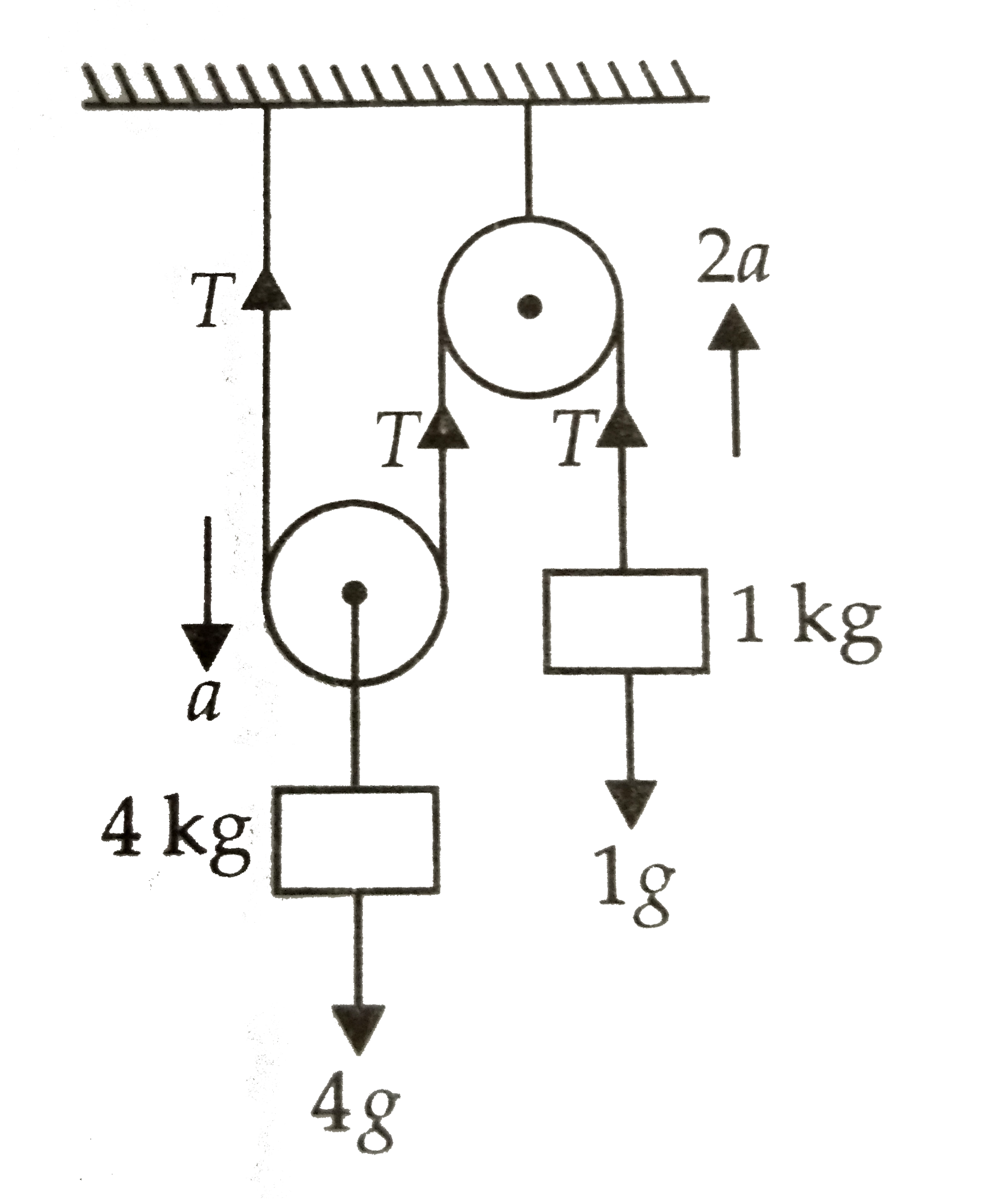
If a downward acceleration of 4 kg block, the upward acceleration of 1 kg block must be 2a. Let T be tension in each part of string. The equation of motion on 4 kg block is 4g-2T=4a
The equation of motion on 1 kg block is
`T-1g=1xx2a`
or `2T-2g=4a...(ii)`
or 2T-2g=4a...(iii)
Adding (i) and (iii), we get
`therefore "Acceleration of 1 kg block"=2a=(g)/(2)"upwards"`
Promotional Banner

Topper's Solved these Questions

  • LAWS OF MOTION

    NCERT FINGERTIPS ENGLISH|Exercise HOTS|8 Videos
  • LAWS OF MOTION

    NCERT FINGERTIPS ENGLISH|Exercise Exemplar Problems|9 Videos
  • KINETIC THEORY

    NCERT FINGERTIPS ENGLISH|Exercise Assertion And Reason|10 Videos
  • MECHANICAL PROPERTIES OF FLUIDS

    NCERT FINGERTIPS ENGLISH|Exercise NCERT Exemplar|5 Videos

Similar Questions

Explore conceptually related problems

Two masses of 10 kg and 20 kg are connected with an inextensible string passing over two smooth pulleys as shown in the figure. The acceleration of 20 kg mass will be :

Two blocks of masses m_1 and m_2 are connected as shown in the figure. The acceleration of the block m_2 is :

Two block of masses m_(1) and m_(2) are connected as shown in the figure. The acceleration of the block m_(2) is:

In the system shown, the initial acceleration of the wedge of mass 5M is (there is no friction anywhere)

All the surfaces are smooth as shown in figure. The acceleration of mass m relative to wedge is :

From the fixed pulley, masses 2 kg, 1 kg and 3 kg are suspended as shown is figure. Find the extension in the spring when acceleration of 3 kg and 1 kg is same if spring constant of the spring k = 100 N/m. (Take g = 10 ms^(-2) )

A body of mass 2.5 kg is subjected to the forces shown in figure. Find the acceleration of the centre of maas.

A block of mass m=5kg is placed on the wedge of mass M=32kg as shown in the figure. Find the acceleration of wedge with respect to ground. (Neglect any type of friction. Spring and pulley are ideal)

In the system shown in the figure, which the following is correct? (Pulleys and strings are of negligible mass)

A block of mass 20 kg is set into motion on a frictionless horizontal surface with the help of massless smooth pulley and rope as shown in the figure. Find the acceleration of the pulley

NCERT FINGERTIPS ENGLISH-LAWS OF MOTION-Assertion And Reason
  1. In the system shown in the figure, the acceleration of 1 kg mass is

    Text Solution

    |

  2. Assertion : An external force is required to keep a body in motion. ...

    Text Solution

    |

  3. Assertion: For applying the second law of motion, there is no conceptu...

    Text Solution

    |

  4. Assertion: If a body is momentarily at rest, it means that force or ac...

    Text Solution

    |

  5. Assertion: If external force on a body is zero, its acceleration is ze...

    Text Solution

    |

  6. Assertion: There is no apprecible change in the position of the body d...

    Text Solution

    |

  7. Assertion:On a merry-go-around, all parts of our body are subjected to...

    Text Solution

    |

  8. Assertion : The moment after a stone is released out of an accelerated...

    Text Solution

    |

  9. Assertion: Force on a body A by body B is equal and opposite to the fo...

    Text Solution

    |

  10. Assertion: There is no cause-effect relation between action and reacti...

    Text Solution

    |

  11. Assertion: The terms action and reaction in the third law of motion st...

    Text Solution

    |

  12. Assertion : The total momentum of an isolated system of particles is c...

    Text Solution

    |

  13. Assertion: Friction opposes relative motion and thereby dissipates pow...

    Text Solution

    |

  14. Assertion: On a rainy day, it is difficult to drive a car or bus at h...

    Text Solution

    |

  15. Assertion : Static friction is a self-adjusting force upto its limit m...

    Text Solution

    |

  16. Assertion: The familiar equation mg=R for a body on a table is true on...

    Text Solution

    |

