Home
Class 12
PHYSICS
Which arrangement of 3Omega resistors wi...

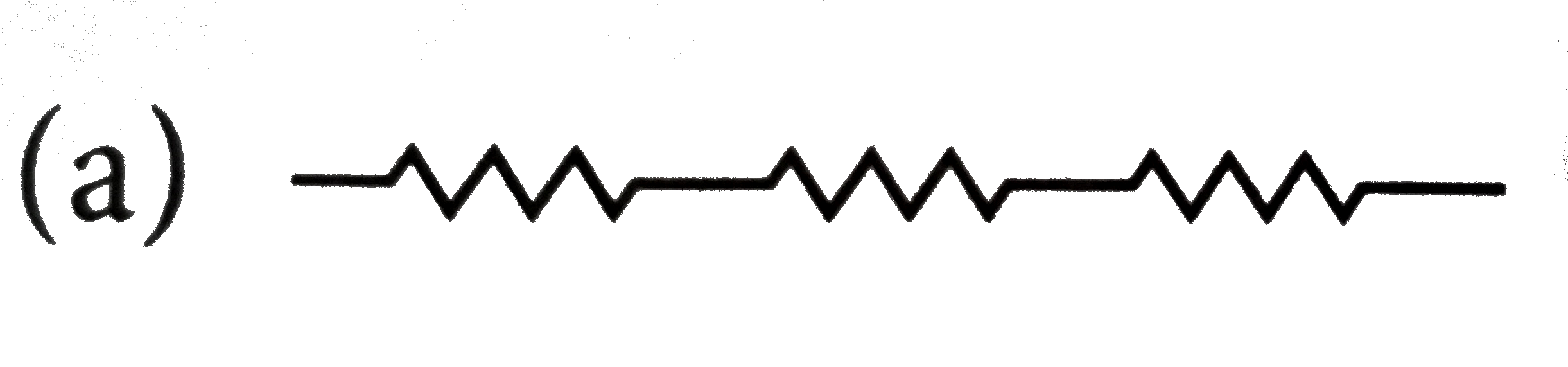
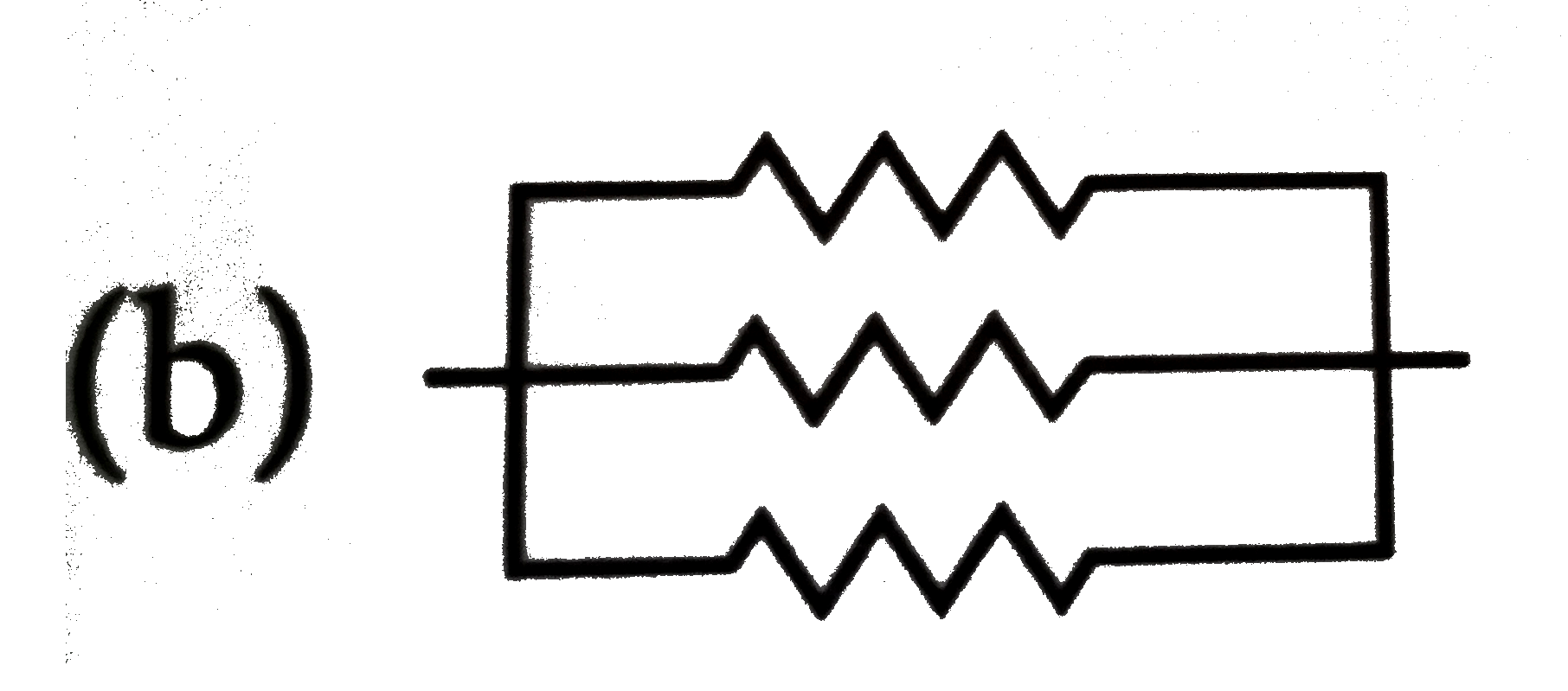
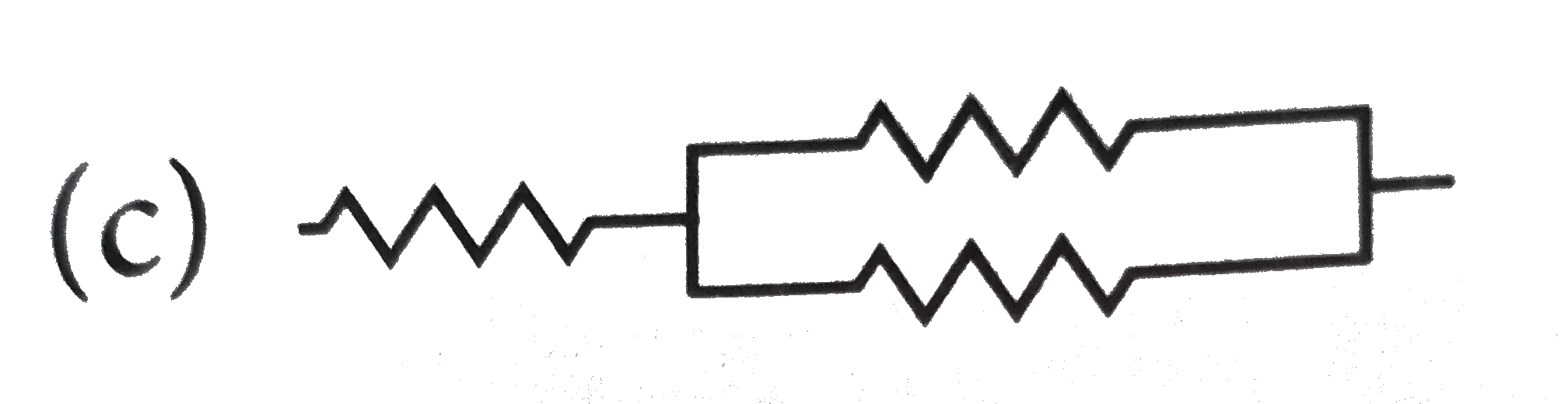
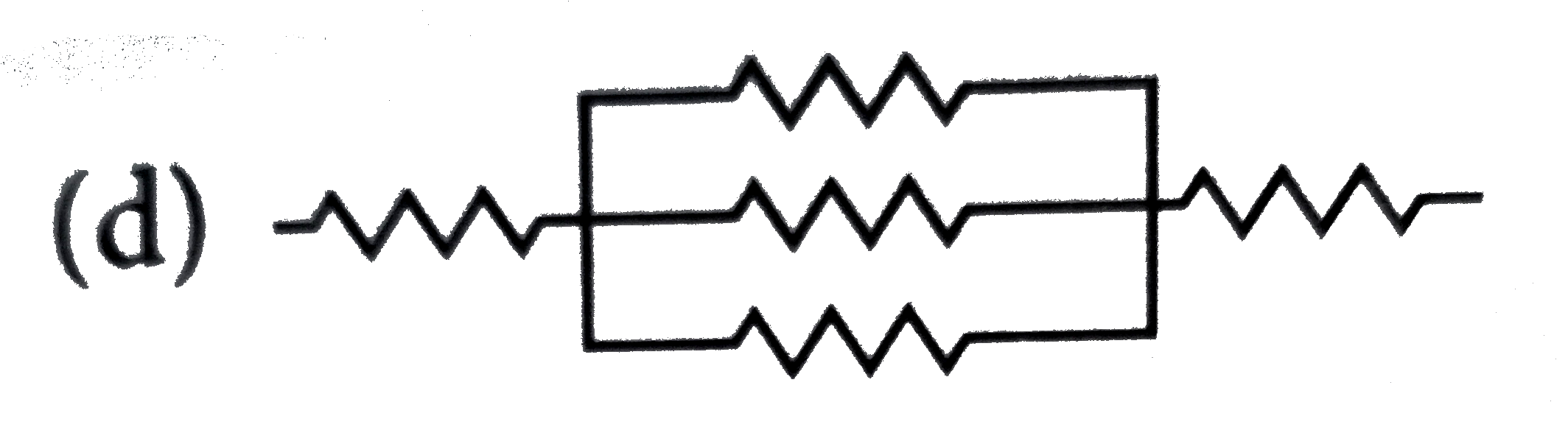
Which arrangement of `3Omega` resistors will give a total resistance of `7Omega`?

A

B

C

D

Text Solution

AI Generated Solution

The correct Answer is:

To find the arrangement of three 3-ohm resistors that results in a total resistance of 7 ohms, we can analyze the different configurations of resistors: series and parallel. ### Step-by-Step Solution: 1. **Series Connection**: - When resistors are connected in series, the total resistance (R_s) is the sum of the individual resistances. - For three 3-ohm resistors in series: \[ R_s = R_1 + R_2 + R_3 = 3\, \Omega + 3\, \Omega + 3\, \Omega = 9\, \Omega \] - This configuration gives us 9 ohms, which is not the required 7 ohms. **Hint**: Remember that in a series connection, the total resistance is simply the sum of all resistances. 2. **Parallel Connection**: - When resistors are connected in parallel, the total resistance (R_p) can be calculated using the formula: \[ \frac{1}{R_p} = \frac{1}{R_1} + \frac{1}{R_2} + \frac{1}{R_3} \] - For three 3-ohm resistors in parallel: \[ \frac{1}{R_p} = \frac{1}{3} + \frac{1}{3} + \frac{1}{3} = 1 \implies R_p = 1\, \Omega \] - This configuration gives us 1 ohm, which is also not the required 7 ohms. **Hint**: In a parallel connection, the total resistance is less than the smallest individual resistance. 3. **Combination of Series and Parallel**: - Now, let's consider a combination where one resistor is in series with two resistors in parallel. - Let’s take one 3-ohm resistor in series with two 3-ohm resistors connected in parallel. - First, calculate the equivalent resistance of the two parallel resistors: \[ \frac{1}{R_{parallel}} = \frac{1}{3} + \frac{1}{3} = \frac{2}{3} \implies R_{parallel} = \frac{3}{2} = 1.5\, \Omega \] - Now, add this result to the resistance of the series resistor: \[ R_{total} = R_{series} + R_{parallel} = 3\, \Omega + 1.5\, \Omega = 4.5\, \Omega \] - This configuration gives us 4.5 ohms, which is still not 7 ohms. **Hint**: When combining resistors, carefully calculate the equivalent resistance for both series and parallel arrangements. 4. **Final Configuration**: - Now, let’s try connecting one 3-ohm resistor in series with a parallel combination of three 3-ohm resistors. - First, calculate the total resistance of the three resistors in parallel: \[ \frac{1}{R_{parallel}} = \frac{1}{3} + \frac{1}{3} + \frac{1}{3} = 1 \implies R_{parallel} = 1\, \Omega \] - Now, add this to the resistance of the series resistor: \[ R_{total} = R_{series} + R_{parallel} = 3\, \Omega + 1\, \Omega = 4\, \Omega \] - This configuration gives us 4 ohms, which is still not 7 ohms. 5. **Correct Configuration**: - The correct arrangement is one resistor in series with a parallel combination of two resistors. - One 3-ohm resistor is in series with the equivalent resistance of two 3-ohm resistors in parallel: \[ R_{parallel} = 1.5\, \Omega \quad \text{(from previous calculation)} \] - Now, add the series resistor: \[ R_{total} = 3\, \Omega + 1.5\, \Omega = 4.5\, \Omega \] - This configuration gives us 4.5 ohms, which is still not 7 ohms. 6. **Final Check**: - The correct arrangement is to have one 3-ohm resistor in series with the parallel combination of the other two 3-ohm resistors: \[ R_{total} = 3\, \Omega + 1\, \Omega = 4\, \Omega \] - This configuration gives us 4 ohms, which is still not 7 ohms. After checking all configurations, the only way to achieve a total resistance of 7 ohms is to have one 3-ohm resistor in series with the equivalent resistance of three 3-ohm resistors connected in parallel. ### Conclusion: The correct arrangement of three 3-ohm resistors to achieve a total resistance of 7 ohms is to connect one 3-ohm resistor in series with the parallel combination of the other two 3-ohm resistors. **Final Answer**: The correct option is D.

To find the arrangement of three 3-ohm resistors that results in a total resistance of 7 ohms, we can analyze the different configurations of resistors: series and parallel. ### Step-by-Step Solution: 1. **Series Connection**: - When resistors are connected in series, the total resistance (R_s) is the sum of the individual resistances. - For three 3-ohm resistors in series: \[ ...
Promotional Banner

Topper's Solved these Questions

  • CURRENT ELECTRICITY

    NCERT FINGERTIPS ENGLISH|Exercise CELLS, EMF, INTERNAL RESISTANCE|6 Videos
  • CURRENT ELECTRICITY

    NCERT FINGERTIPS ENGLISH|Exercise KIRCHOFF S LAW|14 Videos
  • CURRENT ELECTRICITY

    NCERT FINGERTIPS ENGLISH|Exercise ELECTRICAL ENERGY, POWER|8 Videos
  • COMMUNITCATION SYSTEMS

    NCERT FINGERTIPS ENGLISH|Exercise Assertion And Reason|30 Videos
  • DUAL NATURE OF RADIATION AND MATTER

    NCERT FINGERTIPS ENGLISH|Exercise Assertion And Reason|15 Videos

Similar Questions

Explore conceptually related problems

In which of the follwing arrangements of resistors does the meter M , which has a resistance of 2 Omega , give the largest reading when the same potential difference is appliced between points P and Q ?

How can three resistors of resistances 2 Omega,3 Omega , and 6 Omega be connected to give a total resistance of (a) 4 Omega (b) 1 Omega ?

The current in a circuit containing a battery connected to 2Omega resistance is 0.9A. When a resistance of 7Omega is connected to the same battery, the current observed in the circuit is 0.3A. Then the internal resistance of the battery.

The network shown in figure is an arrangement of nine identical resistors. The resistance of the network between points A and B is 1.5 Omega . The resistance r is

A circuit consists of a resistor of 1 ohm in series with a parallel arrangement of resistors of 6 ohm and 3 ohm. Calculate the total resistance of the circuit. Draw a diagram of the arrangment.

Three resistors each of 2 Omega are connected together so that their total resistance is 3 Omega . Draw a diagram to show this arrangement and check it by calculation.

A 5Omega resistor is connected in series with a parallel combination of n resistors of 6Omega each. The equivalent resistance is 7Omega . Find n

Find the current in each resistor of the circuit shown in fig a. Current thorugh resistance of 6 Omega is ……….. b. Current thorugh resistance of 3 Omega is ……….. c. Current thorugh resistance of 2 Omega is ……….. d. Current thorugh resistance of 5 Omega is ………..

You have three resistors of values 2Omega,3Omegaand5Omega . How will you join them so that the total resistance is more than 7Omega ? Draw a diagram for the arrangement.

You have three resistors of values 2Omega,3Omegaand5Omega . How will you join them so that the total resistance is more than 7Omega ? Calculate the equivalent resistance.

NCERT FINGERTIPS ENGLISH-CURRENT ELECTRICITY-COMBINED OF RESISTORS;
  1. Combine three resistors 5Omega, 4.5Omega and 3Omega is such a way that...

    Text Solution

    |

  2. The total resistance in the parallel combination of three resistances ...

    Text Solution

    |

  3. Equivalent resistance (in ohm) of the given network is

    Text Solution

    |

  4. Which arrangement of 3Omega resistors will give a total resistance of ...

    Text Solution

    |

  5. The equivalent resistance of series combination of four equal resistor...

    Text Solution

    |

  6. Five equal resistances of 10Omega are connected between A and B as sho...

    Text Solution

    |

  7. The correct combination of three resistances 1Omega, 2Omega and 3Omega...

    Text Solution

    |

  8. Equivalent resistance of the given network between points A and B is

    Text Solution

    |

  9. n resistors each of resistance R first combine to give maximum effecti...

    Text Solution

    |

  10. The equivalent resistance between A and B for . the circuit shown in t...

    Text Solution

    |

  11. A copper cylindrical tube has inner radius a and outer radius b. The r...

    Text Solution

    |

  12. A wire of resistance 12 Omega m^(-1) is bent to from a complete circle...

    Text Solution

    |

  13. A and B are two points on a uniform ring of resistance 15Omega. The lt...

    Text Solution

    |

  14. Two metal wires of identical dimesnios are connected in series. If sig...

    Text Solution

    |

  15. Three resistors 2Omega, 4Omega and 5Omega are combined in parallel. Th...

    Text Solution

    |

  16. Three resistors of resistances 3Omega, 4Omega and 5Omega are combined ...

    Text Solution

    |

  17. The reading of ammeter shown in figure is

    Text Solution

    |

  18. Three resistances 2Omega, 4Omega, 5Omega are combined in series and th...

    Text Solution

    |

  19. In the shown in the given figure, the resistances R(1) and R(2) are re...

    Text Solution

    |

  20. An infinite ladder network is constructed with 1Omega and 2Omega resis...

    Text Solution

    |
