Home
Class 11
PHYSICS
A uniform square plate S (side c) and a ...

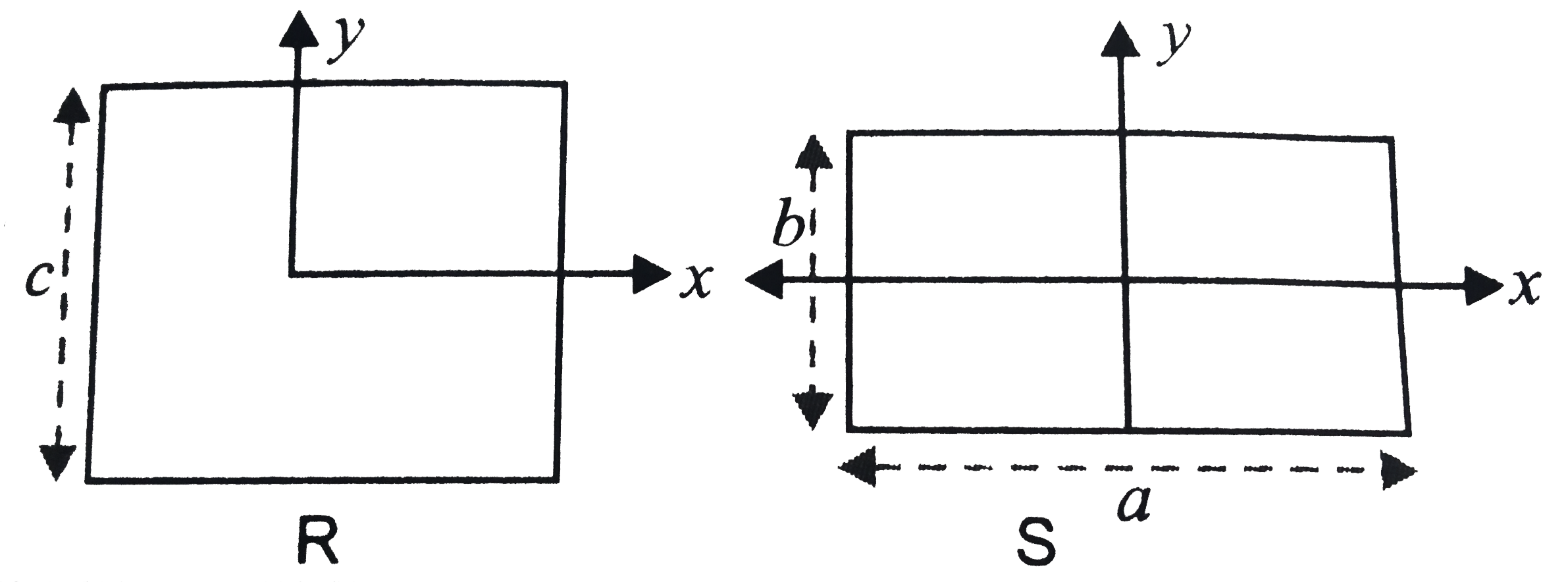
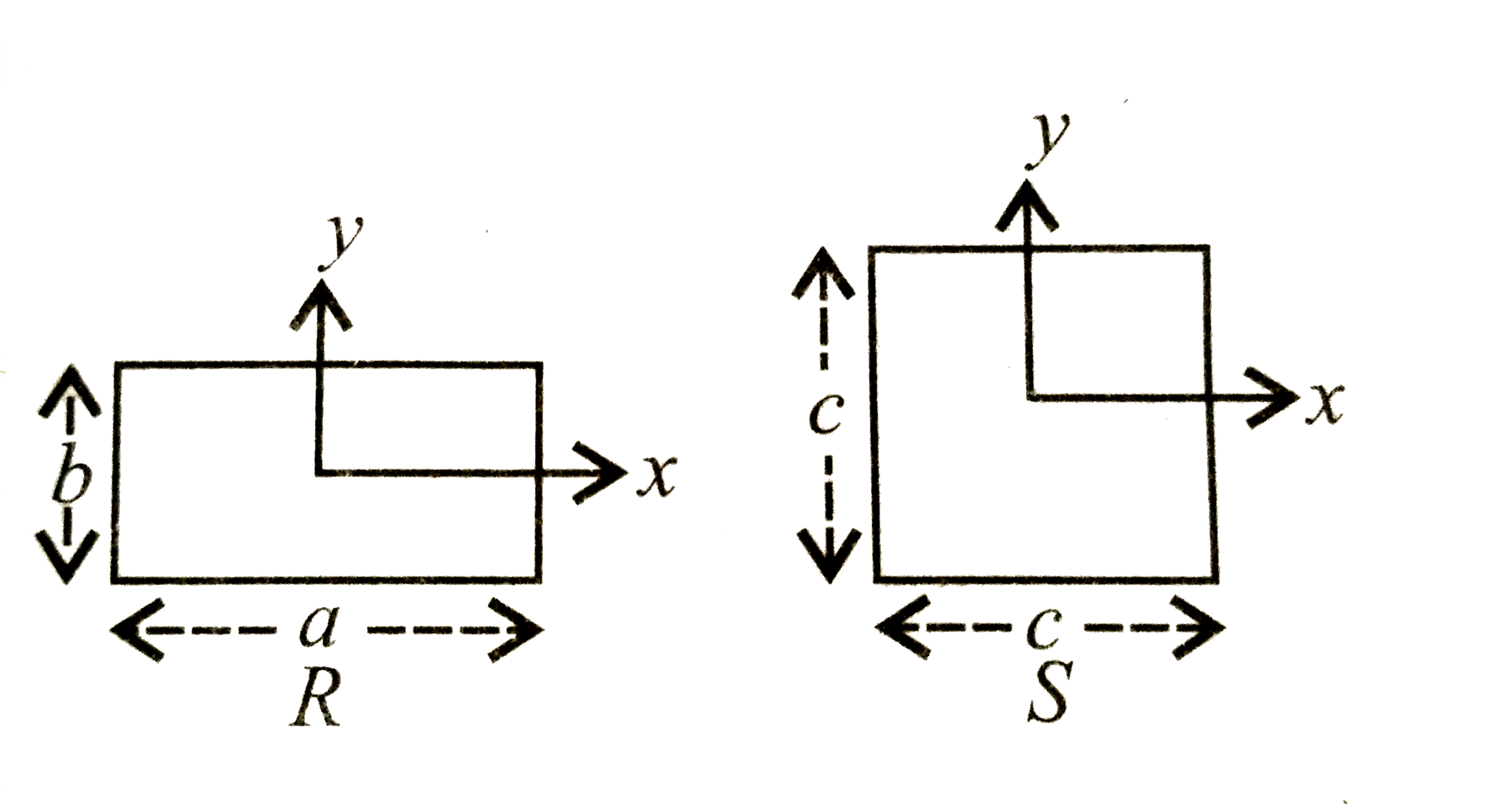
A uniform square plate `S (side c)` and a unifrom rectangular plate `R(side b,a)` have identical areas and mass [Fig.]
Show that
(i) `I_(xR)//I_(xS) lt 1`, (ii) `I_(yR)//I_(yS) gt 1`, (iii) `I_(zR)//I_(zS) gt 1`.

A

(i) only

B

(ii) only

C

Both (i) and (ii)

D

Neither (i) nor (ii)

Text Solution

Verified by Experts

The correct Answer is:
c

As, areaof rectangular plate R= Area of square plate S
`therefore a xx b =c^(2)`
i) `(I_(x)R)/(I_(x)S)=b^(2)/c^(2)=b/a`
As `b lt a therefore (I_(x)R)/(I_(x)S) lt 1`
ii) `(I_(y)R)/(I_(y)S) = a^(2)/c^(2)=a/b`
As `a gt b therefore (I_(y)R)/(I_(y)S) gt 1`
Promotional Banner

Topper's Solved these Questions

  • SYSTEM OF PARTICLES AND ROTATIONAL MOTIONS

    NCERT FINGERTIPS ENGLISH|Exercise KENEMATICS OF ROTATIONAL MOTION ABOUT A FIXED AXIS|3 Videos
  • SYSTEM OF PARTICLES AND ROTATIONAL MOTIONS

    NCERT FINGERTIPS ENGLISH|Exercise DYNAMICS OF ROTATIONAL MOTION ABOUT A FIXED AXIS|10 Videos
  • SYSTEM OF PARTICLES AND ROTATIONAL MOTIONS

    NCERT FINGERTIPS ENGLISH|Exercise MOMENT OF INERTIA|7 Videos
  • PRACTICE PAPERS

    NCERT FINGERTIPS ENGLISH|Exercise All Questions|150 Videos
  • THERMAL PROPERTIES OF MATTER

    NCERT FINGERTIPS ENGLISH|Exercise Assertion And Reason|10 Videos

Similar Questions

Explore conceptually related problems

In Fig., write another name for: (i) /_1 (ii) /_2 (iii) /_3

The argument of (1+i)/(1-i) is (i) 0 (ii) -(pi)/(2) (iii) (pi)/(2) (iv) pi

Let I_(1) and I_(2) be the moment of inertia of a uniform square plate about axes shown in the figure. Then the ratio I_(1):I_(2) is

Two loops P and Q are made from a uniform wire. The radii of P and Q are R_(1) and R_(2) , respectively, and their moments of inertia about their axis of rotation are I_(1) and I_(2) , respectively. If (I_(1))/(I_(2))=4 , then (R_(2))/(R_(1)) is

Find the modulus and argument of the complex numbers : (i) (1+i)/(1-i) (ii) 1/(1+i)

The perimeter of a square is 28 cm. Find its: (i) one side (ii) area (iii) diagonal

In Fig. 9.17, PQRS and ABRS are parallelograms and X is any point on side BR. Show that (i) a r(P Q R S) = a r(A B R S) (ii) a r(A XS)\ =1/2 ar(P Q R S)

Find the values of the following : (i) i^(73) (ii) i^(-6) (iii) (1)/(i)

Consider two uniform discs of the same thickness and different radii R_(1)=R and R_(2)=alphaR made of the same material. If the ratio of their moments of inertia I_(1) and I_(2) , respectively, about their axes is I_(1):I_(2)=1:16 then the value of alpha is :

In quadrilateral ABCD, AB is the shortest side and DC is the longest side. Prove that : (i) angleB gt angleD (ii) angleA gt angleC

