Home
Class 12
PHYSICS
The above is a plot of binding energy pe...

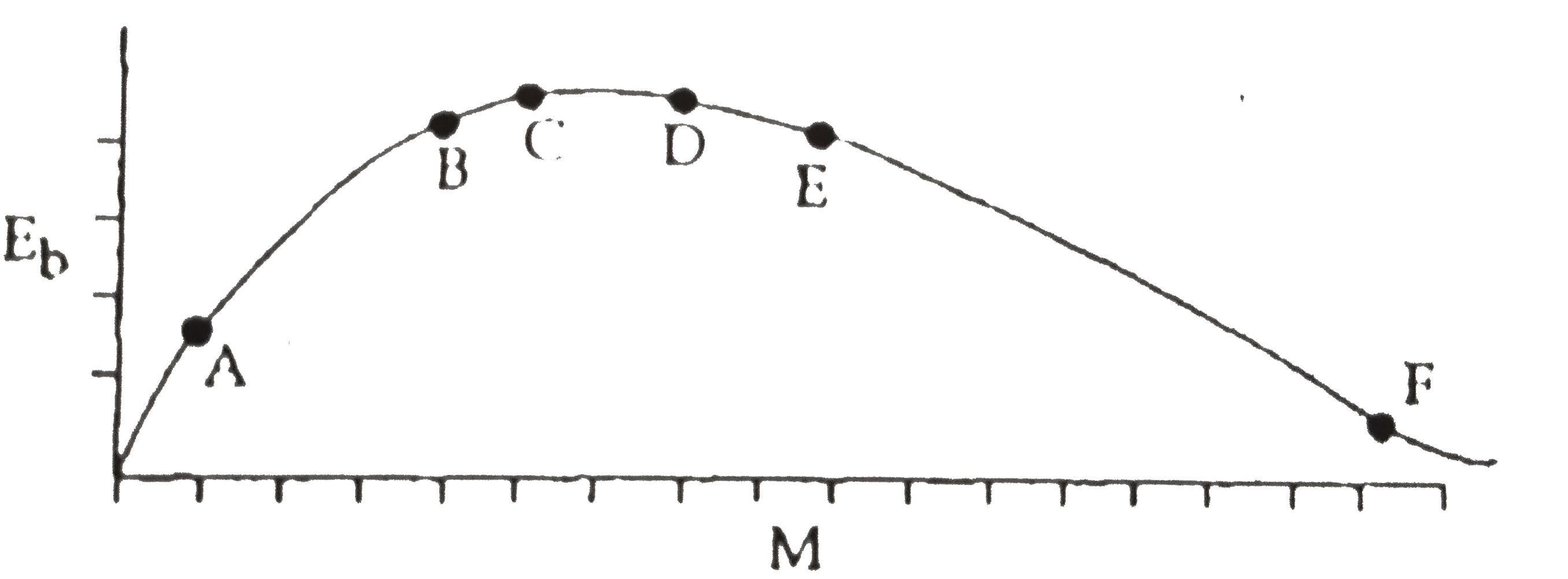
The above is a plot of binding energy per nucleon `E_(b)`, against the nuclear mass M, A, B, C, D, E, F correspond to different nuclei. Consider four reactions
(i) `A + B rarr C + epsi` (ii) `C rarr A + B +epsi`
(iii) `D + E rarr F + epsi` and (iv) `F rarr D + E + epsi`
where `epsi` is the energy released ? In which reactions is `epsi` positive ?

A

(i) and (iii)

B

(ii) and (iv)

C

(ii)and (iii)

D

(i) and (iv)

Text Solution

Verified by Experts

The correct Answer is:

d

Energy `(epsilon)` is released when lighter nuclei fuse to form a heavier nucleus , such as in (i) `A+B to C + epsilon`
Again, energy is released when a heavy nucleus splits into lighter nuclei , such as in (iv) `F to D + E + epsilon`.
Promotional Banner

Topper's Solved these Questions

  • NUCLEI

    NCERT FINGERTIPS ENGLISH|Exercise NCERT Exemplar|7 Videos
  • NUCLEI

    NCERT FINGERTIPS ENGLISH|Exercise Assertion And Reason|15 Videos
  • NUCLEI

    NCERT FINGERTIPS ENGLISH|Exercise Nuclear Energy|10 Videos
  • MOVING CHARGES AND MAGNETISM

    NCERT FINGERTIPS ENGLISH|Exercise Assertion And Reason|15 Videos
  • PRACTICE PAPPER

    NCERT FINGERTIPS ENGLISH|Exercise Practice Paper 3|50 Videos

Similar Questions

Explore conceptually related problems

The above is a plate of binding energy per nucleon E_(0) against the nuclear mass M, A, B,C,D,E,F correspond to different nuclei Consider four reactions:

The alongside is a plot of binding energy per nucleon E_(b) ,against the nuclear mass M,A,B,C,D,E,F correspond to different nuclei. Consider four reactions. (i) A + B to C + epsilon (ii) C to A + B + epsilon (iii) D + E to F + epsilon (iv) F to D + E + epsilon where epsilon is the energy released. In which reactions , is epsilon positive?

Consider this reaction: A +B rarr C + D + energy

A nuclear reaction is given as A + B rarr C+ D Binding energies of A,B,C, and D , are given as B_1,B_2,B_3 and B_4 . Find the energy released in the reaction.

A nuclear reaction is given as A + B rarr C+ D Binding energies of A,B,C, and D , are given as B_1,B_2,B_3 and B_4 . Find the energy released in the reaction.

On the basis of given reactions,the correct order of increasing oxidising of A,B,C & D is. [ (a) A^- + B rarr A + B^- , (b) C + D^- rarr no reaction , (c) C^- + B rarr no reaction , (d) D + A^- rarr D^- + A]

A following mechanism has been proposed for a reaction 2A +B rarr D rarr E A+ B rarrC+D (slow) A+C rarr E (fast) The rate law expression for the reaction by RDS methd is:

In Figure, D E F G is a square and /_B A C=90 . Prove that (i) A G F ~ D B G (ii) A G F ~ E F C (iii) D B G ~ E F C (iv) D E^2=B D x E C

Given the following reaction involving A,B,C and D (i) C+B^(+) rarr C^(+)+B (ii) A^(-)+D rarr NO reaction (iii) C^(+)+A rarr NO reaction (iv) D+B^(+) rarr D^(+)+B the correct arrangement of A,B,C,D in the order of their decreasing ability as reducing agent

If U = {a , b , c , d , e , f, g, h} , find the complements of the following sets :(i) A = {a , b , c} (ii) B = {d , e , f, g] (iii) C = {a , c , e , g} (iv) D = {f, g, h , a)
