Home
Class 11
PHYSICS
When a mass m is connected individually ...


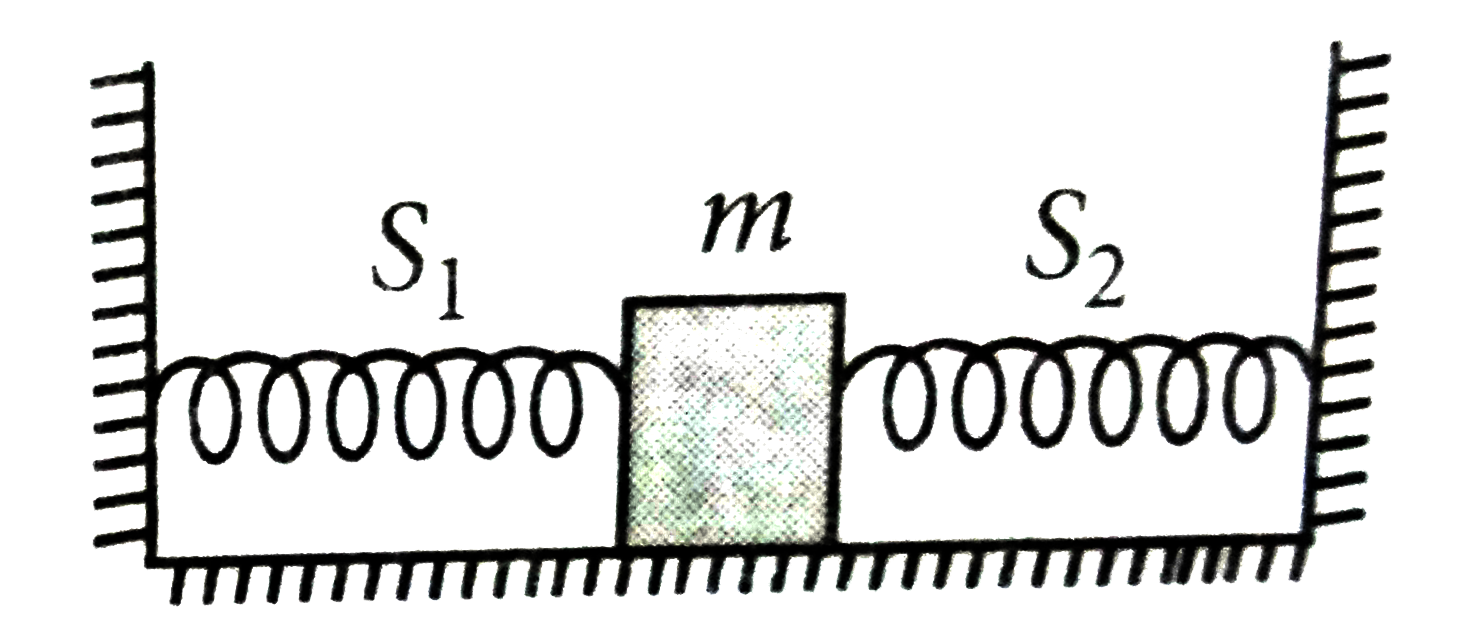
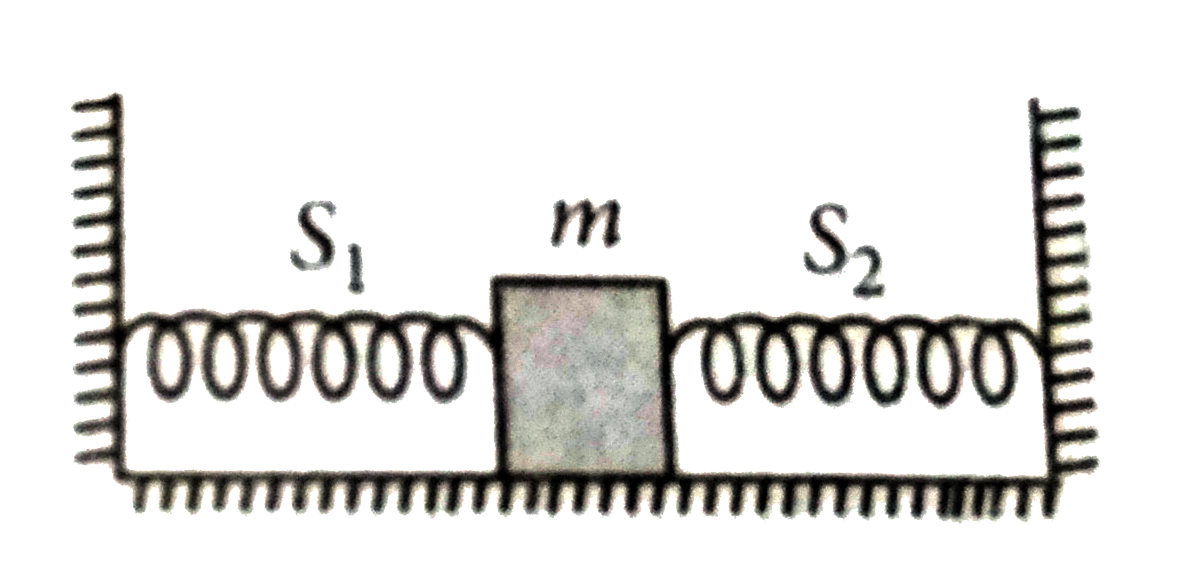
When a mass m is connected individually to two springs `S_(1) and S_2`, the oscillation frequencies are `upsilon_(1) and upsilon_(2)`. If the same mass is attached to the two springs as shown in figure, the oscillation frequency would be

A

`upsilon_(1)+upsilon_(2)`

B

`sqrt(upsilon_(1)^(2)+upsilon_(2)^(2))`

C

`((1)/(upsilon_(1))+(1)/(upsilon_(2)))^(-1)`

D

`sqrt(upsilon_(1)^(2)-upsilon_(2)^(2))`

Text Solution

Verified by Experts

The correct Answer is:
B


Let `k_(1) and k_(2)` be the spring constant fo springs `S_(1) and S_(2)` respectively. Then
`upsilon_(1)=(1)/(2pi)sqrt((k_(1))/(m))` . . . (i)
and `upsilon_(2)=(1)/(2pi)sqrt((k_(2))/(m))` . .. (ii)
If k is effective spring constant of two springs `S_(1) and S_(2)`. then, `k=k_(1)+k_(2)` (`because` springs are connected in parallel) if `upsilon` is the effectie frequency of oscilltion when the mass m is attached to the springs `S_(1) and S_(2)` as shown in figure, then
`upsilon=(1)/(2pi)sqrt((k)/(m))=(1)/(2pi)sqrt((k_(1)+k_(2))/(m))=(1)/(2pi)sqrt((k_(1))/(m)+(k_(2))/(m))`
`upsilon=(1)/(2pi)sqrt(4pi^(2)upsilon_(1)^(2)+4pi^(2)upsilon_(2)^(2))` (Using (i) and (ii))
`=sqrt(upsilon_(1)^(2)+upsilon_(2)^(2))`.
Promotional Banner

Topper's Solved these Questions

  • OSCILLATIONS

    NCERT FINGERTIPS ENGLISH|Exercise Assertion And Reason|15 Videos
  • OSCILLATIONS

    NCERT FINGERTIPS ENGLISH|Exercise Forced Oscillation And Resonance|6 Videos
  • MOTION IN A STRAIGHT LINE

    NCERT FINGERTIPS ENGLISH|Exercise NCERT Exemplar|6 Videos
  • PHYSICAL WORLD

    NCERT FINGERTIPS ENGLISH|Exercise Assertion And Reason|10 Videos

Similar Questions

Explore conceptually related problems

When a mass m is connected individually to two springs S_(1) and S_(2) , the oscillation frequencies are v_(1) and v_(2) . If the same mass is attached to the two springs as shown in figure, the oscillation frequency would be

Four spring connect with mass as shown in figure. Find frequency of S.H.M.

Four spring connect with mass as shown in figure. Find frequency of S.H.M.

A mass is suspended separately by two springs of spring constants k_(1) and k_(2) in successive order. The time periods of oscillations in the two cases are T_(1) and T_(2) respectively. If the same mass be suspended by connecting the two springs in parallel, (as shown in figure) then the time period of oscillations is T. The correct relations is

When a body is suspended from two light springs separately, the periods of vertical oscillations are T_1 and T_2 . When the same body is suspended from the two spring connected in series, the period will be

When a block of mass m is suspended separately by two different springs have time period t_(1)" and "t_(2) . If same mass is connected to parallel combination of both springs, then its time period is given by :-

The frequency of oscillation of amass m suspended by a spring is v_(1) . If length of spring is cut to one third then the same mass oscillations with frequency v_(2) . Then

A very light rod of length l pivoted at O is connected with two springs of stiffness k_1 & k_2 at a distance of a & l from the pivot respectively. A block of mass ma attached with the spring k_(2) is kept on a smooth horizontal surface. Find the angular frequency of small oscillation of the block m .

An object suspended from a spring exhibits oscillations of period T. Now the spring is cut in two halves and the same object is suspended with two halves as shown in figure. The new time period of oscillation will become

A mass m is suspended from a spring. Its frequency of oscillation is f. The spring is cut into two halves and the same mass is suspended from one of the pieces of the spring. The frequency of oscillation of the mass will be

