Home
Class 11
CHEMISTRY
Packing of Na^+ " and " Cl^- ions in sod...

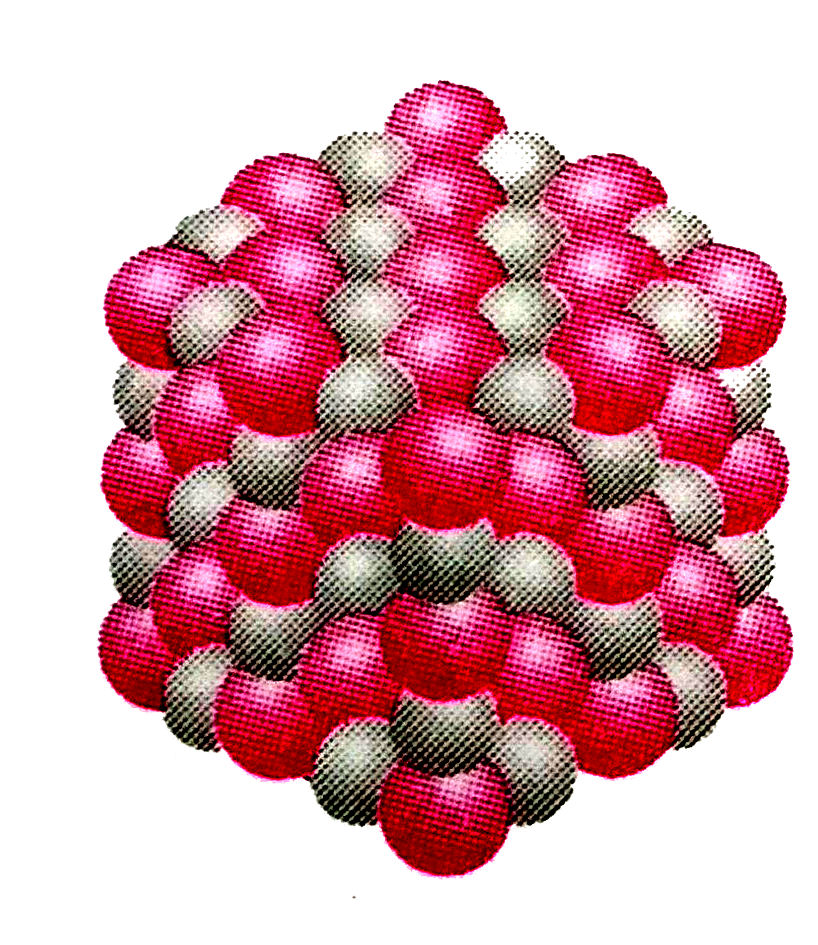
Packing of `Na^+ " and " Cl^-` ions in sodium chloride is depicted by the given figure. Choose the correct option regarding formula mass of sodium chloride.
(A) in solid state, sodium chloride does not exist as a single entity (B) formula mass of NaCl is 68.0u (C) formula mass of NaCl is the sum of atomic masses of Na and Cl (D) both A and C

A

In the solid, sodium chloride does not exist as a single entity.

B

Formula mass of NaCl is 68.0 u.

C

Formula mass of NaCl is the sum of atomic masses of Na and Cl

D

Both (a) and (c)

Text Solution

Verified by Experts

Formula mass of NaCl = Atomic mass of Na + Atomic mass of Cl
=23.0 u + 35.5 u = 58.5 u
Promotional Banner

Topper's Solved these Questions

  • SOME BASIC CONCEPTS OF CHEMISTRY

    NCERT FINGERTIPS ENGLISH|Exercise Mole Concept And Molecular Masses|23 Videos
  • SOME BASIC CONCEPTS OF CHEMISTRY

    NCERT FINGERTIPS ENGLISH|Exercise Percentage Composition|9 Videos
  • SOME BASIC CONCEPTS OF CHEMISTRY

    NCERT FINGERTIPS ENGLISH|Exercise Laws Of Chemical Combination|13 Videos
  • REDOX REACTIONS

    NCERT FINGERTIPS ENGLISH|Exercise Assertion And Reason|15 Videos
  • STATES OF MATTER

    NCERT FINGERTIPS ENGLISH|Exercise Assertion And Reason|15 Videos

Similar Questions

Explore conceptually related problems

A crystalline solid AB adopts sodium chloride type structure with edge length of the unit cell as 745 pm and formula mass of 74.5 g The density of the crystalline compound is

Choose the correct option : When dilute sodium chloride solution is electrolysed using graphite electrodes , the cation is discharged at the cathode most readily [ Na^(+) , OH , H^(+) , Cl^(-)]

A 10 g sample of a mixture of calcium chloride and sodium chloride is treated with Na_(2)CO_(3) to precipitate calcium as calcium carbonate. This CaCO_(3) is heated to convert all the calcium to CaO and the final mass of CaO is 1.12gm. Calculate % by mass of NaCl in the original mixture.

Sodium chloride has a crystalline structure made up of Na^(+) and Cl^(-) ions. Why does NaCl not conduct electricity in solid state ?

Sodium chloride is composed of 39.4% sodium and 60.6% chlorine. Prove by calculations that its empirical formula is NaCl. (R.A.M. : Na = 23, CI = 35.5)

On passing 0.1 faraday of electricity through fused sodium chloride, the amount of chlorine liberated is (At. Mass of Cl=35.45 )

A solution containing 1g of sodium chloride in 100g of water freezes at - 0.604^@C . Calculate the degree of dissociation of sodium chloride. (Na = 23, Cl = 35.5, Kf for water = 1.87 k "mol"^(-1) )

Common salt obtained from sea-water contains 8.775% Na Cl by mass. The number of formula units of NaCl present in 25 g of this salt is :

Common salt obtained from sea-water contains 8.775% Na Cl by mass. The number of formula units of NaCl present in 25 g of this salt is :

Can sodium chloride conduct eletricity in the solid state ? (A)Solids do not conduct electricity. (B)The ions of NaCl become mobile only in molten state and are not free to move in solid state. (C)The crystalline structure does not have ions. (D)When a bond is formed between ions they lose their charges.

