Home
Class 11
CHEMISTRY
If a spoon of copper metal is placed in ...

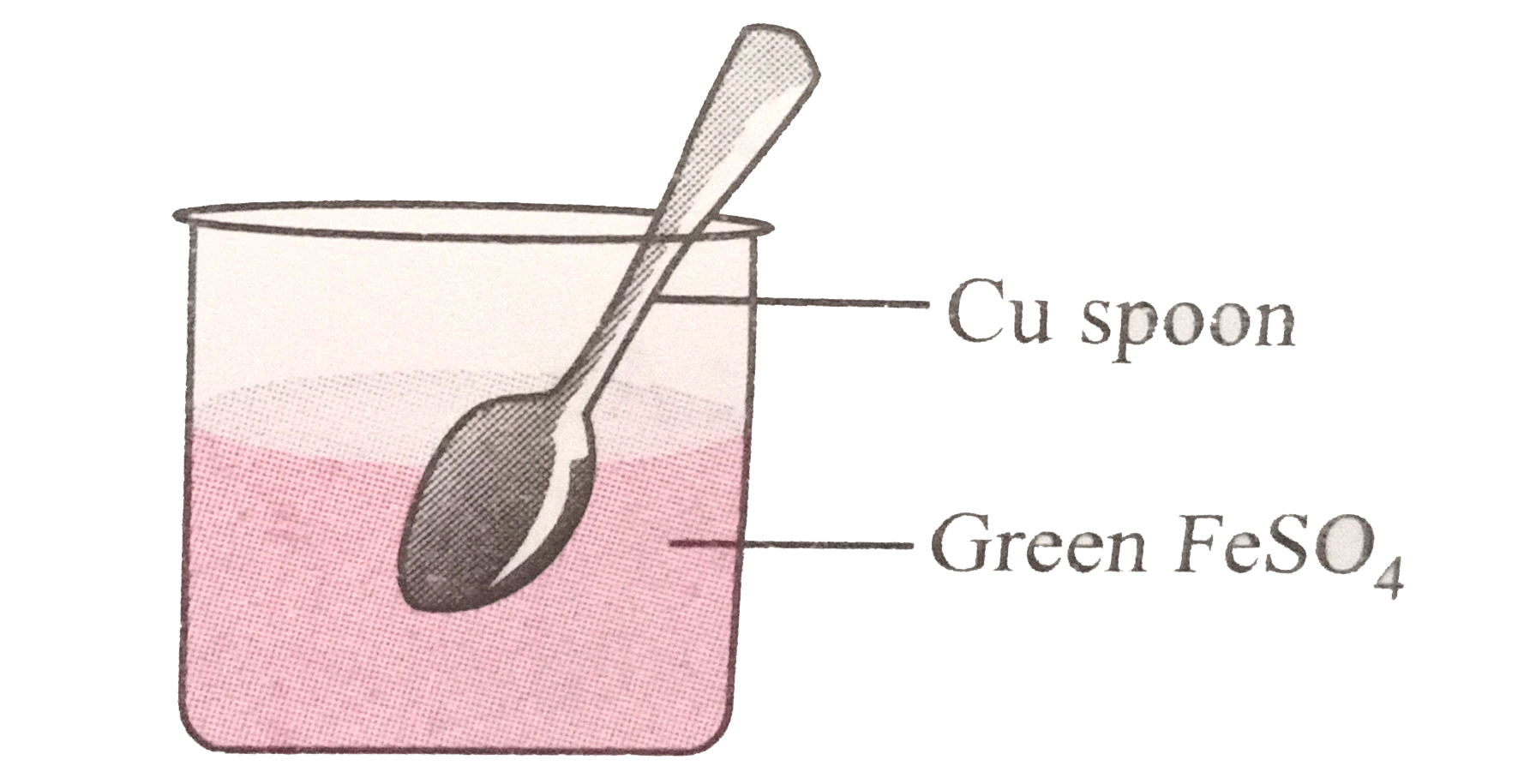
If a spoon of copper metal is placed in a solution of `FeSO_(4)`, what will be the correct observation ?
(A)Copper is dissolved in F e S O 4 to give brown deposit. (B)No reaction takes place. (C)Iron is deposited on copper spoon. (D)Both copper and iron are precipitated

A

Copper is dissolved in `FeSO_(4)` to give brown deposit.

B

No reaction takes place.

C

Iron is deposited on copper spoon.

D

Both copper and iron are precipitated.

Text Solution

Verified by Experts

The correct Answer is:

B

Since reduction potential of copper is higher than iron it does not get oxidised and no reaction takes place.
Promotional Banner

Topper's Solved these Questions

  • REDOX REACTIONS

    NCERT FINGERTIPS ENGLISH|Exercise NCERT Exemplar|11 Videos
  • REDOX REACTIONS

    NCERT FINGERTIPS ENGLISH|Exercise Assertion And Reason|15 Videos
  • REDOX REACTIONS

    NCERT FINGERTIPS ENGLISH|Exercise Oxidation Number|70 Videos
  • PRACTICE PAPER 3

    NCERT FINGERTIPS ENGLISH|Exercise Practice Paper 3|46 Videos
  • SOME BASIC CONCEPTS OF CHEMISTRY

    NCERT FINGERTIPS ENGLISH|Exercise NCERT Exemplar|11 Videos

Similar Questions

Explore conceptually related problems

If a spoon of copper metal is placed in a solution of ferrous sulphate .

Assertion: During electrolysis of CuSO_4 (aq) using copper electrodes, copper is dissolved at anode and deposited at cathode. Reason: Oxidation takes place at anode and reduction at cathode.

How many gram of copper metal will be deposited when a solution of copper sulphate (CuSO_4) is electrolysed with a current of 9.65 ampere for 10 minutes? (1F = 96500 C, Atomic mass of Cu = 63.5 u)

Identify (A) to ( E) . (a) An inorganic iodide (A) on heating with a solution of KOH gives a gas (B) and the solution of a compound ( C) . (b) The gas (B) on ignition air gives a compound (D) and water. ( C) Copper sulphate is reduced to the metal on passing (B) through the solution. (d) A precipitate of the compound ( E) is formed on reaction of ( C) with copper sulphate solution.

Alkanline earth metal nitrate (A) on heating decompose, leaving a solid residue (B) which goes into solution with dilute HCI . The solution of (B) gives a white precipitate (C ) is dissolved in dilute HCl and the solution is treated with potassium chromae to get yellow precipitate (D) . The solution (B) with dilute H_(2)SO_(4) also gives a white precipitate (E) insoluble in diute HCl and nitric acid. the precipitate (E) is a part of a white pigment lithopone. The yellow precipitate (D) is

Alkanline earth metal nitrate (A) on heating decompose, leaving a solid residue (B) which goes into solution with dilute HCI . The solution of (B) gives a white precipitate (C ) is dissolved in dilute HCl and the solution is treated with potassium chromae to get yellow precipitate (D) . The solution (B) with dilute H_(2)SO_(4) also gives a white precipitate (E) insoluble in diute HCl and nitric acid. the precipitate (E) is a part of a white pigment lithopone. The metal nitrate (A) is

Alkanline earth metal nitrate (A) on heating decompose, leaving a solid residue (B) which goes into solution with dilute HCI . The solution of (B) gives a white precipitate (C ) is dissolved in dilute HCl and the solution is treated with potassium chromae to get yellow precipitate (D) . The solution (B) with dilute H_(2)SO_(4) also gives a white precipitate (E) insoluble in diute HCl and nitric acid. the precipitate (E) is a part of a white pigment lithopone. The compound (E) is

Alkanline earth metal nitrate (A) on heating decompose, leaving a solid residue (B) which goes into solution with dilute HCI . The solution of (B) gives a white precipitate (C ) is dissolved in dilute HCl and the solution is treated with potassium chromae to get yellow precipitate (D) . The solution (B) with dilute H_(2)SO_(4) also gives a white precipitate (E) insoluble in diute HCl and nitric acid. the precipitate (E) is a part of a white pigment lithopone. The solid residue (B) is

(a) What is the reaction which a taking place ? (b) Give the function of acidified copper sulphate solution. (c) Give a reaction in which acetylene gas is prepared by synthesis reaction. (d) Compare the reaction of acetylene with bromine water and liquid bromine. (e) What happens when acetylene is heated in copper tube at 600^@C ?

Can we store : (i) Copper sulfate solution in zinc vessel ? (ii) FeSO_(4) solution in silver vessel ? (iii) Copper sulfate solution in iron vessel? (iv) 1 M CuSO_(4) solution in Ni container ? Give suitable explanation in support of your answer.

NCERT FINGERTIPS ENGLISH-REDOX REACTIONS-Redox Reactions And Electrode Processes
  1. What will be the products of electrolysis of AgNO(3) solution in water...

    Text Solution

    |

  2. In an oxidation proces for a cell, M(1)rarr M(1)^(n+)+n e^(-), t...

    Text Solution

    |

  3. Which of the following reactions takes place at anode ?

    Text Solution

    |

  4. Which of the following will act as cathode when connected to standard ...

    Text Solution

    |

  5. Which of the following reaction does not take place at cathode ?

    Text Solution

    |

  6. Based on the following reactions, arrange the metals in increasing ord...

    Text Solution

    |

  7. Which of the following is not a correct statement about electrochemica...

    Text Solution

    |

  8. If a spoon of copper metal is placed in a solution of FeSO(4), what wi...

    Text Solution

    |

  9. The solution in a beaker turns blue if

    Text Solution

    |

  10. The standard electrode potential a Ag^(+)//Ag is +0.80 V and of Cu^(2+...

    Text Solution

    |

  11. The E^(@) values of redox complex of halogens are given. Based on thes...

    Text Solution

    |

  12. Arrange the following metals in the order in which they displace easy ...

    Text Solution

    |

  13. Arrange the following metals in increasing order of their reducing po...

    Text Solution

    |

  14. A metal X displaces nickel from nickel sulphate solution but does not ...

    Text Solution

    |

  15. Given E(Ag^(+)//Ag)^(@)=+0.80 V, E(Cu^(2+)//Cu)^(@)=+0.34 V, E(Fe^(3+)...

    Text Solution

    |

  16. निम्नलिखित आयनो को इलेक्ट्रॉन ग्रहण करने की बढ़ती क्षमता के क्रम में लि...

    Text Solution

    |

  17. What will be the order of decreasing reducing nature for the given met...

    Text Solution

    |

  18. Which of the following is the strongest oxidizing agent ?

    Text Solution

    |

  19. Fluorine is the best oxidising agent because it has

    Text Solution

    |

  20. Which of the following halides is most acidic ?

    Text Solution

    |
