Home
Class 12
CHEMISTRY
What is the standard electrode (Half-cel...

What is the standard electrode (Half-cell) potential ? Give its uses.

Text Solution

Verified by Experts
Potential of standard electrode (Half-cell):
Standard condition means at 298K temperature and 1 bar pressure of gases and 1M concentration of solution, the reproduction potential of electrode (Half-cell) is called as standard electrode potential which has volt unit.
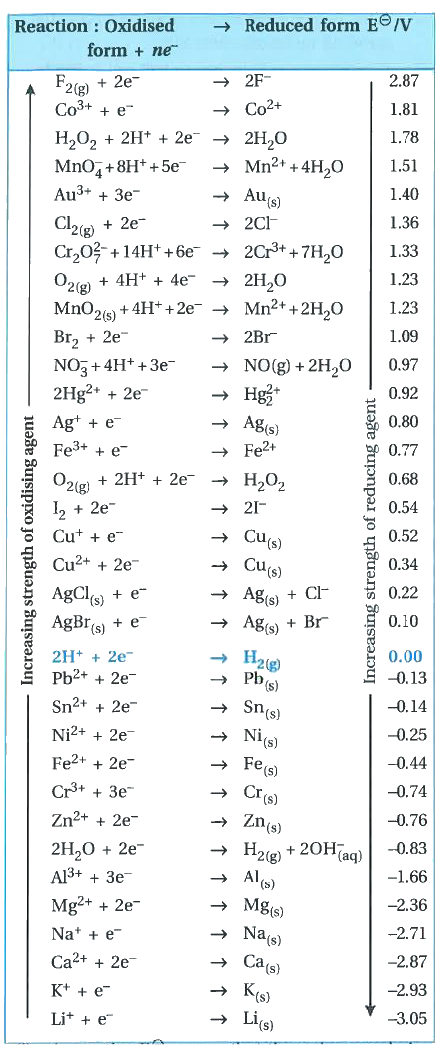
Construction of emf series: When half cell reaction are arranged in a decreasing order of their standard reduction potential then such series of half-cell is known as emf series. it is as follows :

(i) A negative `E^(Theta)` means that the redox couple is a stronger reducing agent than the `H^(+)|H_(2)` couple.
(ii) A positive `E^(Theta)` means that the redox couple is a weaker reducing agent than the `H^(+)|H_(2)` couple.
Determine the stability order of reduction form:
If the standard electrode potential of an electrode is greater than zero then its reduced form is more stable compared to hydrogen gas.
E.g., stability order: `Ag gt Cu gt H_(2)`
If the standard electrode potential is negative then hydrogen gas is more stable than the reduced form of the species.
e.g., stability order : `H_(2) gt Pb gt Sn gt Ni gt Fe gt Cr gt Zn`
(iii) To determine strength as oxidizing-reducing agent:
Positive `E^(Theta)`: The standard electrode potential for fluorine is the highest in the Table indicating that fluorine gas (`F_(2)`) has the maximum tendency to get reduce to fluoride ions `(F^(-))` and therefore fluorine gas is the strongest oxidising agent and fluoride ion is the weakest reducing agent.
Negative `E^(Theta)`: Lithium has the lowest electrode potential indicating that lithium io is the weakest oxidising agent while lithium metal is the most powerrful reducing agent in an aqueous solution.
Note: The standard electrode potential decreases and with this, decreases the oxidising power of the species on the left and increases the reducing powre of the species on the right hand side of the reaction e.g., `F_(2)` is strong oxidizing agent and `F^(-)` is strong reducing agent.
(iv) To determine the possibilities of reaction : The half-cell with high standard reduction potential will give more reduction reaction with respect to less standard reduction potetnial, which gives reduction reactions.
`E_((Cu^(2)|Cu))^(Theta)=+0.34V and H^(+)|H_(2(g))` of `E^(Theta)=0V`
`[E_((Cu^(2+)|Cu))^(Theta) gt E_(H^(+)|H_(2))]`
So `H^(+)` ion can.t oxidize Cu. and so Cu metal can.t be dissolved in HCl.
`2H_((aq))^(+)+Cu_((S)) to `Reaction will not occurs
But `H_(2(g))+Cu_((aq))^(2+) to 2H^(+)+Cu_((S))` reaction will occur
Hydrogen gas can reduced copper ion into copper metal.
Reduction: `Cu_((aq))^(2+)+2e^(-) to Cu_((S)) (E_(Cu^(2+)|Cu)^(Theta)" More")`
Oxidation `:H_(2(g)) to 2H_((aq))^(+) + 2e^(-) (E_(Cu^(2+)|Cu)" Less")`
Note: Oxidation of Cu metal into `Cu^(2+)` ion is possible by nitrate ions of nitric acid.
Promotional Banner

Topper's Solved these Questions

  • ELECTROCHEMISTRY

    KUMAR PRAKASHAN|Exercise SECTION-A (Try Yourself)|25 Videos
  • ELECTROCHEMISTRY

    KUMAR PRAKASHAN|Exercise SECTION-A (Practice Questions)|3 Videos
  • ELECTROCHEMISTRY

    KUMAR PRAKASHAN|Exercise SECTION-E MCQ.s Asked in GUJCET/Board Exam|55 Videos
  • CHEMISTRY IN EVERYDAY LIFE

    KUMAR PRAKASHAN|Exercise SECTION - E (MCQs ASKED IN GUJCET/BOARD EXAM)|37 Videos
  • GENERAL PRINCIPLES AND PROCESSES OF ISOLATION OF ELEMENTS

    KUMAR PRAKASHAN|Exercise SECTION - E (MCQs ASKED IN GUJET/BOARD EXAMS)|46 Videos

Similar Questions

Explore conceptually related problems

The electrode potential becomes equal to standard electrode potential when reactants and products concentaration ratio is .

KUMAR PRAKASHAN-ELECTROCHEMISTRY-SECTION-A
  1. Explain symbolic representation of galvanic cell (electrochemical cell...

    Text Solution

    |

  2. Give the type and examples of electrodes.

    Text Solution

    |

  3. What is the standard electrode (Half-cell) potential ? Give its uses.

    Text Solution

    |

  4. Give Nernst equation for following reaction M((aq))^(n+)+n e^(-)to M...

    Text Solution

    |

  5. Derive Nernst equation for calculating E(cell) of Nernst equation and ...

    Text Solution

    |

  6. Derive Nernst equation for the following galvanic cell. Ni((S))|Ni((...

    Text Solution

    |

  7. For general redox reaction: aA+bB overset(n e^(-)) to cC=dD. Derive ...

    Text Solution

    |

  8. Explain equilibrium state in Daniell cell and derive its equilibrium c...

    Text Solution

    |

  9. Derive an equation for equilibrium constant K(c) of any galvanic cell ...

    Text Solution

    |

  10. Write a note on relation between Gibbs free energy and cell potential ...

    Text Solution

    |

  11. What is an electric resistance ? Give note on it.

    Text Solution

    |

  12. Define resistance or specific resistance and write a note on it.

    Text Solution

    |

  13. What is conductivity ? Give note on it.

    Text Solution

    |

  14. Write a note on specific conductivity (k).

    Text Solution

    |

  15. Conductivity depends on what ?

    Text Solution

    |

  16. What is metallic or electronic conductivity? It depends on what basis?

    Text Solution

    |

  17. What is ionic conductivity ? It is dependent on which bases ?

    Text Solution

    |

  18. Write a note on classification of conductor based on mass of conductor...

    Text Solution

    |

  19. Write a note on difficulties associated with the measurement of resist...

    Text Solution

    |

  20. Discuss construction and uses of conductivity cell.

    Text Solution

    |

