A
B
C
D
Text Solution
Verified by Experts
The correct Answer is:



Topper's Solved these Questions
KINEMATICS
MTG-WBJEE|Exercise WB JEE WORKOUT ( CATEGORY 3 : One or More than One Option Correct Type (2 Marks))|10 VideosKINEMATICS
MTG-WBJEE|Exercise WB JEE Previous Years Questions (CATEGORY 1 : Single Option Correct Type (1 Mark) )|9 VideosKINEMATICS
MTG-WBJEE|Exercise WB JEE Previous Years Questions (CATEGORY 3 : One or More than One Option Correct Type (2 Marks) )|1 VideosHEAT AND THERMAL PHYSICS
MTG-WBJEE|Exercise WB JEE PREVIOUS YEARS QUESTIONS|15 VideosKINETIC THEORY OF GASES
MTG-WBJEE|Exercise WB JEE PREVIOUS YEARS QUESTIONS (MCQ)|7 Videos
Similar Questions
Explore conceptually related problems
MTG-WBJEE-KINEMATICS -WB JEE WORKOUT ( CATEGORY 2 : Single Option Correct Type (2 Marks))
- If veca+vecb=vec c and a+b=c, what is the angle between veca and vecb ...
Text Solution
|
- What will be the a versus x graph for the following graph?
Text Solution
|
- Given vecC= vecAxxvecB and vecD = vecBxxvecA What is the angle between...
Text Solution
|
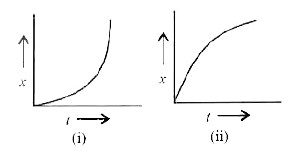
- Figure (i) and (i) show the displacement-time graphs of two particles ...
Text Solution
|
- The acceleration of a particle is increasing linearly with time t as b...
Text Solution
|
- Two trains A and B cach of length 400 m are moving on two parallel tra...
Text Solution
|
- If a ball is thrown vertically upwards with speed u, the distance cove...
Text Solution
|
- If |vecAxxvecB|=sqrt(3) vecA.vecB, then the value of |vecA+vecB| is
Text Solution
|
- If vecA = vecB + vecC and the magnitudes of vecA, vecB and vecC are ...
Text Solution
|
- Given vecA=2hati+3hatj and vecB=hati+hatj . The component of vector ve...
Text Solution
|
- A particle is moving with velocity 5 m/s towards cast and its velocity...
Text Solution
|
- The displacement time graph of a body is shown in figure. The velocity...
Text Solution
|
- The displacement time graph of a particle moving along a straight line...
Text Solution
|
- The sum of magnitudes of two forces acting at a point is 16 and magnit...
Text Solution
|
- A ball is released from the top of a tower of height h metre. It takes...
Text Solution
|