Home
Class 12
PHYSICS
Derive an expression for electric field ...

Derive an expression for electric field due to an electric dipole at a point on the axial line.

Text Solution

Verified by Experts
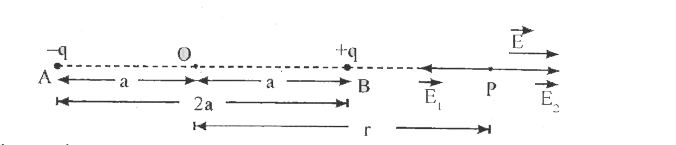

Consider a point .P. on the axis of an electric dipole at a distance .r. from its midpoint as shown in the figure. The magnitude of dipole moment of the dipole .P. (directed from -q to +q) is given by
`P=qxx2ato(1)`
Electric field at P due to -q is
`E_(1)=(1)/(4piepsi_(0))(q)/(AP^(2))=(1)/(4piepsi_(0))(q)/((r-a)^(2))` along PA.
Electric fielda at .P. due to +q is
`E_(2)=(1)/(4piepsi_(0))(q)/((r-a)^(2))` along BP produced
Resultant electric field at P, is
`E=E_(2)-E_(1)[because E_(2)gtE_(1) "because"(r-a)lt(r+a)]`
`E=(q)/(4piepsi_(0))((1)/((r-a)^(2))-(1)/((r+a)^(2)))`
`E=(q)/(4piepsi_(0))(((r+a)^(2)-(r-a)^(2))/((r-a)^(2)(r+a)^(2)))[because (r+a)^(2)-(r-a)^(2)=4ar]`
`E=(q)/(4piepsi_(0))(4ar)/(r^(2)-a^(2))^(2)`
`E=(1)/(4piepsi_(0))(2rp)/((r^(2)-a^(2))^(2))[because (1),P=2aq]`
For `rgtgta" "E=(1)/(4piepsi_(0))((2P)/(r^(3)))P`
Promotional Banner

Topper's Solved these Questions

  • [II PUC PHYSICS] ANNUAL EXAM QUESTION PAPER MARCH-2016

    SUNSTAR PUBLICATION|Exercise PART-D (Answer any two of the following).|3 Videos
  • [II PUC PHYSICS] ANNUAL EXAM QUESTION PAPER MARCH-2016

    SUNSTAR PUBLICATION|Exercise PART-D (Answer any three of the following questions).|5 Videos
  • [II PUC PHYSICS] ANNUAL EXAM QUESTION PAPER MARCH-2016

    SUNSTAR PUBLICATION|Exercise PART-C ( Answer any five of the following questions)|8 Videos
  • SUPPLEMENTARY EXAM QUESTION PAPER JUNE-2019

    SUNSTAR PUBLICATION|Exercise Part-C|18 Videos

Similar Questions

Explore conceptually related problems

Derive an expression for electrical conductivity.

What is an electric dipole ?

Obtain an expression for the electric field intenstiy at a point on the equatorial line of an electric dipole.

Derive an expression for the electric field at a point due to an infinitely long thin charged straight wire using Gauss Law.

Arrive at the expression for electric potential at a point due to a dipole and hence apply the expression for electric potential at a point on the dipole axis and on the equatorial lines.

