Home
Class 12
BIOLOGY
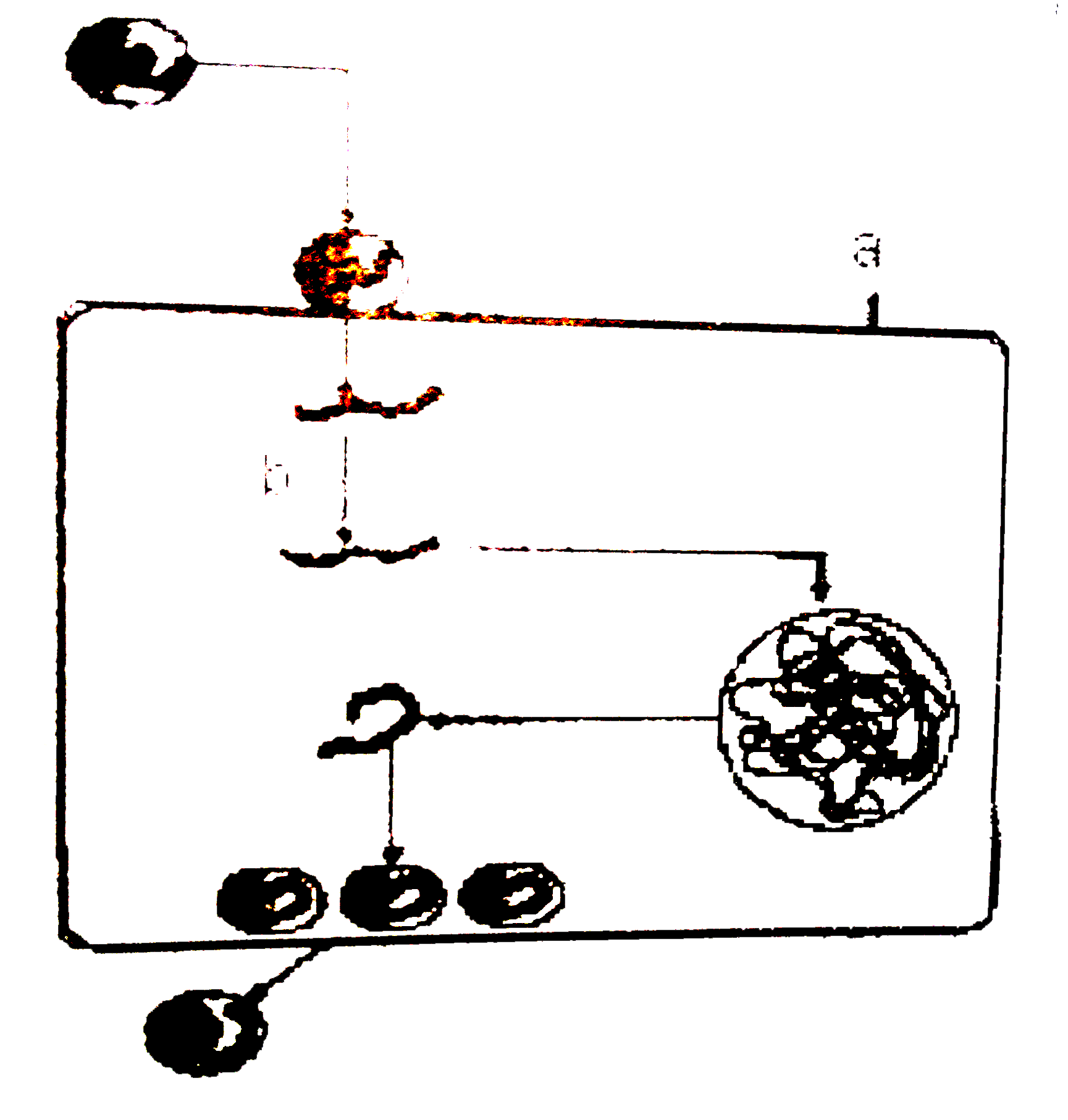
(i) What does this diagrammatic sketch d...

(i) What does this diagrammatic sketch depict?
(ii) Identify a' and 'b
(iii) Name the widely used diagnostic test when a person gets this disease.

Text Solution

Verified by Experts

(i)Replication of retrovirus
(ii) (a)- Plasma Membrane.
(b) - Formation of viral DNA by reverse transcriptase
(iii) ELISA (Enzyme linked immunosorbent assay test.
Promotional Banner

Topper's Solved these Questions

  • GENETICS AND EVOLUTION

    TRUEMEN BIOLOGY ENGLISH|Exercise SECTION-D|25 Videos
  • GENETICS AND EVOLUTION

    TRUEMEN BIOLOGY ENGLISH|Exercise SECTION-B|38 Videos
  • Genetics

    TRUEMEN BIOLOGY ENGLISH|Exercise ASSERTION AND REASON|122 Videos
  • HUMAN HEALTH AND DISEASE

    TRUEMEN BIOLOGY ENGLISH|Exercise MULTIPLE CHOICE QUESTIONS|209 Videos

Similar Questions

Explore conceptually related problems

(i) Identify the stage a and b (ii) Name the structures c and d (iii) In which stage implantation occurs

A patient showed symptoms of sustained high fever, stomach pain and constipation, but no blood clot in stools. Name the disease and its pathogen. Write the diagnostic test for the disease. How does the disease get transmitted?

Given alongside is a diagrammatic sketch of a part in human lungs (i) Name the parts numbered 1-4 (ii) What do the arrows 5 and 6 indicate ?

A person may suffer from both myopia and hypermetropia defects. (a) What is this condition called? (b) When does it happen? (c) Name the type of lens often required by the persons suffering from this defect. Draw labelled diagram of such lenses.

Observe the figures given below and then answer the questions that follow : (i) What is the picture depicting ? (ii) What was the reason that the giraffe stretched their neck and forelimbs ? (iii) Name the theory to which this picture belongs. (iv) Who explained this theory? (V) What is the conclusion of this theory?

Given below is a diagram depicting a defect of the human eye, study the same and then answer the questions that follow: (i) Name the defect shown in the diagram. (ii) What are the two possible reasons that cause this defect? (iii) Name the type of lens used to correct this defect. (iv) With the help of a diagram show how the defect shown above is rectified using a suitable lens.

The given picture shows the face of a Cro-Magnon Man. (i) What is his scientific name? (ii) Who discovered the fossil of Cro-Magnon Man ? (iii) When did they became extinct ? (iv) Write the characters of the picture shown alongside on the basis of the following: Height, Body hair, Chin, Posture

(a) Name the causative agent of typhoid in humans. (b) Name the test administered to confirm the disease. (c) How does the pathogen gain entry into the human body ? Write the diagnostic symptoms and mention the body organ that gets affected in severe cases.

In the diagram drawn alongside (i) Label the parts a, b and c. (ii) In which part does the light reaction occur? (iii) Name the part which the dark phase of photosynthesis occur in.

Study the figure given below and answer the questions: (i) How does the repressor molecule get inactivated? (ii) When does the transcription of lac mRNA stop? (iii) Name the enzyme transcribed by the gene Z'.

TRUEMEN BIOLOGY ENGLISH-GENETICS AND EVOLUTION -SECTION-C
  1. (i) What does this diagrammatic sketch depict? (ii) Identify a' an...

    Text Solution

    |

  2. A 3' 5' B C 5' 3'D AB and CD represent two strands of a DNA mol...

    Text Solution

    |

  3. In the following diagram the two DNA strands represented are ready for...

    Text Solution

    |

  4. What are types of sex-linkage?

    Text Solution

    |

  5. A non-haemophilic couple was informed by their doctor that there is po...

    Text Solution

    |

  6. What is 'semi- conservative' DNA replication ? How was it experimenta...

    Text Solution

    |

  7. A homozygous tall pea plant with green seeds is crossed with a dwarf ...

    Text Solution

    |

  8. Haemophilia is a sex linked recessive disorder of humans. The pedigree...

    Text Solution

    |

  9. Inheritance pattern of ABO blood groups in humans shows dominance. cod...

    Text Solution

    |

  10. (a) What is this diagram representing? (b) Name the parts a, b and c...

    Text Solution

    |

  11. (a) In human genome which one of the chromosomes has the most genes an...

    Text Solution

    |

  12. Study the pedigree chart given, showing the Inheritance pattern of blo...

    Text Solution

    |

  13. Why are F(2) phenotypic and genotypic ratios same in a cross between r...

    Text Solution

    |

  14. (i) Why are grasshopper and Drosophila said to show male heterogamity ...

    Text Solution

    |

  15. Why is tRNA called an adapter molecule?

    Text Solution

    |

  16. (i) List the chromosomal disorders a human may suffer from if karyotyp...

    Text Solution

    |

  17. How are dominance, codominance and incomplete dominance patterns of in...

    Text Solution

    |

  18. A pea plant with purple flowers was crossed with white flowers produci...

    Text Solution

    |

  19. (i) Name the enzyme that catalysis the transcription of hnRNA. (ii) ...

    Text Solution

    |

  20. Unambiguous, universal and degenerate are some of the terms used for t...

    Text Solution

    |
