Home
Class 12
BIOLOGY
Study the figures below and answer the f...

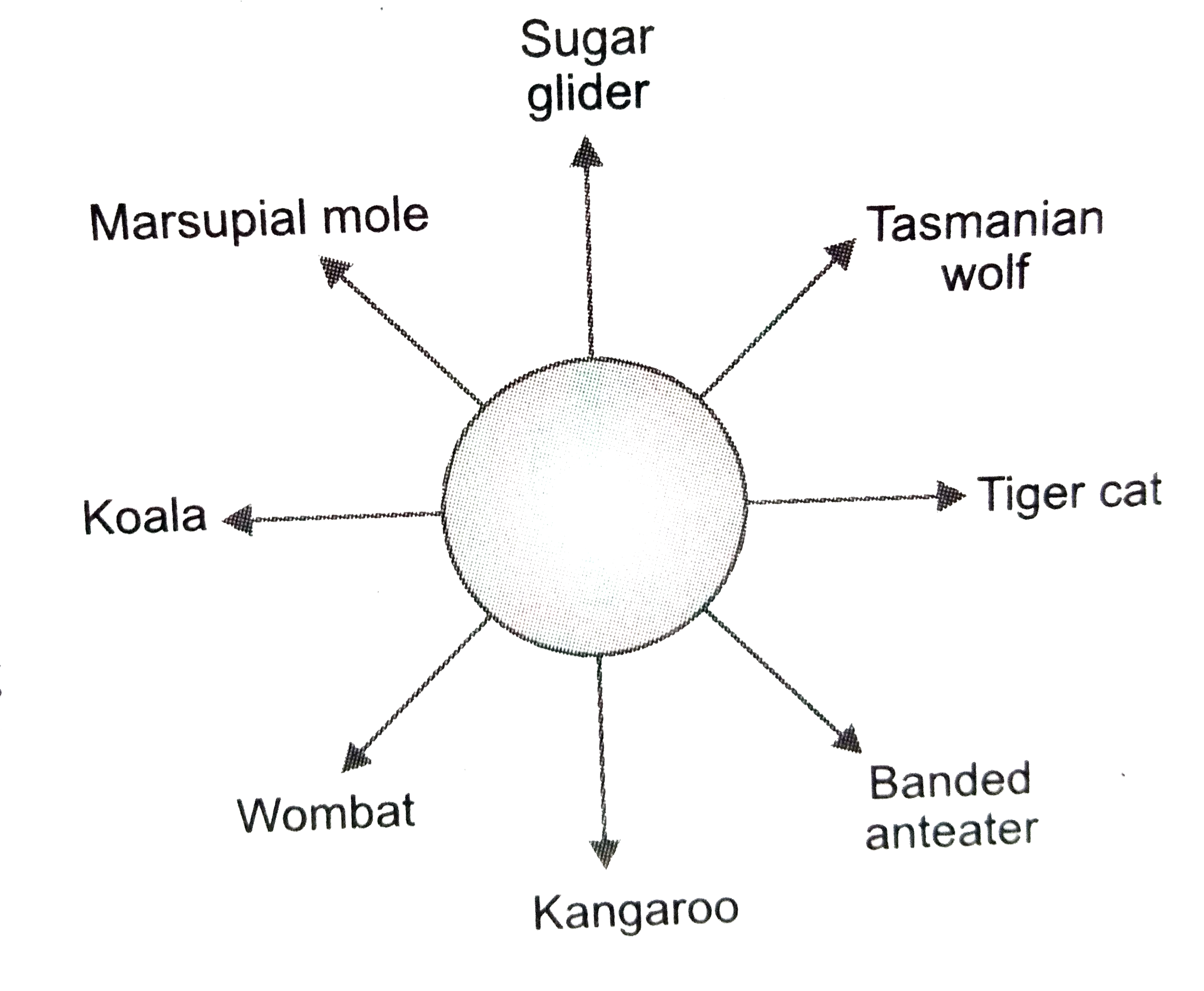
Study the figures below and answer the following :
(a)Mention the specific geographical region where these organisms are found.
(b)Name and explain the phenomenon that has resulted in the evolution of such diverse species in the region.
(c )Explain giving reasons the existance of placental wolf and Tasmanian wolf sharing the same habitat.

Text Solution

Verified by Experts

(a) The figure represents the adaptive radiation in Australian marsupials (b) The marsupials which evolved in North America first migrated to South America and then at the time of separation they were left in newly formed Australia. In Australia marsupials were present only with protherian mammals hence. didn't have much competition to exhibit divergent evolution. (c) Tasmanian wolf and placental wolf shows resemblance with the placental mammals hence, show convergent evolution
Promotional Banner

Topper's Solved these Questions

  • GENETICS AND EVOLUTION

    TRUEMEN BIOLOGY ENGLISH|Exercise SECTION-D|25 Videos
  • GENETICS AND EVOLUTION

    TRUEMEN BIOLOGY ENGLISH|Exercise SECTION-B|38 Videos
  • Genetics

    TRUEMEN BIOLOGY ENGLISH|Exercise ASSERTION AND REASON|122 Videos
  • HUMAN HEALTH AND DISEASE

    TRUEMEN BIOLOGY ENGLISH|Exercise MULTIPLE CHOICE QUESTIONS|209 Videos

Similar Questions

Explore conceptually related problems

Explain giving reasons the existence of Placental wolf and Tasmanian wolf sharing the same habitat.

Mention the specific geographical region where these organisms are found. Name and explain the phenomenon that has resulted in the evolution of such diverse species in the region. Explain giving reason the existence of placental wolf and Tasmania wolf sharing the same habitat.

Give reasons Placental wolf and Tasmanian wolf exist-sharing the same habitat.

Study the figure given below and answer the questions that follow : (a)Name the stage of human embryo the figure represents. (b)Identify 'A' in the figure and mention its function . ( c )Mention the fate of the inner cell mass after implantation in the uterus . (d)Where are the stem cells located in this embryo ?

Given below is the diagram of a human ovum surrounded by a few sperms. Study the diagram and answer the following questions : (a) Which one of the sperms would reach the ovum earlier ? (b) Identify 'D' and 'E'. Mention the role of 'E'. (c ) Mention what helps the entry of sperm into the ovum and write the changes occuring in the ovum during the process. (d) Name the specific region in the female reproductive system where the event represented in the diagram takes place.

Study a part of the life cycle of malarial parasite given below. Answer the questions that follows: (a) Mention the roles of 'A' in the life cycle of the malarial parasite. (b) Name the event 'C' and the organ where this event occurs . (c) Identify the organ 'B' and name the cells being released from it.

Study the diagrammatic representation of S.L. Miller's experiment given below and answer the questions that follow: (a) How did S.L. Miller create the conditions which existed before the origin of any life on Earth (b) Name the organic compound formed and collected at the end of his experiment. (c)Mention the kind of evolution is experiment supports

Study the diagrammatic representation of S.L. Miller's experiment given below and answer the questions that follow: (a) How did S.L. Miller create the conditions which existed before the origin of any life on Earth (b) Name the organic compound formed and collected at the end of his experiment. (c)Mention the kind of evolution is experiment supports

The diagram given below represents two reproductive cells A and B. Study the same and then answer the questions that follow: (i) Identify the reproductive cells A and B. (ii) Name the specific part of the reproductive system where the above cells are produced (iii) Where in the female reproductive system do these cells unite ? (iv) Name the main hormones secreted by the (1) ovary (2) testes. (v) Name an accessory gland found in the male reproductive system and state the function of its secretion.

Given below are two stages in the evolution of man. Study them and answer the questions that follow : (i) Identify Australopithecus and Neanderthal man from the above pictures. (ii) Mention two characteristic features each for the two stages. (iii) Who proposed the theory of Natural Selection? (iv) Name the organism used as an example to explain 'Industrial Melanisum'. (v) Give two examples of Vestigial organs in humans.

TRUEMEN BIOLOGY ENGLISH-GENETICS AND EVOLUTION -SECTION-C
  1. Study the given pedigree chart showing the pattern of blood group inhe...

    Text Solution

    |

  2. a) Construct a complete transcription unit with promoter and terminato...

    Text Solution

    |

  3. What is the genetic basis for proof that codon is a triplet?

    Text Solution

    |

  4. What are Satellite DNA in a genome? Explain their role in DNA fingerpr...

    Text Solution

    |

  5. Describe the structure of an RNA polynucleotide chain having four diff...

    Text Solution

    |

  6. Why are human females rarely haemophilic? Explain. How do haemophilic ...

    Text Solution

    |

  7. In a maternity clinic, for some reasons the authorities are not able t...

    Text Solution

    |

  8. a) Explain DNA polymorphism as the basis of genetic mapping of human g...

    Text Solution

    |

  9. Explain codominance taking an example of human blood groups in the pop...

    Text Solution

    |

  10. (a) State Hardy Weinberg principle. Name any two factors which affect ...

    Text Solution

    |

  11. "A population has been exhibiting genetic equilibrium". Answer the fo...

    Text Solution

    |

  12. In the 1950s, there were hardly any mosquitoes in Delhi. The use of th...

    Text Solution

    |

  13. Discovery of Lobefins is considered very significant by evolutionary b...

    Text Solution

    |

  14. Study the figure and answer the following (a)Write your observati...

    Text Solution

    |

  15. (a) Rearrange the following in an ascending order of evolutionary tree...

    Text Solution

    |

  16. (a) What is adaptive radiation. (b) Explain with the help of suitab...

    Text Solution

    |

  17. Study the figures below and answer the following : (a)Mention the sp...

    Text Solution

    |

  18. Branching descent and natural selection are the two key concepts of Da...

    Text Solution

    |

  19. With the help of any two suitable examples explain the effect of anthr...

    Text Solution

    |

  20. Explain the increases in the numbers of melanic(dark winged) moths in ...

    Text Solution

    |
