Home
Class 11
PHYSICS
Two blocks A and B of masses 2kg and 4kg...

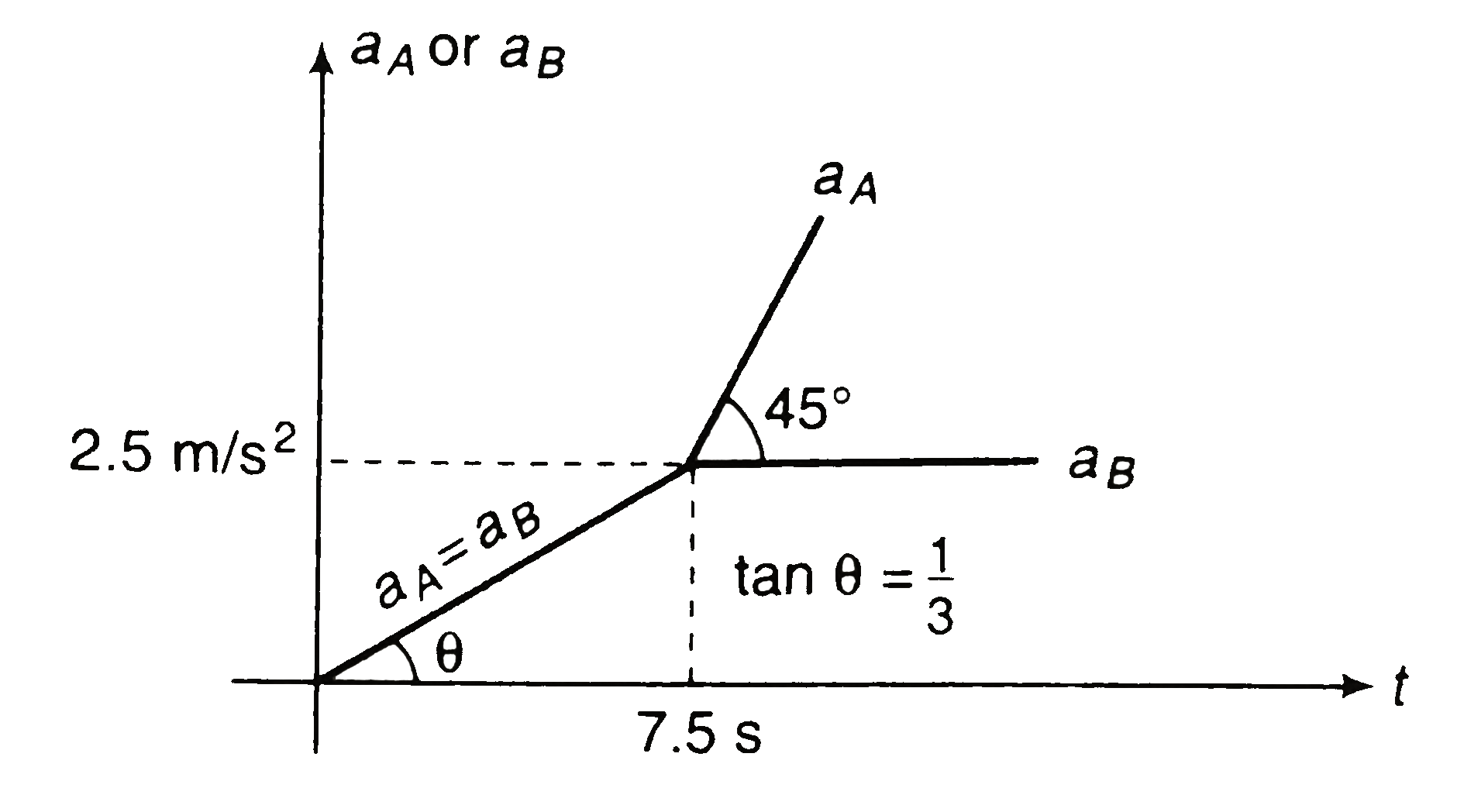
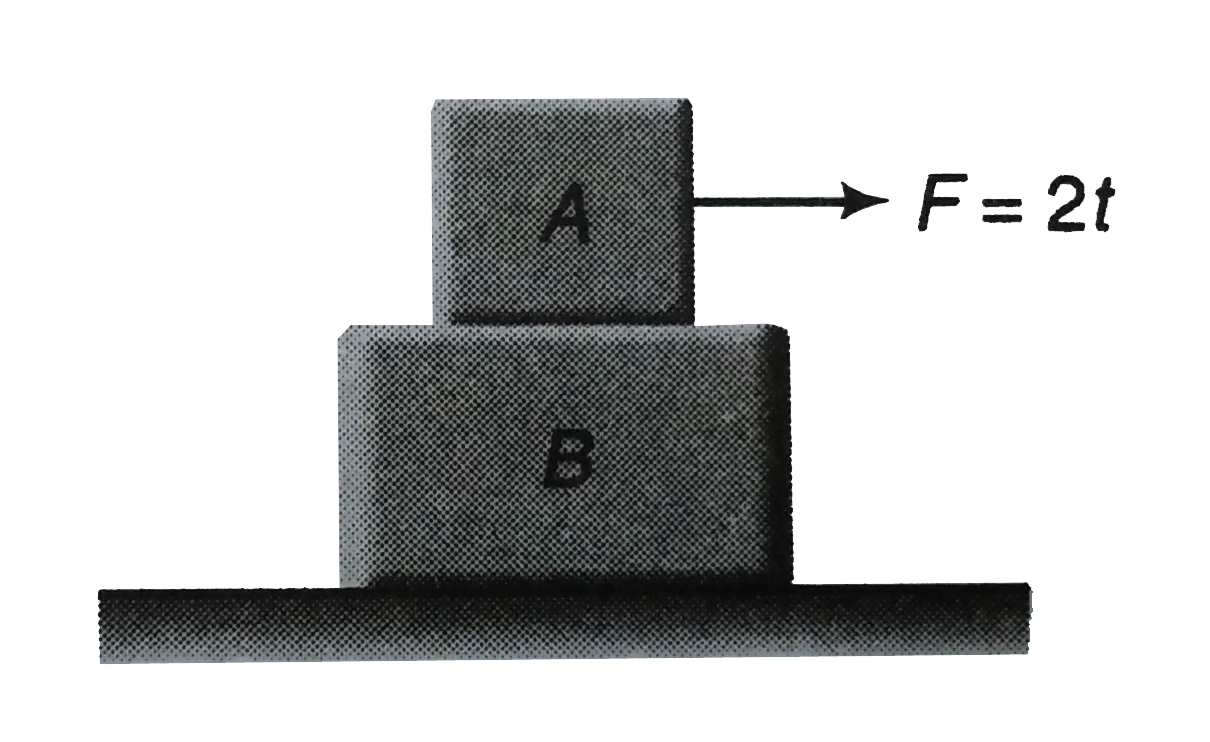
Two blocks `A` and `B` of masses `2kg` and `4kg` are placed one over the other as shown in figure. `A`time varying horizontal force `F =2t` is applied on the upper block as shown in figure. Here `t` is in second and `F` is in newton. Drow a graph showing acceleration of `A` and `B` on y-axis and time on x-axis.Coefficient of friction between `A` and `B` is `mu =(1)/(2)` and the horizontal surface over which `B` is placed smooth. `(g =10m//s^(2))`

Text Solution

Verified by Experts
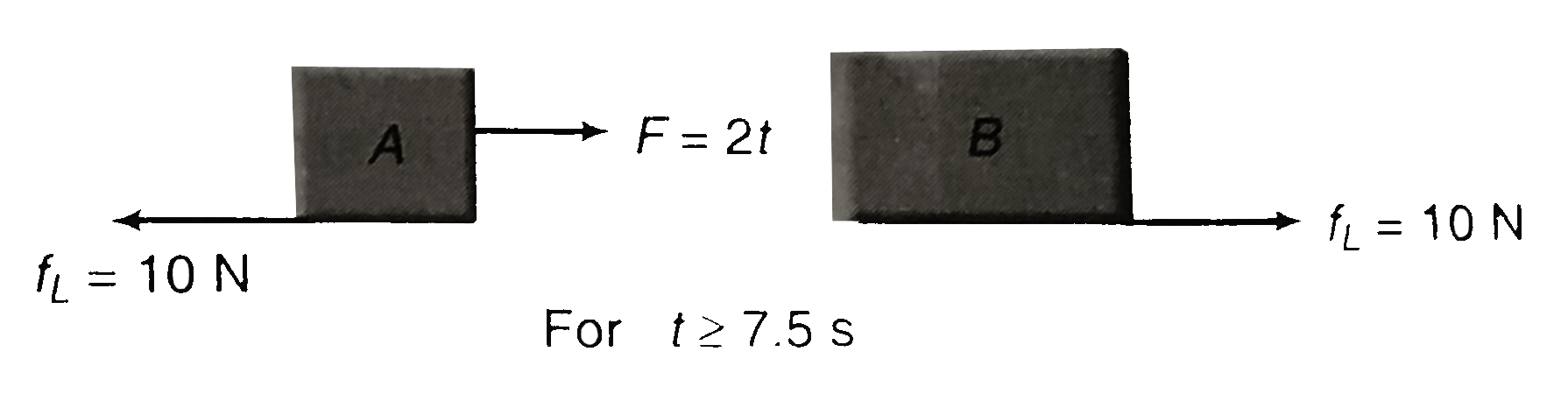
Limiting friction between `A` and `B` is
`f_(1) =mum_(A)g =(1)/(2) (2) (10) =10N`
Block `B` moves due to friction only. Therefore, maximum acceleration of `B` can be
`a_(max) =(f_(L))/(m_(B)) = (10)/(4) =2.5m//s^(2)`
Thus both the blocks move together with same acceleration becomes `25m//s^(2)`, after that acceleration of `B` will become constant while that of `A` will go on increasing. To find the time when the acceleration of both the blocks becomes `25m//s^(2)` (or when slipping will start between `A` and `B`) we will write

`2.5 =(F)/((m_(A)+m_(B)) = (2t)/(6)`
`:. t =7.5_(s)` Hence for `t le7.5_(s)`
`a_(A) =a_(B) = (F)/(m_(A)+m_(B)) = (2t)/(6) =(t)/(3)`
Thus, `a_(A)` versus `t` graph is a straight passing through origin of slop `(1)/(3)`
For, `tge7.5_(s)`
`a_(B) =2.5m//s^(2) = "constant"`
and `a_(A) =(F-f_(L))/(m_(A)`
or `a_(A) =(2t-10)/(2)` or `a_(A) =t-5`

Thus `a-(A)` versus `t` graph is a straight line of slop `1` and intercept`-5`. While `a_(B)` versus `t` graph is a strainght parallel to t-axis. The corresponding graph is as shown in above figure.
Promotional Banner

Topper's Solved these Questions

  • LAWS OF MOTION

    DC PANDEY ENGLISH|Exercise Miscellaneous Examples|9 Videos
  • LAWS OF MOTION

    DC PANDEY ENGLISH|Exercise Exercise 8.1|10 Videos
  • LAWS OF MOTION

    DC PANDEY ENGLISH|Exercise Medical entrances gallery|39 Videos
  • KINEMATICS 1

    DC PANDEY ENGLISH|Exercise INTEGER_TYPE|15 Videos
  • LAWS OF THERMODYNAMICS

    DC PANDEY ENGLISH|Exercise Level 2 Subjective|18 Videos

Similar Questions

Explore conceptually related problems

Two block of masses 2kg and 4kg are released from rest over a smooth inclined place of inclination 30^(@) as shown in figure what is the normal force between the two blocks?

Two blocks of masses 4kg and 2kg are placed side on a smooth horizontal surface as shown in the figure. A horizontal force of 20N is applied on 4kg block. Find (a) the acceleration of each block. (b) the normal reaction between two blocks.

Two blocks of masses 4kg and 2kg are placed side on a smooth horizontal surface as shown in the figure. A horizontal force of 20N is applied on 4kg block. Find (a) the acceleration of each block. (b) the normal reaction between two blocks.

Two blocks of masses m and 2 m are placed one over the other as shown in figure.The coefficient of friction between m and 2m is mu and between 2m and ground is (mu)/(3) . If a horizontal force F is applied on upper block and T is tension developed in string, then choose the incorrect alternative.

Two blocks of mass 2 kg and 4 kg are accelerated with same acceleration by a force 10 N as shown in figure on a smooth horizontal surface. Then the spring force between the two blocks will be (spring is massless)

A force shown in the F-x graph is applied to a 2kg block horizontal as shown in figure. The change in kinetic energy is

Acceleration of block A varies with time as shown in figure the value of coefficient of kinetic friction between block A and B is

Three blocks A , B and C of masses 4kg , 2kg and 1kg respectively are in contact on a frictionless surface, as shown. If a force of 14N is applied on the 4kg block, then the contact force between A and B is.

Three blocks A , B and C of masses 4kg , 2kg and 1kg respectively are in contact on a frictionless surface, as shown. If a force of 14N is applied on the 4kg block, then the contact force between A and B is.

Two blocks of masses 10 kg and 20 kg are connected by a massless string and are placed on a smooth horizontal surface as shown in the figure. If a force F=600 N is applied to 10 kg block, then the tension in the string is