Home
Class 11
PHYSICS
Find the acceleration of the block of ma...

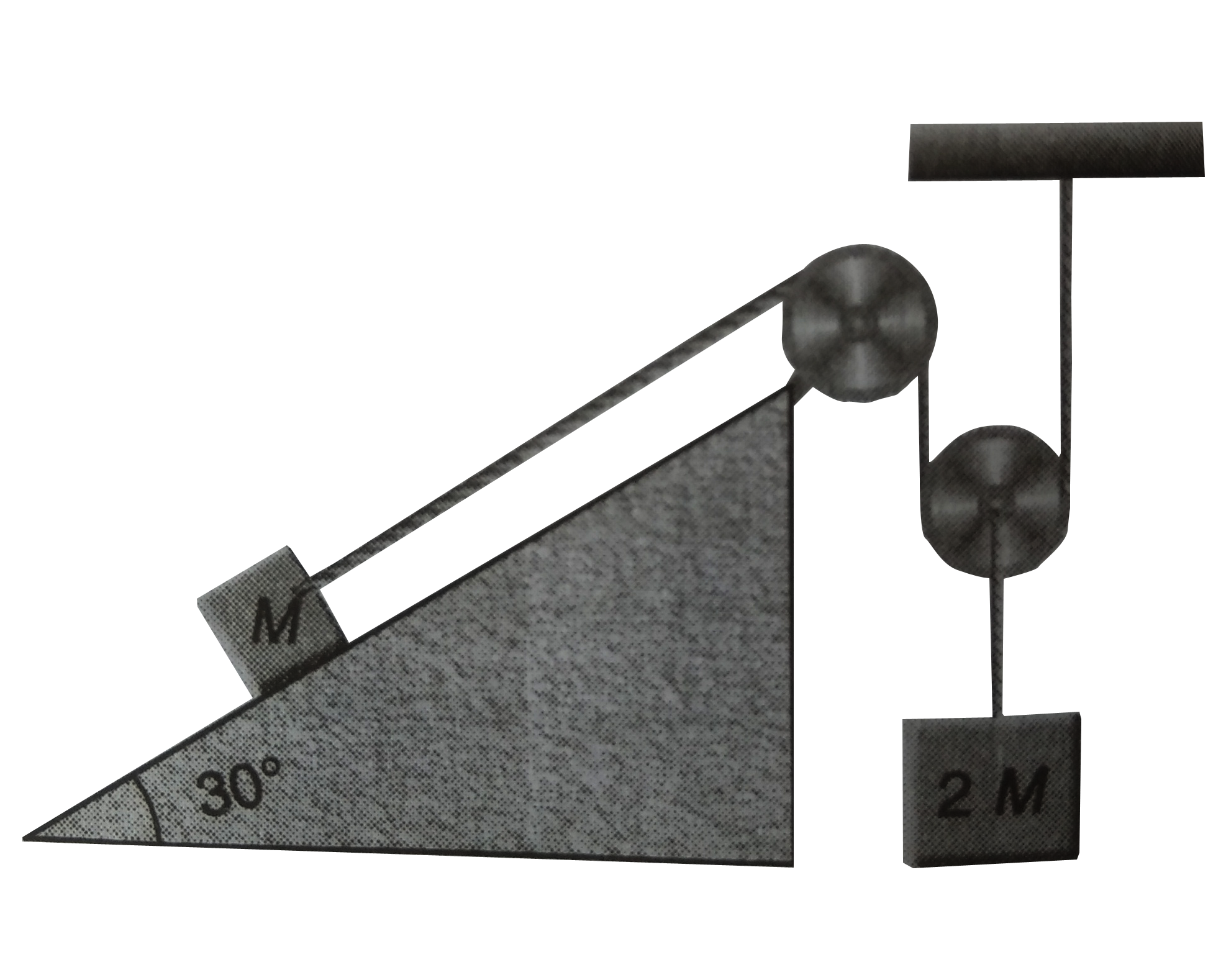
Find the acceleration of the block of mass `M` in the situation shown in figure. All the surfaces are frictionless.

Text Solution

Verified by Experts
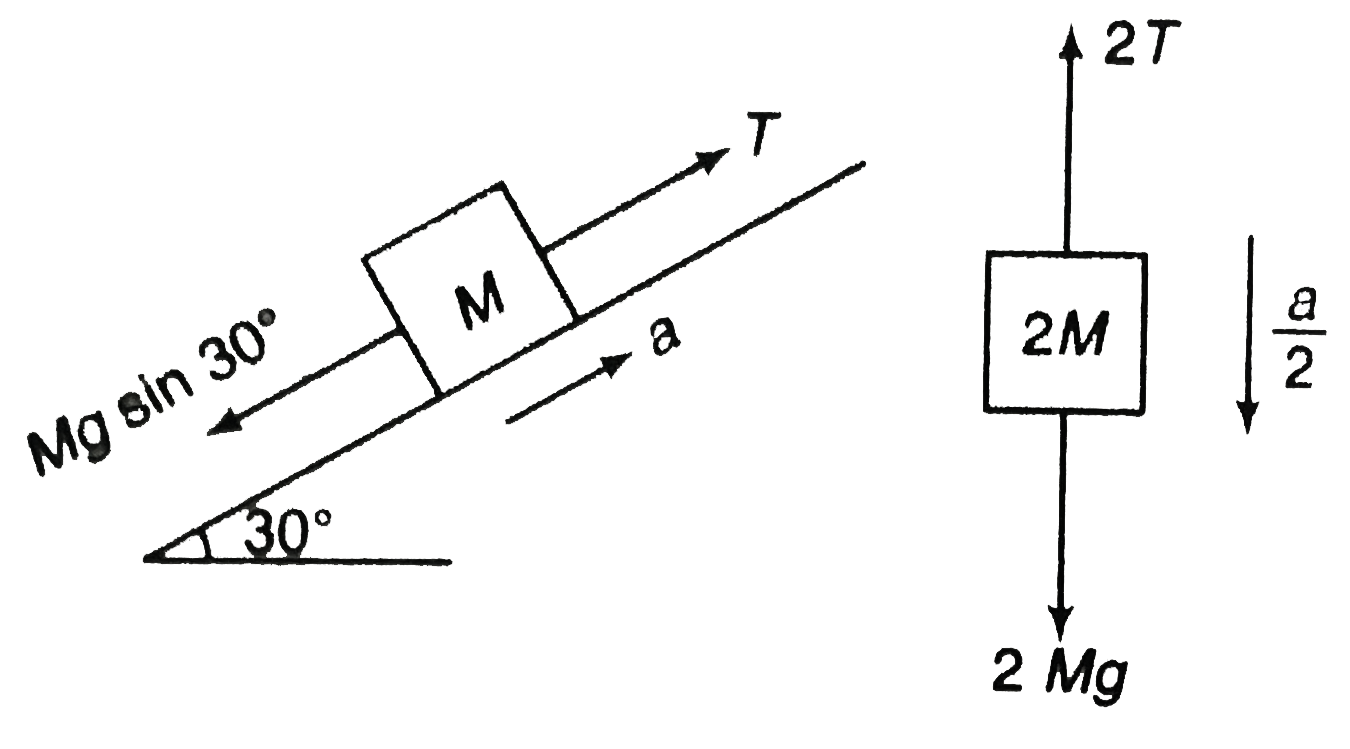
`T - Mg sin 30^(@) = Ma` …(i)
`2Mg - 2T = 2M ((a)/(2))` …(ii)
Solving these equation, we get
`a = (g)/(3)`
Promotional Banner

Topper's Solved these Questions

  • LAWS OF MOTION

    DC PANDEY ENGLISH|Exercise Exercise 8.4|3 Videos
  • LAWS OF MOTION

    DC PANDEY ENGLISH|Exercise Exercise 8.5|2 Videos
  • LAWS OF MOTION

    DC PANDEY ENGLISH|Exercise Exercise 8.2|9 Videos
  • KINEMATICS 1

    DC PANDEY ENGLISH|Exercise INTEGER_TYPE|15 Videos
  • LAWS OF THERMODYNAMICS

    DC PANDEY ENGLISH|Exercise Level 2 Subjective|18 Videos

Similar Questions

Explore conceptually related problems

A block of mass M is placed on the top of a bigger block of mass 10 M as shown in figure. All the surfaces are frictionless. The system is released from rest, then the distance moved by the bigger block at the instant the smaller block reaches the ground :

In the figure shown acceleration of the block is

Three blocks of masses m_1, m_2 and m_3 are connected as shown in the figure. All the surfaces are frictionless and the string and the pulleys are light. Find the acceleration of m_1

Find the acceleration of the 6 kg block in the figure. All the surfaces and pulleys are smooth. Also the strings are inextensible and light. [Take g = 10 m//s^(2) ] .

Find the acceleration of two masses as shown in figure . The pulley are light and frictionless and string are light and frictionless and string are light and inextensible.

Consider the situation shown in the figure. Find acceleration of B.

Consider the situation shown in the figure. Find acceleration of A.

A block of mass m is placed on the inclined sufrace of a wedge as shown in fig. Calculate the acceleration of the wedge and the block when the block is released. Assume all surfaces are frictionless.

A wedge of mass M lies on a smooth fixed wedge of inclination theta . A particle of mass m lies on the wedge of mass M in the figure. All surfaces are frictionless and the distance of the block from the fixed wedge is l . Find. (a) Normal reaction between m and M (b) the time after which the particle will hit the fixed plane.

Figure shows a small block of mass m which is started with a speed v on the horizontal part of the bigger block of mas m placed on a horizontal floor. The curved part of the surface shown is semicircular. All the surfaces are frictionless. Find the speed of the bigger block when the smaller block reaches the point A of the surface.

