Home
Class 11
PHYSICS
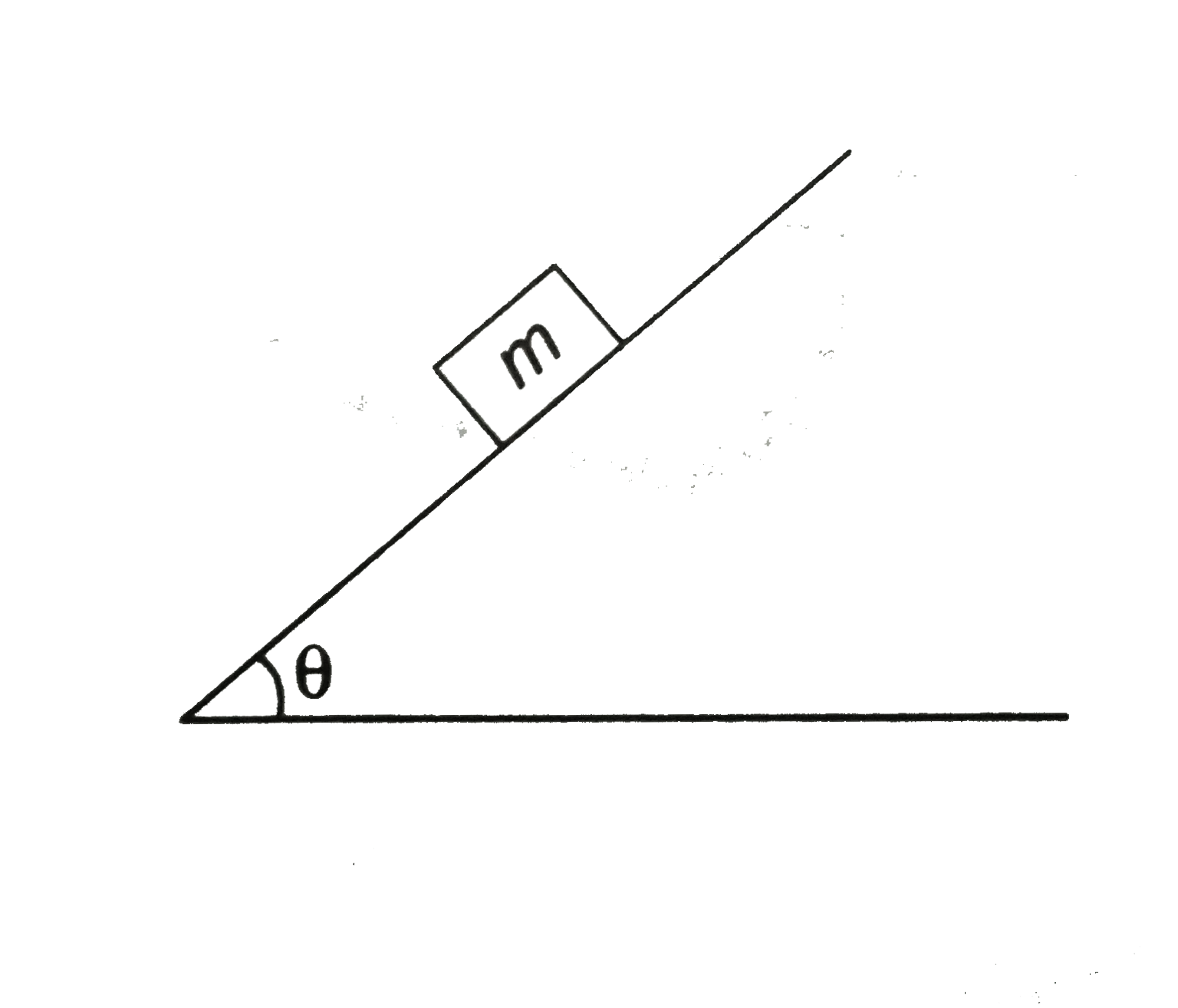
In the figure shown, angle of repose is ...

In the figure shown, angle of repose is `45^(@)`.Find force of friction, net force and acceleration of the block when

(a) `theta = 30^(@)` (b)`theta = 45^(@)` (c)`theta = 60^(@)`

Text Solution

Verified by Experts

If `theta le ` angle of repose , the block is stationary ,
`a = 0, F_("net") = 0` and `f = mg sin theta`,if `theta gt` angle of repose , the block will move ,
`f = mu mg cos theta`
`a = (m g sin theta - mu m g cos theta)/(m)`
`g sin theta - mu g cos theta` and `F_("net") = ma`
further `mu = tan alpha` `(alpha = "angle of repose" = 45^(@)`
`= tan 45^(@) = 1`
Promotional Banner

Topper's Solved these Questions

  • LAWS OF MOTION

    DC PANDEY ENGLISH|Exercise Assertion And Reason|28 Videos
  • LAWS OF MOTION

    DC PANDEY ENGLISH|Exercise Single Correct|90 Videos
  • LAWS OF MOTION

    DC PANDEY ENGLISH|Exercise Exercise 8.4|3 Videos
  • KINEMATICS 1

    DC PANDEY ENGLISH|Exercise INTEGER_TYPE|15 Videos
  • LAWS OF THERMODYNAMICS

    DC PANDEY ENGLISH|Exercise Level 2 Subjective|18 Videos

Similar Questions

Explore conceptually related problems

Acceleration of block 'm' is (theta lt 45^(@))

In the three figure shown, find acceleration of block and force of friction on it in each case.

Find the force of friction acting between both the blocks shown in the figure.

Acceleration of block parallel to plane (if M = 2m, theta = 45, mu = 0.5)

Define angle of friction, angle of repose and obtain the relation for angle of repose (ie., theta _(g) = tan ^(-1) mu).

Find the reference angle theta' for the following angles in standerd position : (a) theta=300^@" (b) "theta=2.3" (c ) " theta=-135^@

In the figure shown, (a) find the force of friction acting on the block. (b) state whether the block will move or not. If yes then with what acceleration?

In the figure shown, (a) find the force of friction acting on the block. (b) state whether the block will move or not. If yes then with what acceleration?

Find the values of theta between 0^(@) and 360^(@) that satisfy the equation sin ( theta + 30^(@)) = 2 cos (45^(@) + theta )

In the figure shown, u=sqrt(6gR)(gtsqrt(5gR)) Find h,v,a_(r),a_(t),T and F_("net") when (a) theta=60^(@) (b) theta=90^(@) (c) theta=180^(@)
