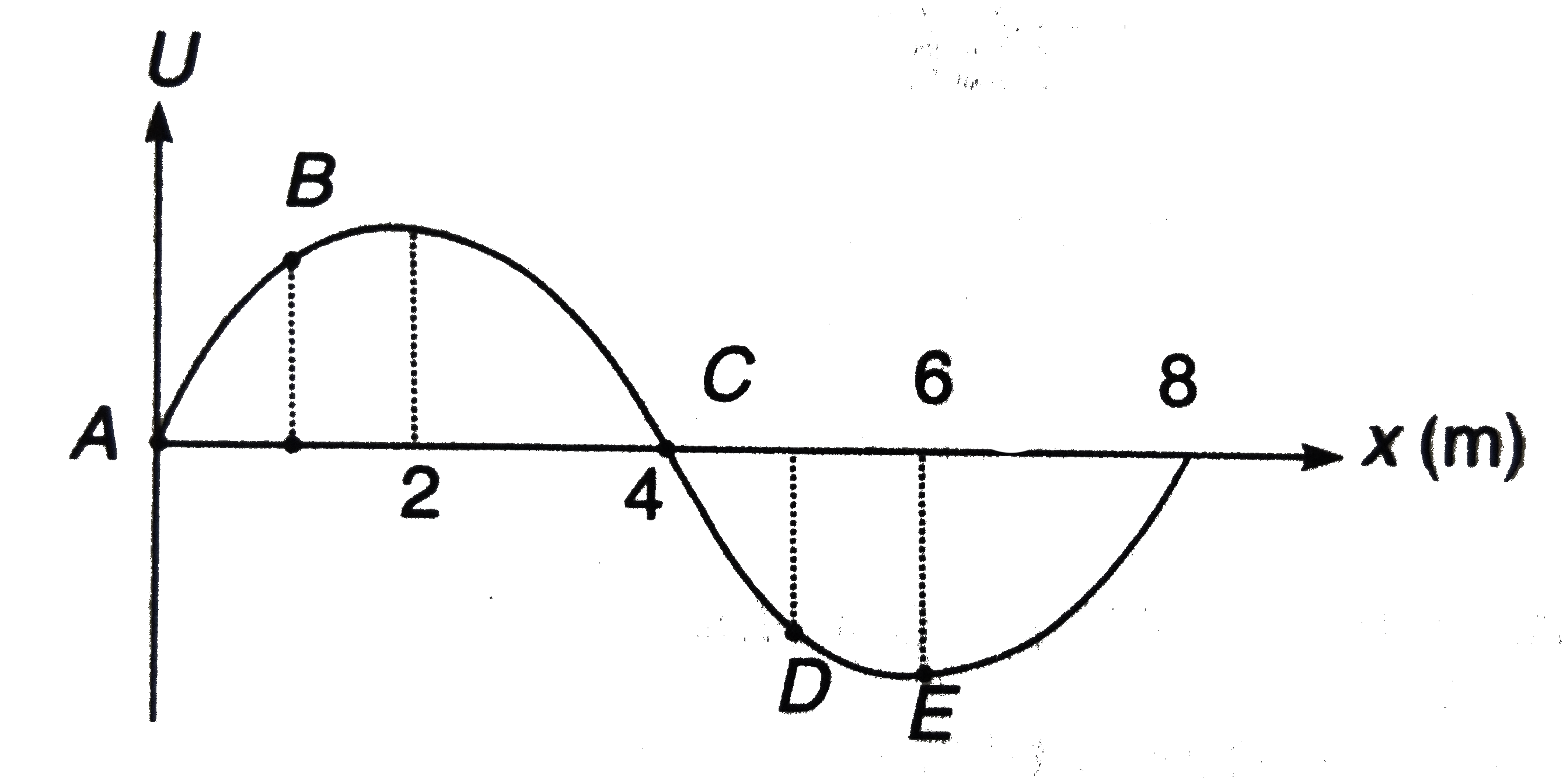
For the potential energy curve shown shown in figure. (a) Find directions of force at points `A, B, C,D` and `E`. (b) Find positions of stable, unstable and neutral equilibriums.
Text Solution
Verified by Experts
(a) `F = - (dU)/(dr)` or `-(dU)/(dx) = -("slope of U-x graph")` (b) At point `x =2m`, potential energy is minimum So. It is stable equilibrium positions. At `x = 2m`, potential energy is maximum. So, it is unstable equilibrium position. Tere is no point, where potential energy is constant. So, we don't have any point of unstable equilibrium position.
Topper's Solved these Questions
WORK, ENERGY & POWER
DC PANDEY ENGLISH|Exercise Solved Examples|12 Videos
WORK, ENERGY & POWER
DC PANDEY ENGLISH|Exercise TYPE2|1 Videos
WAVE MOTION
DC PANDEY ENGLISH|Exercise Integer Type Question|11 Videos
WORK, ENERGY AND POWER
DC PANDEY ENGLISH|Exercise MEDICAL ENTRACES GALLERY|33 Videos
Similar Questions
Explore conceptually related problems
For the potential energy function shown in fig. there will be an unstable equilibrium at position
For the potential energy curve shown in figure. (a) Determine whether the force F_x is positive, negative, or zero at the five points indicated, (b) Indicate points of stable, unstable, and neutral equilibrium, (c) Sketch the curve for F_x versus x from x=0 to x=8m .
Consider the situation shown in the figure. Find acceleration of B.
Find the electrostatic potential energy of the system shown in the figure
Force acting on a particle moving along x-axis as shown in figure. Find points of stable and unstable equlibrium. .
There is a electric circuit as shown in the figure. Find potential difference between points a and b.
Find the potential difference between A and B as shown in the figure
Take the potential of the point B as shown in the figure to be 100 V. (a) Find the potentials at the point c and D. (b) If an uncharged capacitor is connected between C and D, then find the amount of charge that will appear on this capacitor
Potential energy of a particle moving along x-axis is by U=(x^(3)/3-4x + 6) . here, U is in joule and x in metre. Find position of stable and unstable equilibrium.
Find the potential difference V_(a)-V_(b) in the circutis shown in figure
DC PANDEY ENGLISH-WORK, ENERGY & POWER-Level 2 Comprehension Based