Home
Class 11
PHYSICS
A particle free to move along x-axis is ...

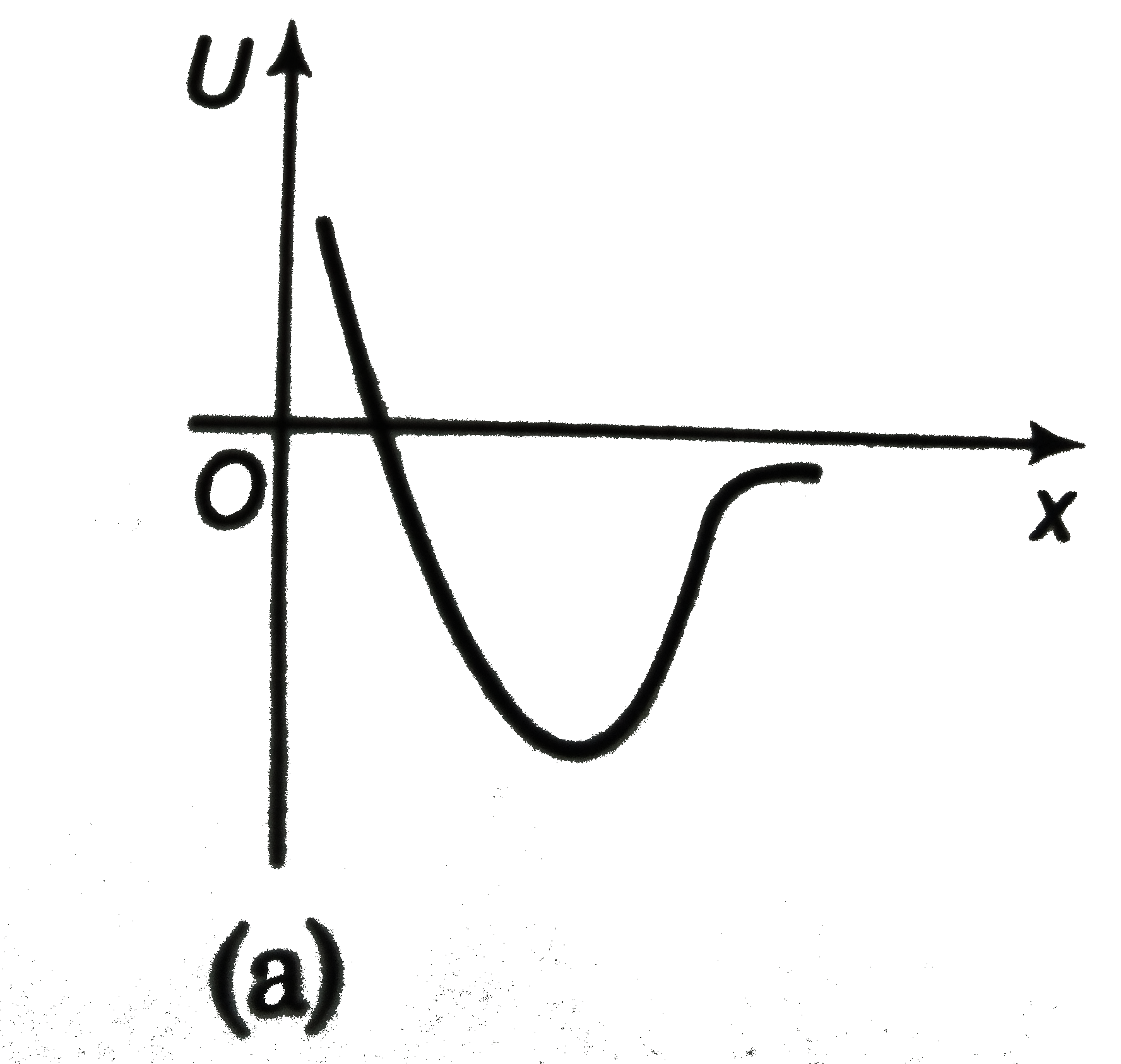
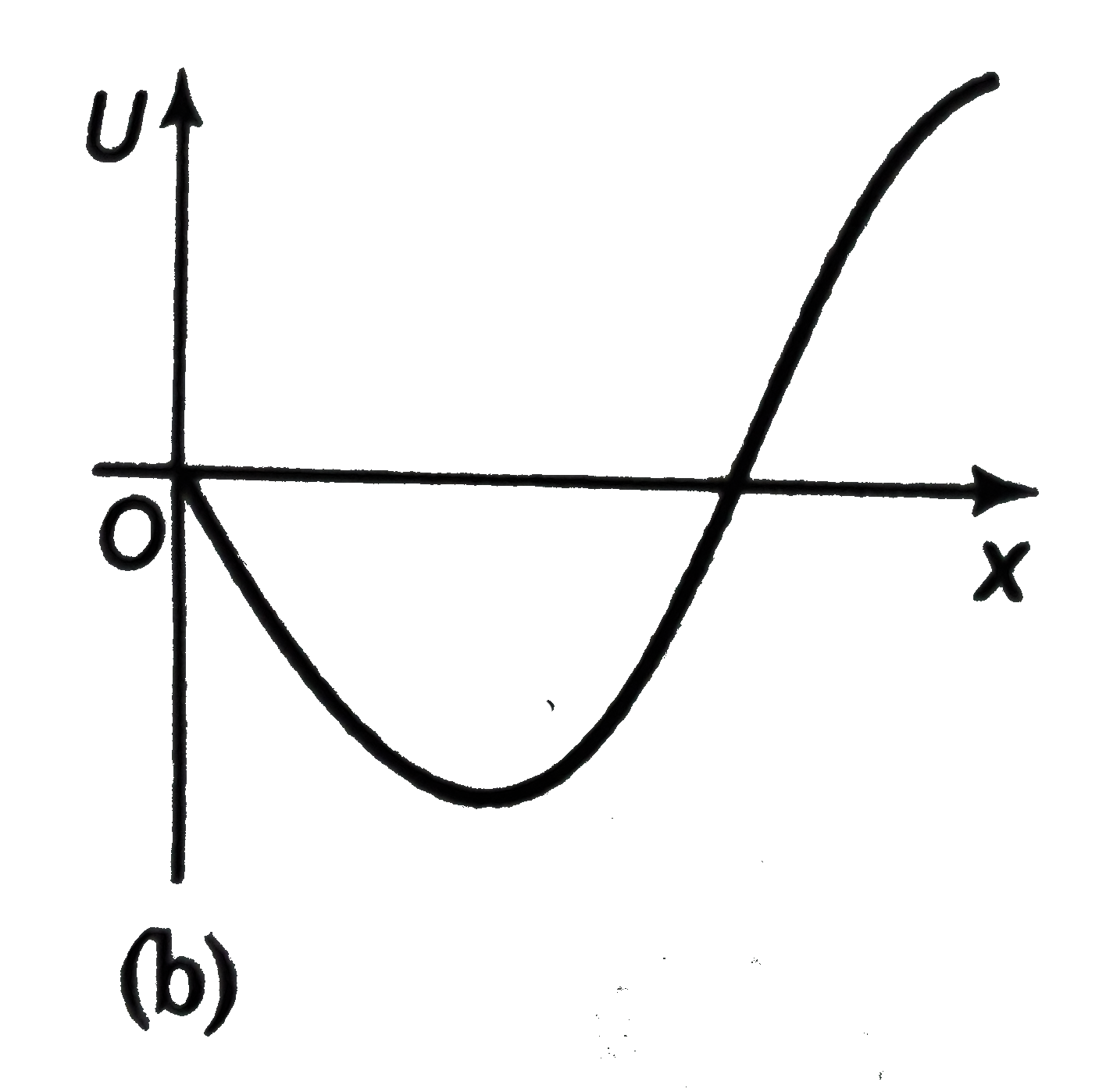
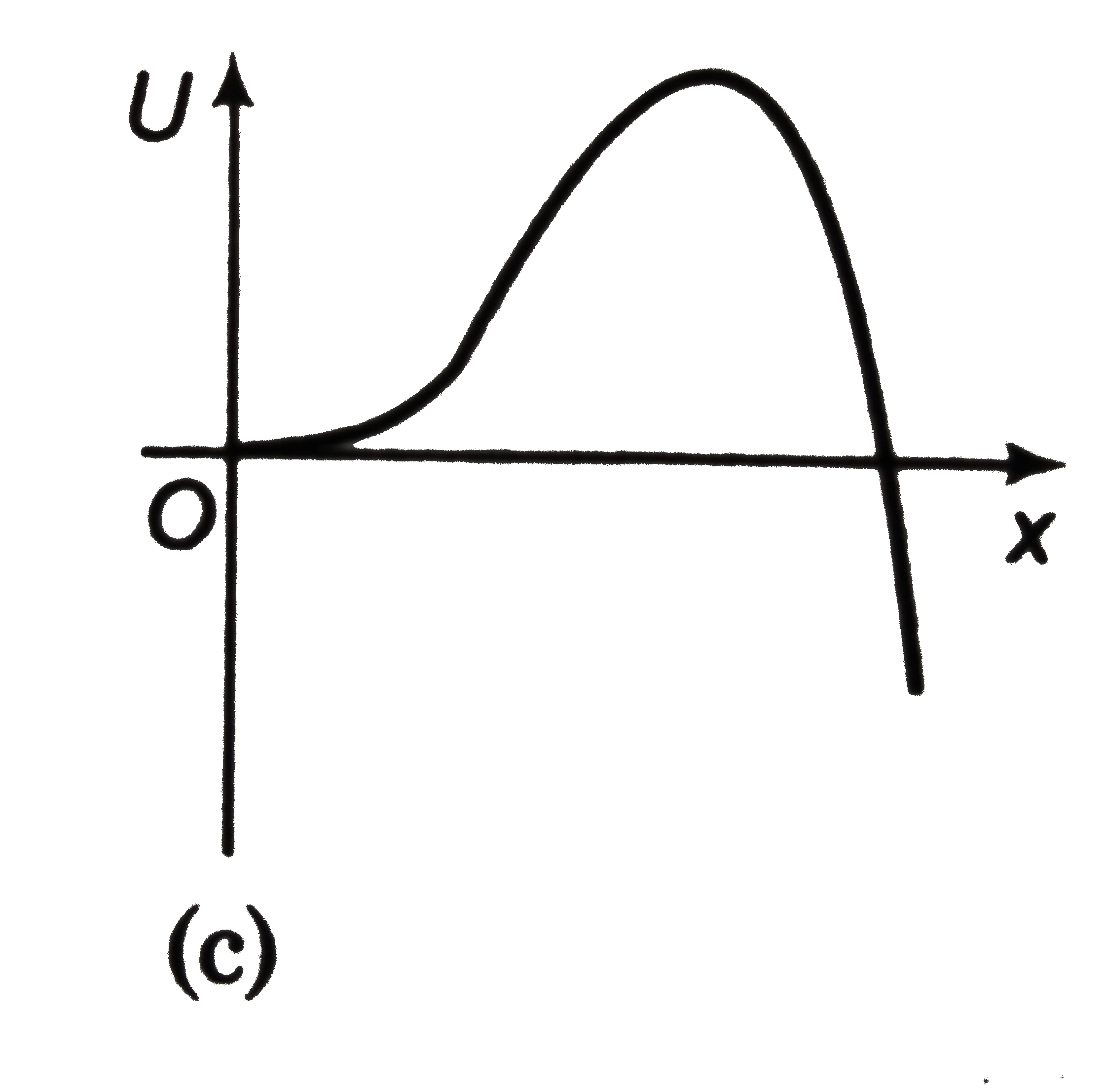
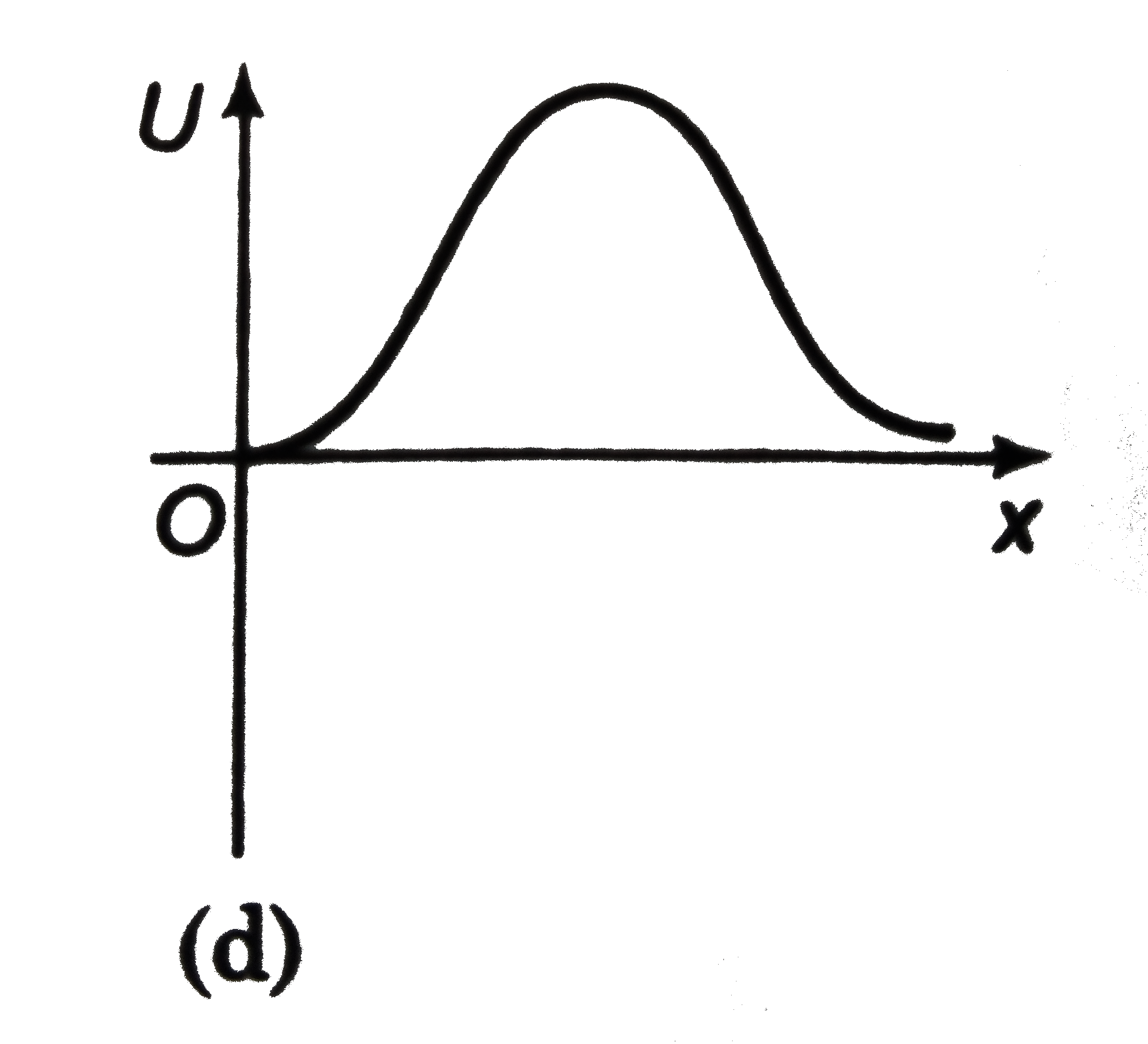
A particle free to move along x-axis is acted upon by a force `F=-ax+bx^(2) whrte a and b are positive constants. `, the correct variation of potential energy function U(x) is best represented by.

A

B

C

D

Text Solution

AI Generated Solution

The correct Answer is:

To solve the problem, we need to find the potential energy function \( U(x) \) corresponding to the given force \( F(x) = -ax + bx^2 \). The relationship between force and potential energy is given by: \[ F = -\frac{dU}{dx} \] ### Step 1: Write the expression for potential energy From the relationship above, we can express the change in potential energy as: \[ dU = -F \, dx \] Substituting the expression for \( F \): \[ dU = -(-ax + bx^2) \, dx = (ax - bx^2) \, dx \] ### Step 2: Integrate to find \( U(x) \) Now, we integrate to find the total potential energy \( U(x) \): \[ U(x) = \int (ax - bx^2) \, dx \] Calculating the integral: \[ U(x) = \int ax \, dx - \int bx^2 \, dx \] \[ U(x) = \frac{a}{2} x^2 - \frac{b}{3} x^3 + C \] Where \( C \) is the constant of integration. ### Step 3: Determine the points where \( U(x) = 0 \) To find the points where the potential energy is zero, we set \( U(x) = 0 \): \[ \frac{a}{2} x^2 - \frac{b}{3} x^3 + C = 0 \] Assuming \( C = 0 \) for simplicity (we can choose the reference point for potential energy), we have: \[ \frac{a}{2} x^2 - \frac{b}{3} x^3 = 0 \] Factoring out \( x^2 \): \[ x^2 \left( \frac{a}{2} - \frac{b}{3} x \right) = 0 \] This gives us two solutions: 1. \( x = 0 \) 2. \( \frac{a}{2} - \frac{b}{3} x = 0 \) which leads to \( x = \frac{3a}{2b} \) ### Step 4: Analyze the behavior of \( U(x) \) - At \( x = 0 \), \( U(0) = 0 \). - As \( x \) increases from 0, the term \( \frac{a}{2} x^2 \) dominates initially, making \( U(x) \) positive. - As \( x \) continues to increase, the \( -\frac{b}{3} x^3 \) term will eventually dominate, causing \( U(x) \) to decrease and become negative after reaching a maximum. ### Step 5: Determine the correct graph Given the behavior of \( U(x) \): - It starts at 0 when \( x = 0 \). - It increases to a maximum and then decreases, eventually becoming negative. Thus, the correct representation of the potential energy function \( U(x) \) is best represented by option C, which shows the potential energy starting at zero, increasing, reaching a maximum, and then decreasing through zero into negative values. ### Summary of Steps: 1. Write the expression for potential energy using the force. 2. Integrate to find the potential energy function. 3. Set the potential energy function to zero to find critical points. 4. Analyze the behavior of the potential energy function. 5. Identify the correct graph representation.

To solve the problem, we need to find the potential energy function \( U(x) \) corresponding to the given force \( F(x) = -ax + bx^2 \). The relationship between force and potential energy is given by: \[ F = -\frac{dU}{dx} \] ### Step 1: Write the expression for potential energy From the relationship above, we can express the change in potential energy as: ...
Promotional Banner

Topper's Solved these Questions

  • WORK, ENERGY & POWER

    DC PANDEY ENGLISH|Exercise Level 2 More Than One Correct|9 Videos
  • WORK, ENERGY & POWER

    DC PANDEY ENGLISH|Exercise Level 2 Subjective|15 Videos
  • WORK, ENERGY & POWER

    DC PANDEY ENGLISH|Exercise Level 1 subjective|27 Videos
  • WAVE MOTION

    DC PANDEY ENGLISH|Exercise Integer Type Question|11 Videos
  • WORK, ENERGY AND POWER

    DC PANDEY ENGLISH|Exercise MEDICAL ENTRACES GALLERY|33 Videos

Similar Questions

Explore conceptually related problems

On a particle placed at origin a variable force F=-ax (where a is a positive constant) is applied. If U(0)=0, the graph between potential energy of particle U(x) and x is best represented by:-

A particle of mass m moving along x-axis has a potential energy U(x)=a+bx^2 where a and b are positive constant. It will execute simple harmonic motion with a frequency determined by the value of

A particle of mass m moving along x-axis has a potential energy U(x)=a+bx^2 where a and b are positive constant. It will execute simple harmonic motion with a frequency determined by the value of

A particle, which is constrained to move along x-axis, is subjected to a force in the some direction which varies with the distance x of the particle from the origin an F (x) =-kx + ax^(3) . Here, k and a are positive constants. For x(ge0, the functional form of the potential energy (u) U of the U (x) the particle is. (a) , (b) , (c) , (d) .

A particle moving along the x axis is acted upon by a single force F = F_0 e^(-kx) , where F_0 and k are constants. The particle is released from rest at x = 0. It will attain a maximum kinetic energy of :

A particle of mass m moves in a one dimensional potential energy U(x)=-ax^2+bx^4 , where a and b are positive constant. The angular frequency of small oscillation about the minima of the potential energy is equal to

A particle is acted by x force F = Kx where K is a( + ve) constant its potential energy at x = 0 is zero . Which curve correctly represent the variation of potential energy of the block with respect to x

Two identical positive charges are placed at x=-a and x=a . The correct variation of potential V along the x-axis is given by

For a body moving with uniform acceleration along straight line, the variation of its velocity (v) with position (x) is best represented by

A particle of unit mass is moving along x-axis. The velocity of particle varies with position x as v(x). =alphax^-beta (where alpha and beta are positive constants and x>0 ). The acceleration of the particle as a function of x is given as

DC PANDEY ENGLISH-WORK, ENERGY & POWER-Level 2 Objective
  1. A block of mass m is attached to one end of a mass less spring of spri...

    Text Solution

    |

  2. A block of mass (m) slides along the track with kinetic friction mu. A...

    Text Solution

    |

  3. The potential energy phi in joule of a particle of mass 1 kg moving in...

    Text Solution

    |

  4. The force acting on a body moving along x-axis variation of the partic...

    Text Solution

    |

  5. A small mass slides down an inclined plane of inclination theta with t...

    Text Solution

    |

  6. Two light vertical springs with equal natural length and spring consta...

    Text Solution

    |

  7. A block of mass 1kg slides down a curved track which forms one quadran...

    Text Solution

    |

  8. The potential energy function for a diatomic molecule is U(x) =(a)/(x^...

    Text Solution

    |

  9. A rod mass (M) hinged at (O) is kept in equilibrium with a spring of s...

    Text Solution

    |

  10. In the figure. (m2) (< m(1)) are joined together by a pulley. When the...

    Text Solution

    |

  11. A particle free to move along x-axis is acted upon by a force F=-ax+b...

    Text Solution

    |

  12. Equal net forces act on two different block (A) and (B) masses (m) and...

    Text Solution

    |

  13. The potential energy function of a particle in the x-y plane is given ...

    Text Solution

    |

  14. A vertical spring is fixed to one of its end and a massless plank plan...

    Text Solution

    |

  15. A uniform chain of length of length pir lies inside a smooth semicircu...

    Text Solution

    |

  16. A block of mass m is connected to a spring of force constant k. Initia...

    Text Solution

    |

  17. Two blocks are connected to an ideal spring of stiffness 200 N//m. At ...

    Text Solution

    |

  18. A block (A) of mass 45kg is placed on another block (B) of mass 123 kg...

    Text Solution

    |

  19. A block of mass 10 kg is released on a fixed wedge inside a cart which...

    Text Solution

    |

  20. A block tied between identical springs is in equilibrium. If upper spr...

    Text Solution

    |
