Home
Class 11
PHYSICS
A block (A) of mass 45kg is placed on an...

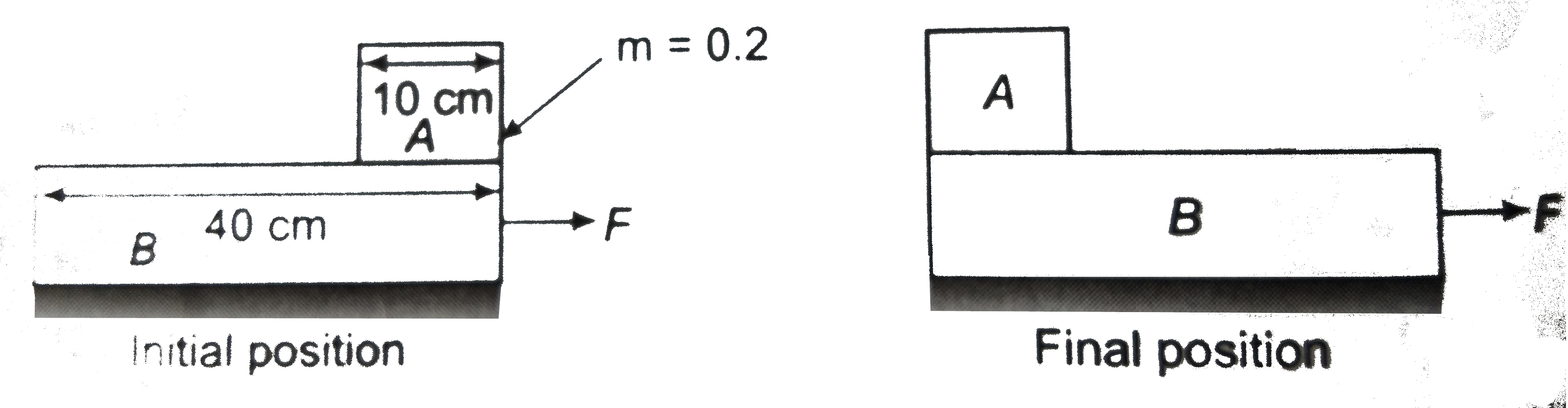
A block (A) of mass `45kg` is placed on another block (B) of mass `123 kg`. Now block (B) is displaced by external agent by `50 cm` horizontally towards right. During the same time block (A) just reaches to the left end of block (B), Initial and final positions are shown in figures . the work done on block (A) in ground frame is
,

A

`-18 J`

B

`18 J`

C

`36 J`

D

`-36 J`.

Text Solution

Verified by Experts

The correct Answer is:
B

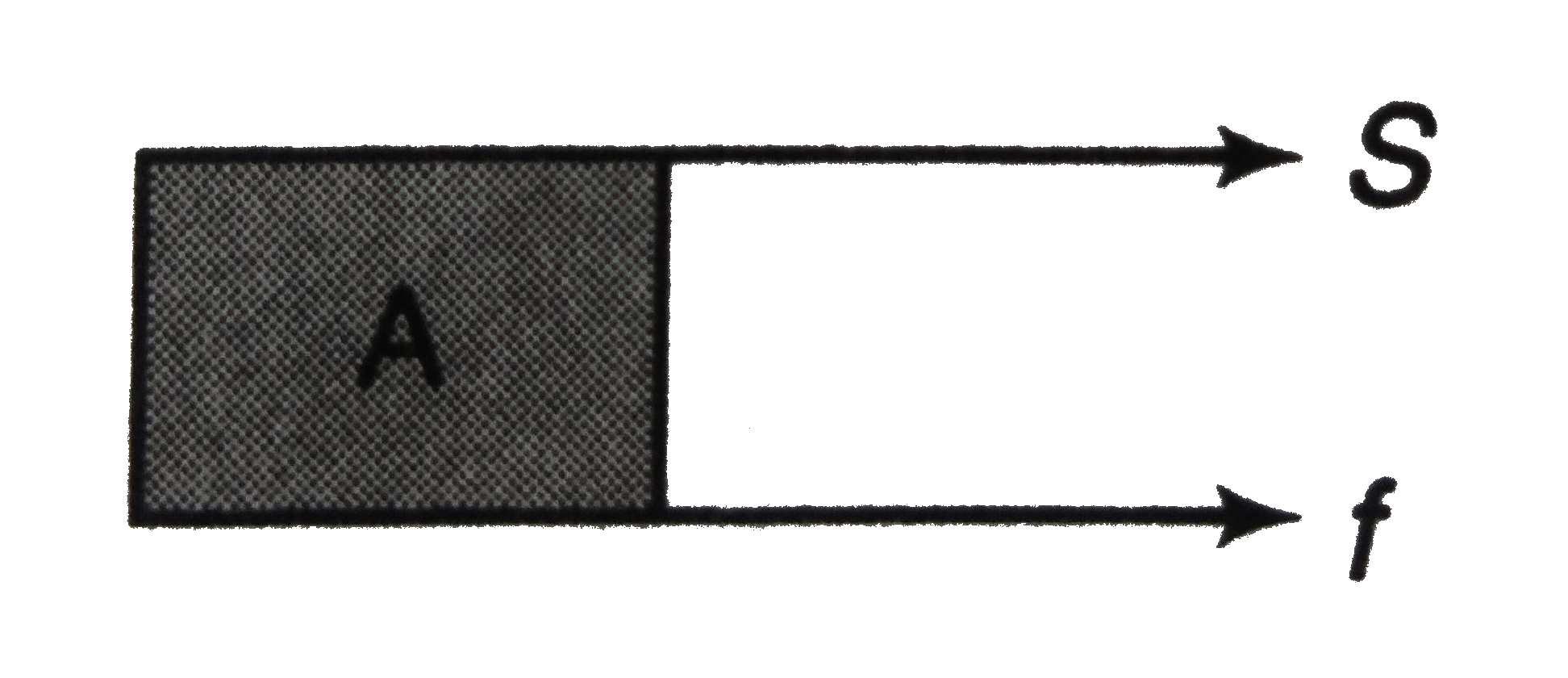
There is slip, so maximum friction will act on A the direction of motion (or towards right)

`f-mu mg=0.2xx45xx10 =90 N`
`S=40-10-10=20 cm =0.2`
`W=fS =18 J`.
Promotional Banner

Topper's Solved these Questions

  • WORK, ENERGY & POWER

    DC PANDEY ENGLISH|Exercise Level 2 More Than One Correct|9 Videos
  • WORK, ENERGY & POWER

    DC PANDEY ENGLISH|Exercise Level 2 Subjective|15 Videos
  • WORK, ENERGY & POWER

    DC PANDEY ENGLISH|Exercise Level 1 subjective|27 Videos
  • WAVE MOTION

    DC PANDEY ENGLISH|Exercise Integer Type Question|11 Videos
  • WORK, ENERGY AND POWER

    DC PANDEY ENGLISH|Exercise MEDICAL ENTRACES GALLERY|33 Videos

Similar Questions

Explore conceptually related problems

Block A of mass 1 kg is placed on the rough surface of block B of mass 3 kg . Block B is placed on smooth horizontal surface. Blocks are given the velocities as shown. Find net work done by the frictional force. [in (-) ve J ]. .

A block A of mass 2 kg is placed over smooth block B of mass 4 kg which is placed over a smooth horizontal floor The coefficient of friction between A and B is 0.4 when a horizontal forces of magnitude 10 N is applied on A the acceleration of block of A and B are

Block A of mass 3 kg is placed on another block B of mass 5 kg placed on the smooth surface. If coefficient of friction between two blocks is 1/2 and 32 N force is applied on block B as shown in the figure, then the work done by the frictional force on block A in first two second will be (initial velocity of the system is zero and g = 10 m/s^2 )

A block of mass 1 kg is placed on a horizontal surface . The reaction force to the weight of the block is

A block of mass 1 kg is pushed towards another block of mass 2 kg from 6 m distance as shown in figure. Just after colision velocity of 2 kg block becomes 4 m//s .

A block A of mass 4 kg is placed on another block B of mass 5 kg and the block rests on a smooth horizontal table. For sliding the block A on B, a horizontal force of 12 N is required to be applied on it. The maximum horizontal force that can be applied on B so that both A and B move together and the acceleration produced by this force is

A block of mass 2 kg is pulled along circular arc from position X to Y as shown in figure. The work done by the horizontal force is pulling the block from X to Y is

A small block B of mass m_2 is placed on another block A of mass m_1 A constant horizontal force F is applied to the block A. All the surfaces are assumed to be frictionless. Find the acceleration of center of mass of the system

A block of mass m is released from a wedge of mass m as shown in figure . Find the time taken by the block to reach the end of the wedge.

A small block B is placed on another block A of mass 5 kg and length 20 cm. Initially, the block B is near the right end of block A. A constant horizontal force of 10 N is applied to the block A. All the surfaces are assumed frictionless. Find the time elapsed before the block B separates from A.

DC PANDEY ENGLISH-WORK, ENERGY & POWER-Level 2 Objective
  1. A block of mass m is attached to one end of a mass less spring of spri...

    Text Solution

    |

  2. A block of mass (m) slides along the track with kinetic friction mu. A...

    Text Solution

    |

  3. The potential energy phi in joule of a particle of mass 1 kg moving in...

    Text Solution

    |

  4. The force acting on a body moving along x-axis variation of the partic...

    Text Solution

    |

  5. A small mass slides down an inclined plane of inclination theta with t...

    Text Solution

    |

  6. Two light vertical springs with equal natural length and spring consta...

    Text Solution

    |

  7. A block of mass 1kg slides down a curved track which forms one quadran...

    Text Solution

    |

  8. The potential energy function for a diatomic molecule is U(x) =(a)/(x^...

    Text Solution

    |

  9. A rod mass (M) hinged at (O) is kept in equilibrium with a spring of s...

    Text Solution

    |

  10. In the figure. (m2) (< m(1)) are joined together by a pulley. When the...

    Text Solution

    |

  11. A particle free to move along x-axis is acted upon by a force F=-ax+b...

    Text Solution

    |

  12. Equal net forces act on two different block (A) and (B) masses (m) and...

    Text Solution

    |

  13. The potential energy function of a particle in the x-y plane is given ...

    Text Solution

    |

  14. A vertical spring is fixed to one of its end and a massless plank plan...

    Text Solution

    |

  15. A uniform chain of length of length pir lies inside a smooth semicircu...

    Text Solution

    |

  16. A block of mass m is connected to a spring of force constant k. Initia...

    Text Solution

    |

  17. Two blocks are connected to an ideal spring of stiffness 200 N//m. At ...

    Text Solution

    |

  18. A block (A) of mass 45kg is placed on another block (B) of mass 123 kg...

    Text Solution

    |

  19. A block of mass 10 kg is released on a fixed wedge inside a cart which...

    Text Solution

    |

  20. A block tied between identical springs is in equilibrium. If upper spr...

    Text Solution

    |

