Home
Class 11
PHYSICS
In the adjoining figure, block A is of m...

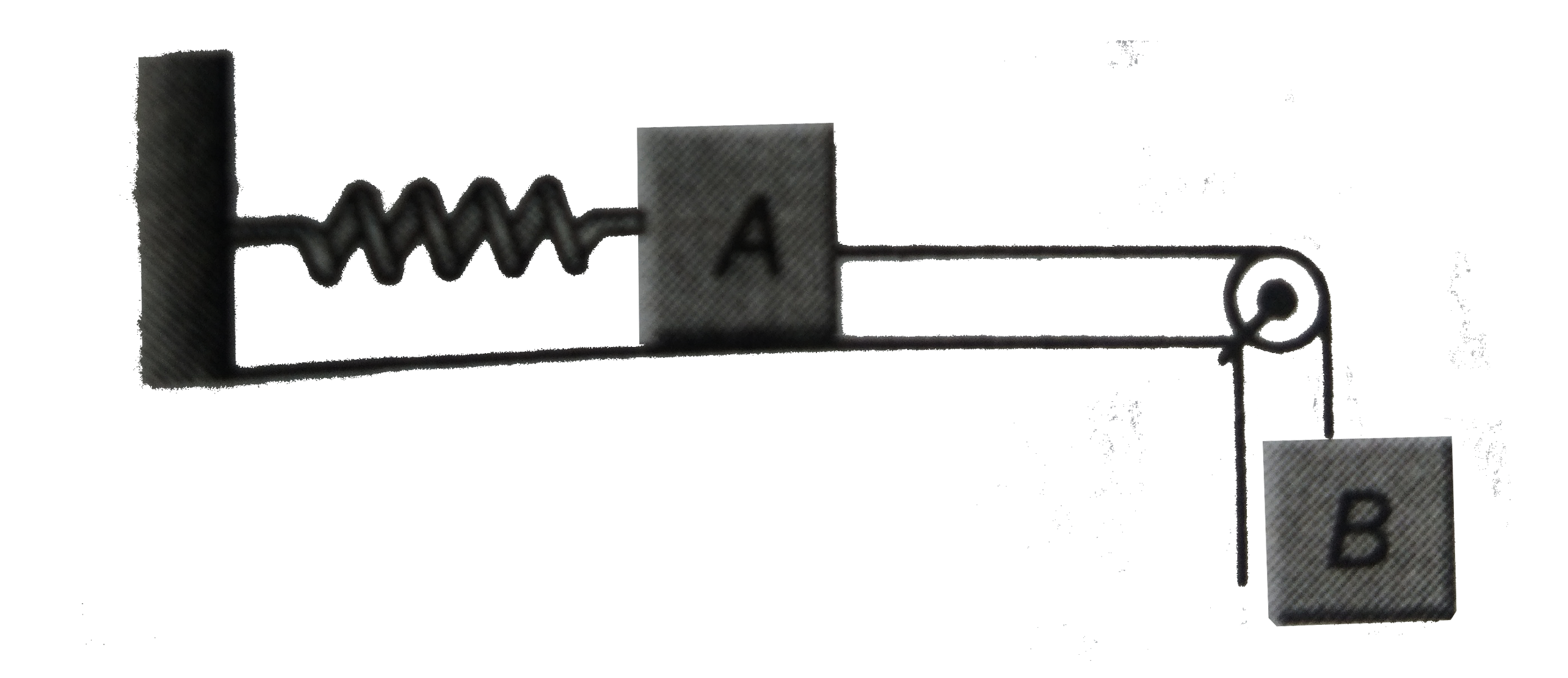
In the adjoining figure, block A is of mass (m) and block B is of mass2 m. The spring has force constant k. All the surfaces are smooth and the system is released form rest with spring unstretched.
.

A

The maximum extension of the spring is `(4mg)/k`.

B

The speed of A when extension in spring is `(2mg)/k` is `2g sqrt((2m)/(3k))`.

C

The acceleration of block B when the extension in the spring is maximum, is `2/3g`

D

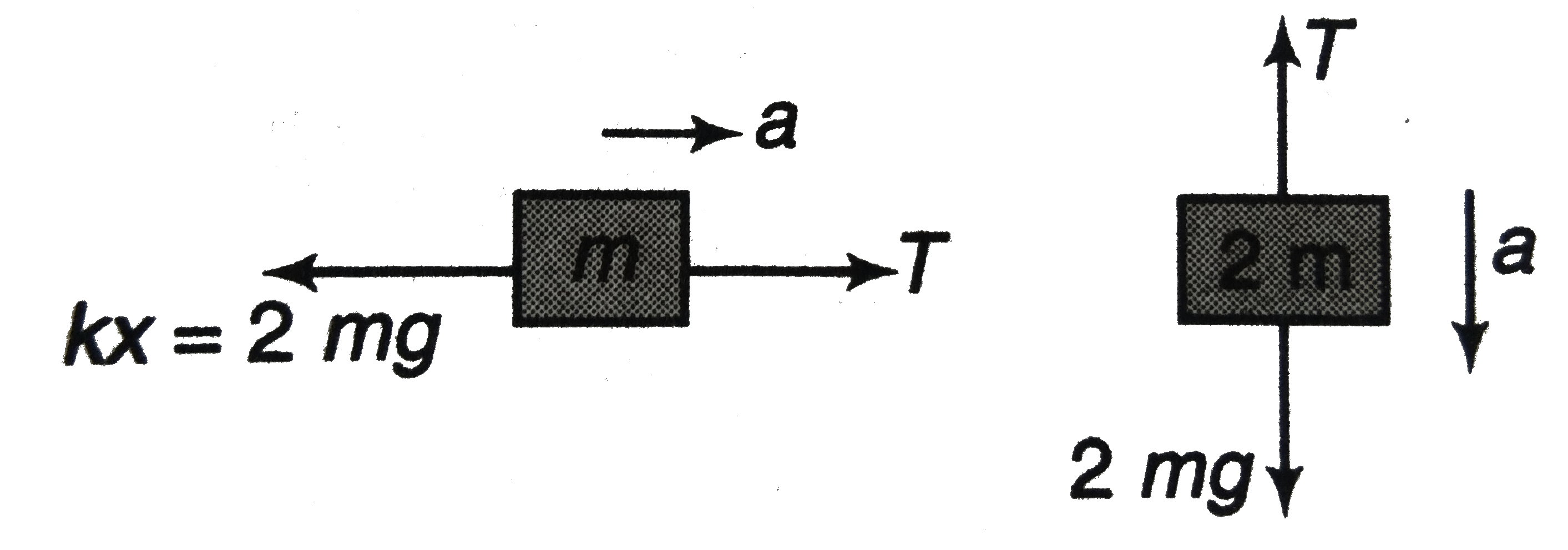
Tension in the thread for extension of `(2mg)/(k)` in spring is `mg`

Text Solution

Verified by Experts

The correct Answer is:
A

(a) Decrease in potential energy of `B=` increase in spring potential
`:. 2mg x_(m)=1/2kx_(m)^(2)`
`:. x_(m)(4mg)/k`
(b) `E_(i) =E_(f)`
`0=1/2(m+2m) v^(2) + 1/2 xxk xx((2mg)/k)^(2)`
`-(2mg)((2mg)/k)`
`:. v=2gsqrt((m)/(3k))`
(c) `a=(kx_(m)-2mg)/(2m) ("upwards")`
`=(k(4mg/k)-2mg)/(2m)=g`
(d)`T-2mg =ma`....(i)
`2mg-T =2mg`......(ii)
Solving these two equations, we get
`a=0` and `T =2mg`
.
Promotional Banner

Topper's Solved these Questions

  • WORK, ENERGY & POWER

    DC PANDEY ENGLISH|Exercise Level 2 Subjective|15 Videos
  • WORK, ENERGY & POWER

    DC PANDEY ENGLISH|Exercise Level 2 Comprehension Based|2 Videos
  • WORK, ENERGY & POWER

    DC PANDEY ENGLISH|Exercise Level 2 Objective|30 Videos
  • WAVE MOTION

    DC PANDEY ENGLISH|Exercise Integer Type Question|11 Videos
  • WORK, ENERGY AND POWER

    DC PANDEY ENGLISH|Exercise MEDICAL ENTRACES GALLERY|33 Videos

Similar Questions

Explore conceptually related problems

In the adjoining figure, block A is of mass (m) and block B is of mass 2m. The spring has force constant k. All the surfaces are smooth and the system is released form rest with spring unstretched. Find the maximum extension in the spring and acceleration of block B at time of maximum extension .

Consider the situation shown in figure. Mass of block A is m and that of blcok B is 2m. The force constant of string is k. Friction is absent everywhere. System is released from rest with the spring unstretched. Find (a) The maximum extension of the spring x_(m) (b) The speed of block A when the extension in the springt is x=(x_(m))/(2) (c ) The net acceleration of block B when extension in the spring is x=(x_(m))/(4).

A block of mass m is placed at rest on a smooth wedge of mass M placed at rest on a smooth horizontal surface. As the system is released

A block of mass m is suspended by different springs of force constant shown in figure.

A block of mass 'm' is connected to another block of mass 'M' by a spring (massless) of spring constant 'k' The blocks are kept on a smooth horizontal plane. Initially the blocks are at rest and the spring is unstretched Then a constant force 'F' starts acting on the block of mass 'M' to pull it. Find the force on the block of mass 'm' :

A block of mass m is connect to another block of mass M by a massless spring of spring constant k. The blocks are kept on a smooth horizontal plane. Initially the blocks are at rest and the spring is upstretched when a constant force F starts acting on the block of mass M to pull it. Find the maximum extension of the spring.

A block of mass m is connect to another block of mass M by a massless spring of spring constant k. The blocks are kept on a smooth horizontal plane. Initially the blocks are at rest and the spring is unsrtretched when a constnt force F starts acting on the block of mass M to pull it. Find the maximum extension of the spring.

A block of mass m attached in the lower and vertical spring The spring is hung from a calling and force constant value k The mass is released from rest with the spring initially unstreched The maximum value of extension produced in the length of the spring will be

In the system as shown in figure, the blocks have masses m_(1) and m_(2) , the spring constant is k, coefficient of friction between the block of mass m_(1) and the surface is mu . The system is released with zero initial speed from the position where the spring is in its natural length.

A block of mass M is placed on the top of a bigger block of mass 10 M as shown in figure. All the surfaces are frictionless. The system is released from rest, then the distance moved by the bigger block at the instant the smaller block reaches the ground :

