Home
Class 11
PHYSICS
Find the speed of both the blocks at the...

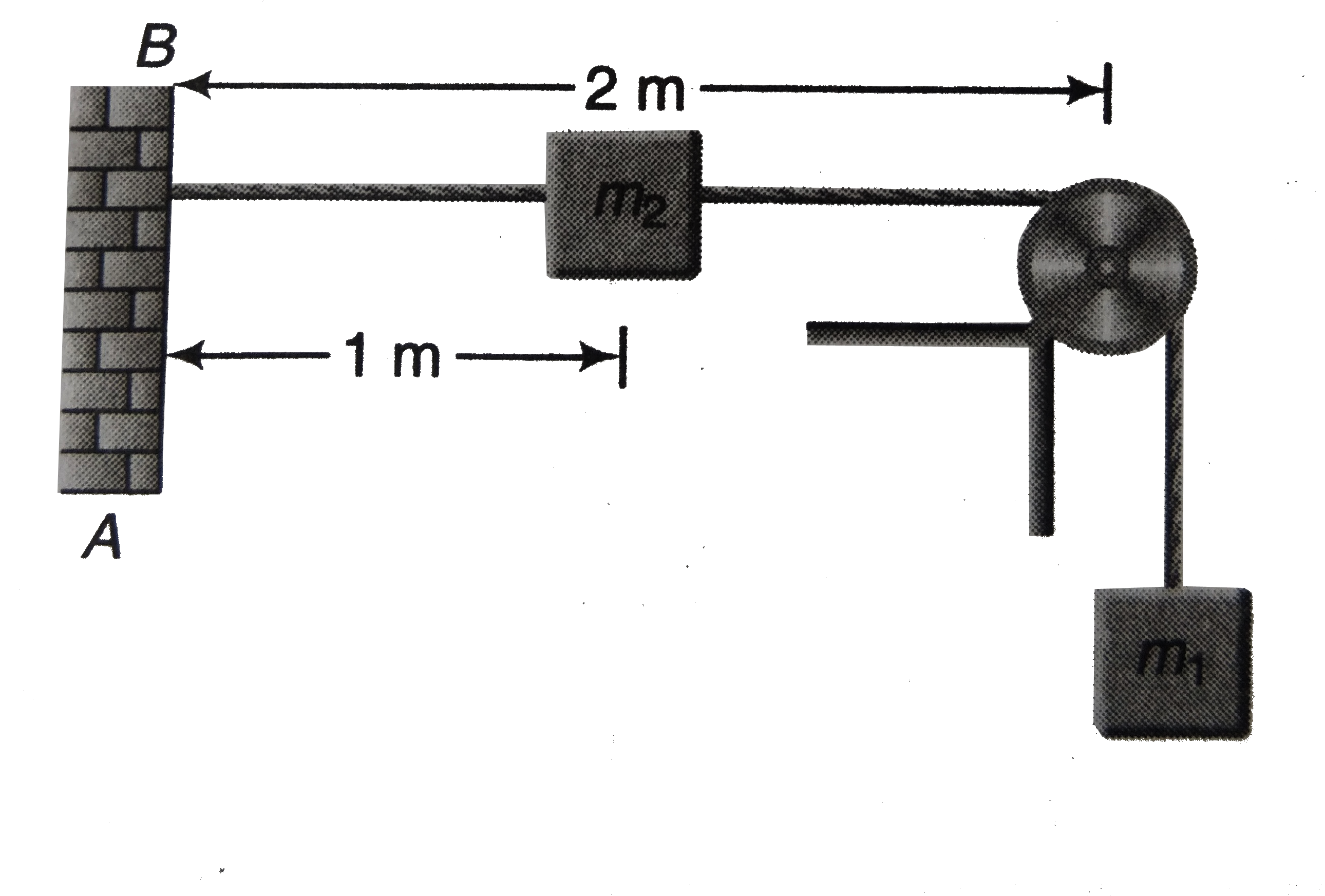
Find the speed of both the blocks at the moment the block `m_(2)` hits the wall AB, after the blocks are released from rest. Given that `m_(1) =0.5 kg` and `m_(2) =2 kg, (g=10 m//s^(2))`
.

Text Solution

Verified by Experts

The correct Answer is:
A, B, C

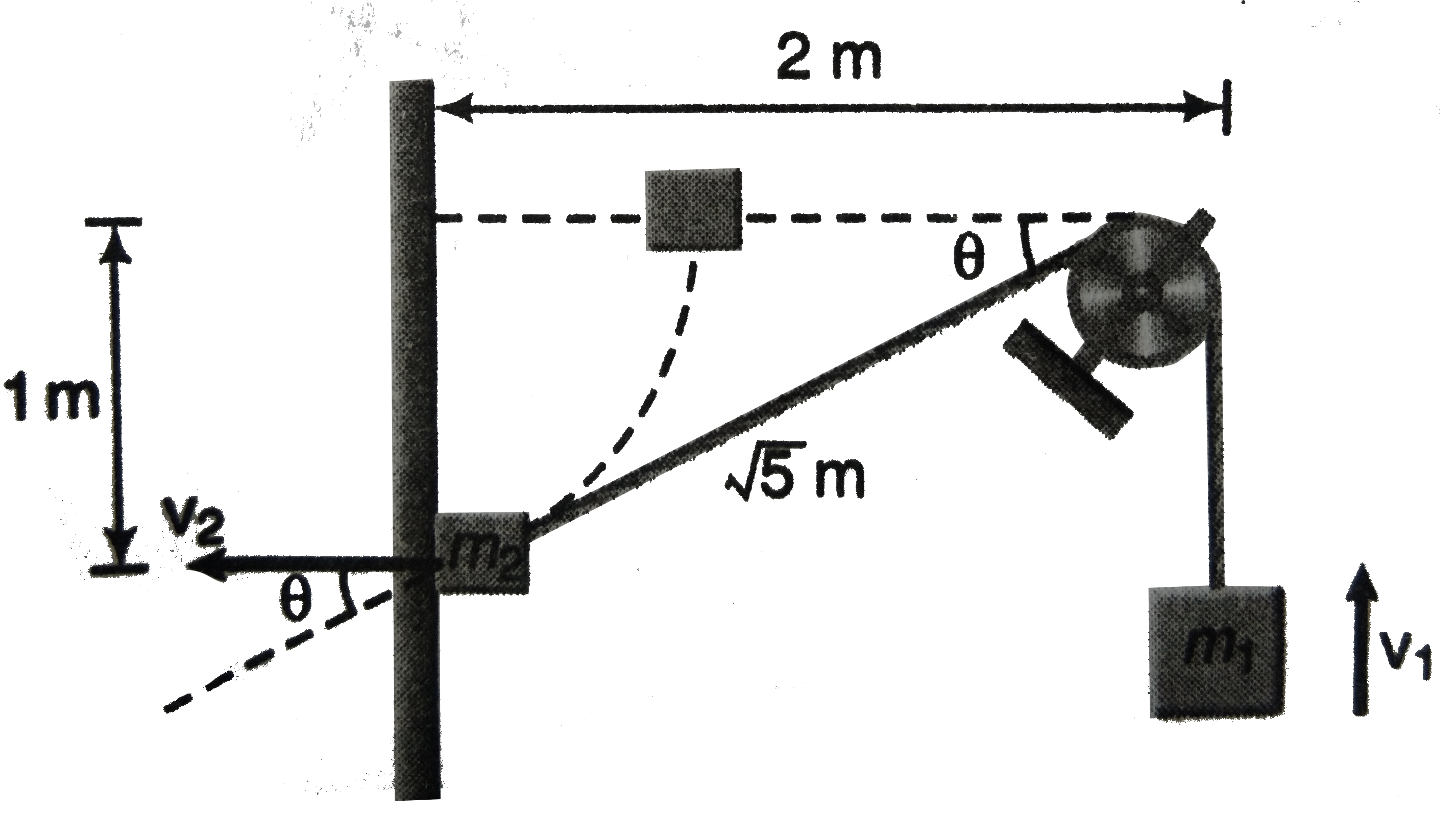
From conservation of energy ,
`m_(2)gh_(2)=m_(1)gh+(1) +1/2m_(1)v_(1)_(2) + 1/2 m_(2)v(1)^(2)`
Here, `v_(1)=v^(2) cos theta`
:. `2xx10xx1=(0.5)(10)(sqrt5-1)+1/2xx0.5`
`xv_(2)^(2)xx((2)/sqrt(5))^(2) +1/2xx2xxv_(2)^(2)`
`:. 20 =6.18+0.2 v_2^(2)+v_(2)^(2)`

`v^(2) =3.39 m//s`
and `v_(1) =v^(2) cos theta =2/sqrt(5)xx3.39`
or `v_(1) =3.03m//s`,
Promotional Banner

Topper's Solved these Questions

  • WORK, ENERGY & POWER

    DC PANDEY ENGLISH|Exercise Level 2 Comprehension Based|2 Videos
  • WORK, ENERGY & POWER

    DC PANDEY ENGLISH|Exercise Level 2 More Than One Correct|9 Videos
  • WAVE MOTION

    DC PANDEY ENGLISH|Exercise Integer Type Question|11 Videos
  • WORK, ENERGY AND POWER

    DC PANDEY ENGLISH|Exercise MEDICAL ENTRACES GALLERY|33 Videos

Similar Questions

Explore conceptually related problems

In the figure shown masses of the blocks A, B and C are 6kg, 2kg and 1kg respectively. Mass of the spring is negligibly small and its stiffness is 1000 N//m. The coefficient of friction between the block A and the table is mu =0.8 . Initially block C is held such that spring is in relaxed position. The block is released from rest. Find (g=10 m//s^(2)) .

The block of mass m_(1) is placed on a wedge of an angle theta , as shown. The block is moving over the inclined surface of the wedge. Friction coefficient between the block and the wedge is mu_(1) , whereas it is mu_(2) between the wedge and the horizontal surface. if mu_(1)=1/2, theta=45^(@), m_(1)=4 kg, m_(2)=5 kg and g=10 m//s^(2) , find minimum value of mu_(2) so that the wedge remains stationary on the surface. express your answer in multiple of 10^(-3)

The block of mass m_(1) is placed on a wedge of an angle theta , as shown. The block is moving over the inclined surface of the wedge. Friction coefficient between the block and the wedge is mu_(1) , whereas it is mu_(2) between the wedge and the horizontal surface. if mu_(1)=1/2, theta=45^(@), m_(1)=4 kg, m_(2)=5 kg and g=10 m//s^(2) , find minimum value of mu_(2) so that the wedge remains stationary on the surface. express your answer in multiple of 10^(-3)

Find the acceleration of the two blocks . The system is initialy at rest and the friction are as shown in fig .Given m_(A) = m_(B) = 10 kg

In the given figure, Find mass of the block A, if it remains at rest, when the system is released from rest. Pulleys and strings are massless. [g=10m//s^(2)]

A block B of mass M is suspended from a cord of length l attached to a cart A of mass M as shown in the figure. The horizontal surface on which the cart moves is smooth. Initially both the cart and the block are at rest in the position shown. Now B is released. Take M=m=2kg, theta=45^(@) and g=10m//s^(2) . The magnitude of acceleration of B (with respect to cart) immediately after the system is released from rest is

A block B of mass M is suspended from a cord of length l attached to a cart A of mass M as shown in the figure. The horizontal surface on which the cart moves is smooth. Initially both the cart and the block are at rest in the position shown. Now B is released. Take M=m=2kg, theta=45^(@) and g=10m//s^(2) . The acceleration of the cart immediately after the system is released from rest is

A block B of mass M is suspended from a cord of length l attached to a cart A of mass M as shown in the figure. The horizontal surface on which the cart moves is smooth. Initially both the cart and the block are at rest in the position shown. Now B is released. Take M=m=2kg, theta=45^(@) and g=10m//s^(2) . The tension in the cord immediately after the system is released from rest is

Two masses m_(1) =10 Kg and m_(2)=5kg are connected by an ideal string as shown in the figure. The coefficient of friction between m_(1) and the surface is mu=0.2 Assuming that the system is released from rest calculate the velocity of blocks when m_(2) has descended by 4m . (g=10 m//s^(2)) .

In the figure shown co-efficient of friction between the block B and C is 0.4. There is no friction between the block C and hte surface on which it is placed. The system of blocks is released from rest in the shown situation. Find the distance moved by the block C when block A descends through a distance 2m. Given masses of the blocks are m_(A)=3 kg, m_(B)=5 kg and m_(C)=10 kg .

