Home
Class 11
PHYSICS
A block of mass M slides along a horizon...

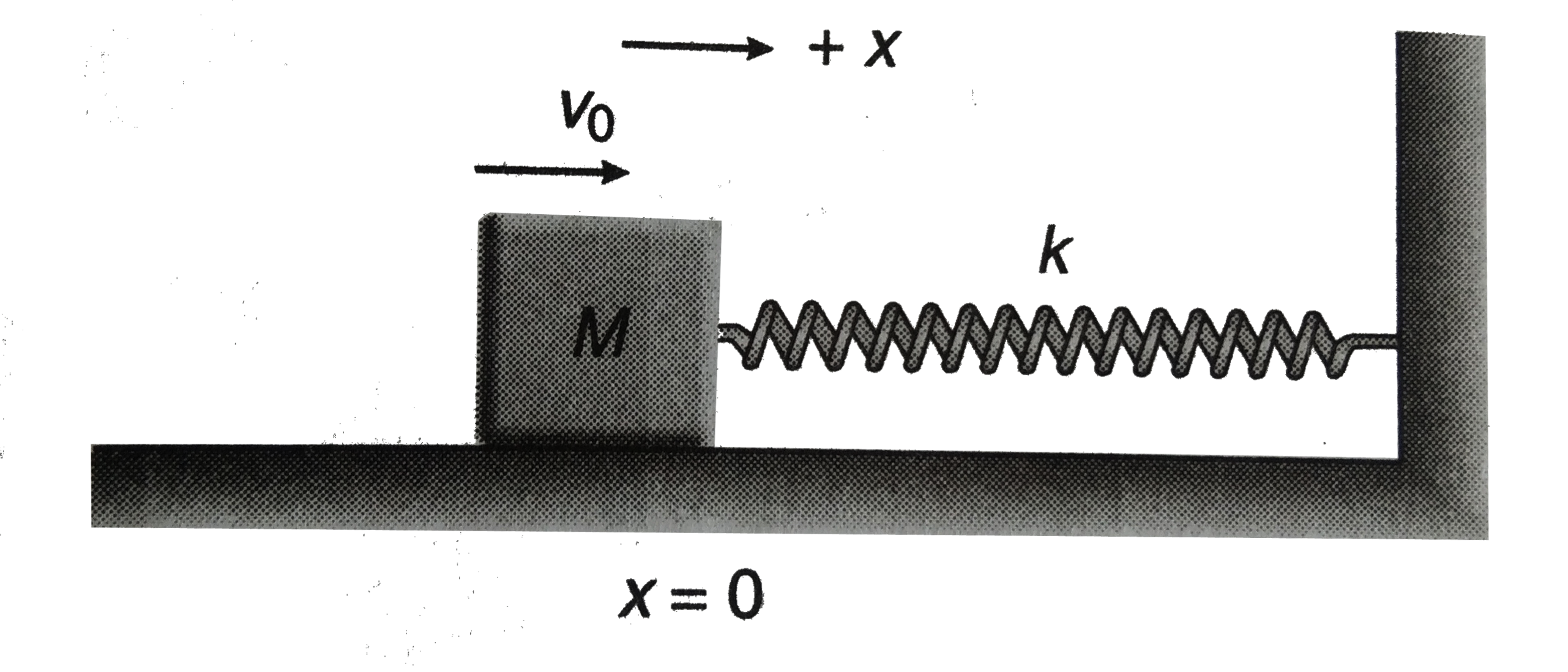
A block of mass M slides along a horizontal table with speed `v_(0)`. At `x=0`, it hits a spring with spring constant k and begins to experience a friction force. The coefficient of friction is variable and is given by `mu=bx`, where b is a positive constant. Find the loss in mechanical energy when the block has first come momentarily to rest.
.

Text Solution

Verified by Experts

The correct Answer is:

B

Net retarding force `=kx +bMgx`
`:.` Net retardatopm `=((k+bMg)/M).x`
So, we can write
`v.(dv)/(dx) = -((k+bMtg)/(M)).x`
`v.(dv)/(dx)=-((k+bMg)/M)int_(0)^(x)xdx`
or `int_(v0)^(0)v.dv =-((k+bMg)/M)int_(0)^(x)xdx`
or `x=sqrt(M/(k_bMg))v0`
Loss in vechanical energy
`DeltaE=1/2Mv_(0)^(2)-1/2kx^(2)`
or `DeltaE=1/2 Mv_(0)^(2) -1/2 (m/(k+bMg))v_(0)^(2)`
or `DeltaE=v_(0)^(2)/2[M-k(M/(k+bMg))]`
`=(v_(0)^(2)M^(2)g)/(2(k+bMg))`.
Promotional Banner

Topper's Solved these Questions

  • WORK, ENERGY & POWER

    DC PANDEY ENGLISH|Exercise Level 2 Comprehension Based|2 Videos
  • WORK, ENERGY & POWER

    DC PANDEY ENGLISH|Exercise Level 2 More Than One Correct|9 Videos
  • WAVE MOTION

    DC PANDEY ENGLISH|Exercise Integer Type Question|11 Videos
  • WORK, ENERGY AND POWER

    DC PANDEY ENGLISH|Exercise MEDICAL ENTRACES GALLERY|33 Videos

Similar Questions

Explore conceptually related problems

A block of mass m is kept on a horizontal table. If the static friction coefficient is mu ., find the frictional force acting on the block.

A block of mass m moving with velocity v_(0) on a smooth horizontal surface hits the spring of constant k as shown. The maximum compression in spring is

A block of mass m moving with a velocity v_(0) on a rough horizontal surface from x=0 coefficient of friction is given by mu=mu_(0)+ax . Find the kinetic energy of the block as function of x before it comes to rest.

A block of mass m slides 0n a frictionless table. It is constrained to move inside a ring of radius R . At time t=0 , block is moving along the inside of the ring (i.e. in the tangential direction) with velocity v_(0) . The coefficient of friction between the block and the ring is mu . Find the speed of the block at time t .

A block of mass m is kept on the edge of a horizontal turn table of radius R which is rotating with constant angular verticle omega (along with the block ) about its axis . If coefficient of friction is mu , find the friction force between block and table.

A block of mass m is connected with another block of mass 2m kept on a rough horizontal table by means of an ideal spring of spring constant K and a massless string as shown in the figure. The minimum coefficient of friction between the block of mass 2m and the table so that the block does not slide, when block of mass m is suddenly released, is

A block of mass m moving at a speed v compresses a spring throgh a distance x before its speed is halved. Find the spring constant of the spring.

A block of mass m, lying on a smooth horizontal surface, is attached to a spring (of negligible mass) of spring constant k. The other end of the spring is fixed, as shown in the figure. The block is initally at rest in its equilibrium position. If now the block is pulled withe a constant force F, the maximum speed of the block is :

In the position shown in figure, the spring is at its natural length. The block of mass m is given a velocity v_0 towards the vertical support at t=0 . The coefficient of friction between the block and the surface is given by mu=alphax , where alpha is a positive constant and x is the position of the block from its starting position. The block comes to rest for the first time at x, which is

A block of mass m lies on a horizontal frictionless surface and is attached to one end of a horizontal spring (with spring constant k ) whose other end is fixed . The block is intinally at rest at the position where the spring is unstretched (x=0) . When a constant horizontal force vec(F) in the positive direction of the x- axis is applied to it, a plot of the resulting kinetic energy of the block versus its position x is shown in figure. What is the magnitude of vec(F) ?
