Home
Class 11
PHYSICS
A block of mass m is placed at rest on a...

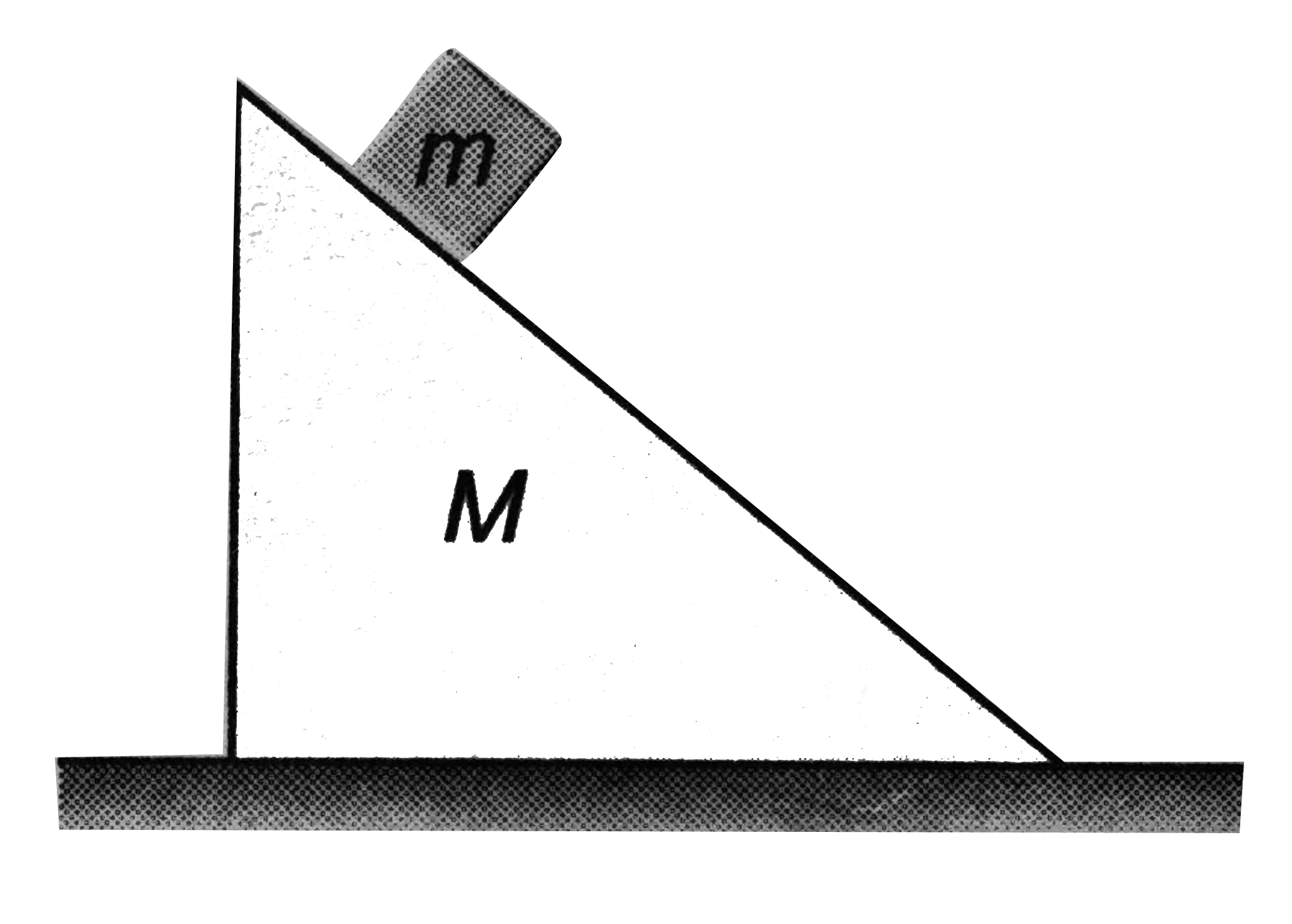
A block of mass `m` is placed at rest on a smooth wedge of mass M placed at rest on a smooth horizontal surface. As the system is released

A

The COM of the system remains stationary

B

The COM of the system has an acceleration g vertically downward

C

Momentum of the system is conserved along the horizontal direction

D

Acceleration of COM is vertically downward (a < g)

Text Solution

Verified by Experts

The correct Answer is:

C, D

Out of two blocks, one block of mass `m` is moving in vertical direction also (downwards). Therefore COM is moving vertically downwards and momentum of the system is not conserved in vertical direction.
Promotional Banner

Topper's Solved these Questions

  • CENTRE OF MASS, LINEAR MOMENTUM AND COLLISION

    DC PANDEY ENGLISH|Exercise Level 2 Comprehension Based|4 Videos
  • CENTRE OF MASS, LINEAR MOMENTUM AND COLLISION

    DC PANDEY ENGLISH|Exercise Level 2 Comprehension Based Questions|3 Videos
  • CENTRE OF MASS, LINEAR MOMENTUM AND COLLISION

    DC PANDEY ENGLISH|Exercise Level 2 Single Correct Option|1 Videos
  • CENTRE OF MASS, IMPULSE AND MOMENTUM

    DC PANDEY ENGLISH|Exercise Comprehension type questions|15 Videos
  • CIRCULAR MOTION

    DC PANDEY ENGLISH|Exercise Medical entrances s gallery|19 Videos

Similar Questions

Explore conceptually related problems

A small block of mass m is placed at rest on the top of a smooth wedge of mass M, which in turn is placed at rest on a smooth horizontal surface as shown in figure. If h be the height of wedge and theta is the inclination, then the distance moved by the wedge as the block reaches the foot of the wedge is

A particle of mass m is placed at rest on the top of a smooth wedge of mass M, which in turn is placed at rest on a smooth horizontal surface as shown in figure. Then the distance moved by the wedge as the particle reaches the foot of the wedge is :

A smooth block of mass m is held stationary on a smooth wedge of mass M and inclination theta as shown in figure .If the system is released from rest , then the normal reaction between the block and the wedge is

A block of mass m slides over a smooth wedge of mass M which is placed over a rough horizontal surface . The centre of mass of the system will move towards left Here mu = coefficient of friction between the wedge and the ground .

A block of mass m rests on a stationary wedge of mass M. The wedge can slide freely on a smooth horizontal surface as shown in figure. If the block starts from rest

Figure shows a block A of mass 6 m having a smooth semicircular groove of radius a placed on a smooth horizontal surface. A block B of mass m is released from a position in groove where its radius is horizontal. Find the speed of the bigger block when the smaller block reaches its bottom most position.

A block of mass m is placed at the bottom of a massless smooth wedge which if placed on a horizontal surface. When we push the wedge with a constant force, the block moves up the wedge. Find the work done by the external agent when the block has a speed v and is reaches the top of the wedge.

A block of mass M is tied to one end of a massless rope. The other end of the rope is in the hands of a man of mass 2M as shown in Fig. The block and the man art resting on a rough wedge of mass M . The whole system is resting on a smooth horizontal surface. The man starts walking towards right while holding the rope in his hands. Pulley is massless and frictionless. Find the displacement of the wedge when the block meets the pulley. Assume wedge is sufficiently long so that man does not fall down.

A block of mass 'M' is placed on the top of a wedge of mass '4M'. All the surfaces are frictionless. The system is released from rest. The distance moved by the wedge at the instant, the block reaches the bottom will be

A block of mass m lies on a wedge of mass M. The wedge in turn lies on smooth horizontal surface. Friction is absent everywhere. The wedge block system is released from rest. All situations given in Table-1 are tol be estimated in the duration the block undergoes a vertical displacement 'h' starting from rest. Match the statement in Table-1 with the results in Table-2 ltbgt
