Home
Class 11
PHYSICS
A disc of radius R has linear velocity v...


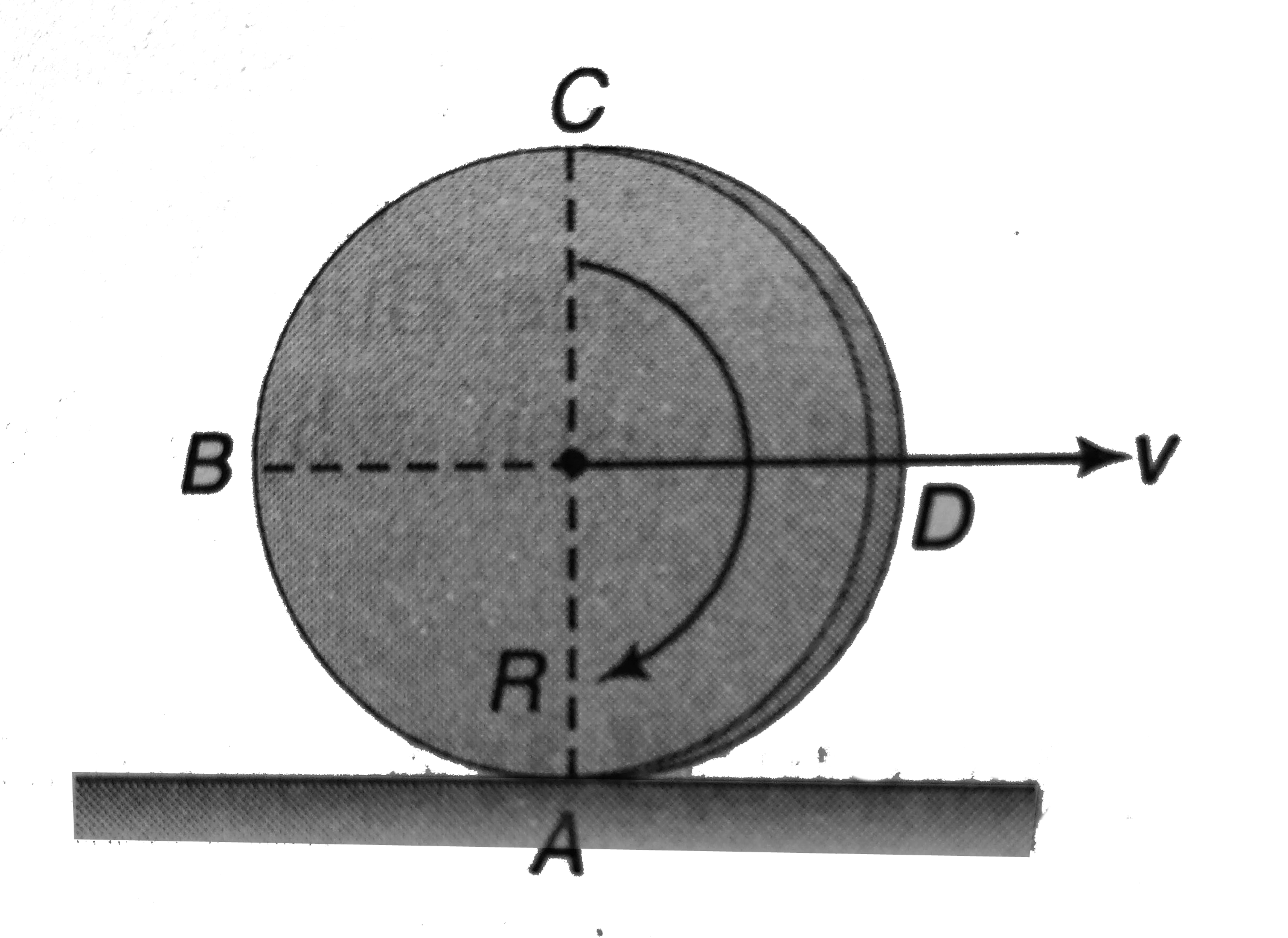
A disc of radius `R` has linear velocity `v` and angular velocity `omega` as shown in the figure. Given `upsilon=romega` find velocity of point A, B, C and D on the disc.

Text Solution

Verified by Experts


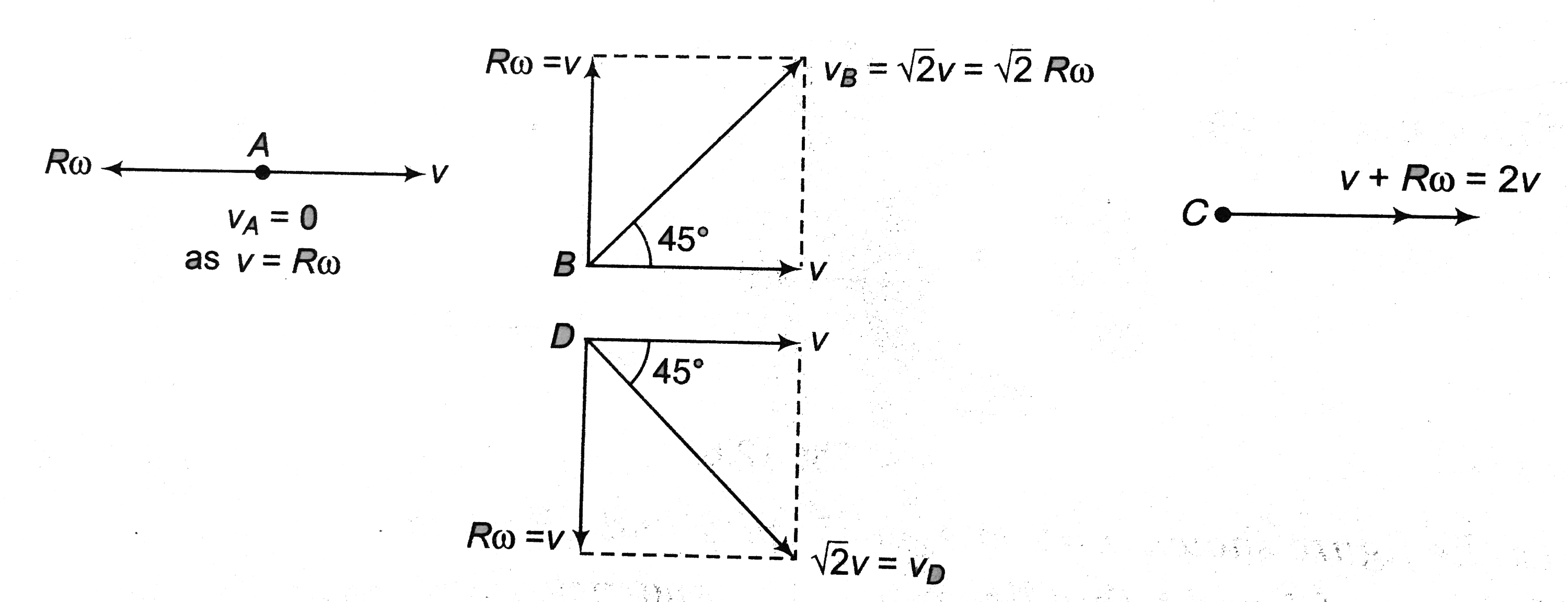
As stated in above article, velocity of ay point of the rigid body in rotation plus translationn is the vector sum of `v` (the velocity of centre of mass) and `romega`. Here, `r` is the distance of the point under consideration from the centre of mass of the body. direction of this `romega` is perpendicular to the line joining the point with centre of mass in the sense of rotation. Based on this, velocities of points A, B ,C and D are as shown below.
thus, `V_(A)` is zero, velocity of B and D is `sqrt(2v)` or `sqrt(2)Romega` and velocity of C is 2 v or `2Romega` in the direction shown in figure.
Promotional Banner

Topper's Solved these Questions

  • ROTATIONAL MECHANICS

    DC PANDEY ENGLISH|Exercise Solved Examples|25 Videos
  • ROTATIONAL MECHANICS

    DC PANDEY ENGLISH|Exercise Miscellaneous Examples|2 Videos
  • ROTATION

    DC PANDEY ENGLISH|Exercise (C) Chapter Exercises|39 Videos
  • ROTATIONAL MOTION

    DC PANDEY ENGLISH|Exercise Integer Type Questions|17 Videos

Similar Questions

Explore conceptually related problems

A circular disc of radius R is rotating about its axis O with a uniform angular velocity omega"rad s"^(-1) as shown in the figure. The magnitude of the relative velocity of point A relative to point B on the disc is

A uniform circular disc placed on a horizontal rough surface has initially a velocity v_(0) and an angular velocity omega_(0) as shown in the figure. The disc comes to rest after moving some distance in the direction of motion. Then v_(0)//r omega_(0) is :

A uniform circular disc placed on a horizontal rough surface has initially a velocity v_(0) and an angular velocity omega_(0) as shown in the figure. The disc comes to rest after moving some distance in the direction of motion. Then v_(0)//omega_(0) is :

A disc is rolling without slipping with linear velocity v as shown in figure. With the concept of instantaneous axis of rotation, find velocities of point A, B, C and D.

A uniform sphere of radius R is palced on a rough horizontal surface and given a linear velocity v_(0) and an angular velocity omega _(0) as shown . If the angular velocity and the linear velocity both become zero simultaneously, then

A tire of radius R rolls on a flat surface with angular velocity omega and velocity upsilon as shown in the diagram. If upsilon > omegaR , in which direction does friction from the tire act on the road?

A uniform circular disc of radius r is placed on a rough horizontal surface and given a linear velocity v_(0) and angular velocity omega_(0) as shown. The disc comes to rest after moving some distance to the right. It follows that

A disc of radius R rolls on a horizontal ground with linear acceleration a and angular acceleration α as shown in figure. The magnitude of acceleration of point P at an instant when its linear velocity is v and angular velocity is ω will be:

A disc is given an angular velocity omega_(0) and a linear velocity v_(0) as shown in the figure. It is released on a rough horizontal surface of friction coefficient mu. Mark the correct statement (omega_(0)=3v_(0)//R)

A disc of radius R is moving on a rough horizontal surface with velocity v and angular speed omega at an instant as shown in figure. Choose the correct statement.

