Home
Class 11
PHYSICS
In the figure shown the time period and ...

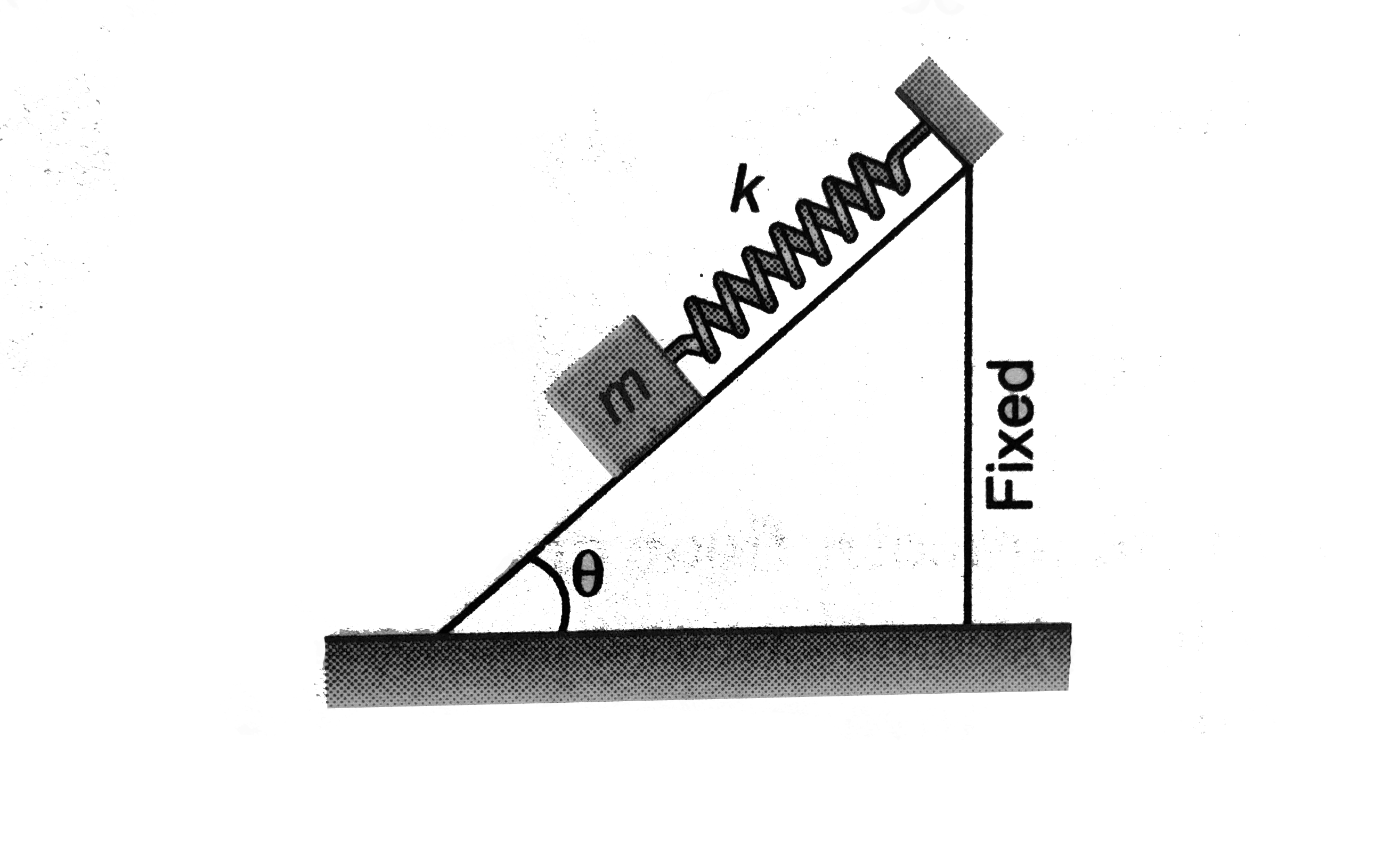
In the figure shown the time period and the amplitude respectively, when `m` is left from rest when spring is relaxed are (the inclined plane is smooth)

A

`2pisqrt((m)/(k)),(mg sin theta)/(k)`

B

`2pi sqrt ((m sin theta)/(k))`, `(2 mg sin theta)/(k)`

C

`2pi sqrt ((m)/(k))`, `(mg cos theta)/(k)`

D

None of these

Text Solution

Verified by Experts

The correct Answer is:

A

In equilibrium, let `x_(0)` is extention in spring then
`kx_(0) = mg sin theta`
`:. x_(0) = (mg sin theta)/(k)` = amplitude of oscillations.
Promotional Banner

Topper's Solved these Questions

  • SIMPLE HARMONIC MOTION

    DC PANDEY ENGLISH|Exercise Level 1 Subjective|39 Videos
  • SIMPLE HARMONIC MOTION

    DC PANDEY ENGLISH|Exercise Level 2 Single Correct|28 Videos
  • SIMPLE HARMONIC MOTION

    DC PANDEY ENGLISH|Exercise Level 1 Assertion And Reason|10 Videos
  • SEMICONDUCTORS AND ELECTRONIC DEVICES

    DC PANDEY ENGLISH|Exercise More than One Option is Correct|3 Videos
  • SOLVD PAPERS 2017 NEET, AIIMS & JIPMER

    DC PANDEY ENGLISH|Exercise Solved paper 2018(JIPMER)|38 Videos

Similar Questions

Explore conceptually related problems

Two blocks A and B are shown in figure have masses 5 kg and 4kg respectively. The system is released from rest. The speed of B after A has travelled the distance 1 m along the incline is (take g= 10m/s^2 ,pulleys and strings are ideal and plane is smooth)

A mass is suspended separately by two different springs in successive order then time period is t_1 and t_2 respectively. If it is connected by both spring as shown in figure then time period is t_0 , the correct relation is : -

A mass M is attached to a horizontal spring of force constant k fixed one side to a rigid support as shown in figure. The mass oscillates on a frictionless surface with time period T and amplitude A. When the mass M is in equilibrium position, another mass m is gently placed on it. When will be the new amplitude of ocillation?

A block of mass m connected with a smooth prismatic wedge of mass M is released from rest when the spring is relaxed. Find the angular frequency of oscillation.

A block of mass m is attached to a cart of mass 4m through spring of spring constant k as shown in the figure. Friction is absent everywhere. The time period of oscillations of the system, when spring is compressed and then released, is

Blocks A and B shown in the figure are having equal masses m. The system is released from rest with the spring unstretched. The string between A and ground is cut, when there is maximum extension in the spring. The acceleration of centre of mass of the two blocks at this instant is

When body slides down from rest along smooth inclined plane making angle of 45^(@) with the horizontal, it takes time T When the same body slides down from rest along a rough inclined plane making the same angle and through the same distance it is seen to take time pT , where p is some number greater that 1. Calculate late the coefficient of friction beween the body and the rough plane. .

When body slides down from rest along smooth inclined plane making angle of 45^(@) with the horizontal, it takes time T When the same body slides down from rest along a rough inclined plane making the same angle and through the same distance it is seen to take time pT , where p is some number greater that 1. Calculate late the coefficient of friction beween the body and the rough plane. .

Three blocks A, B and C of masses 5 kg, 5 kg and 10 kg respectively are connected with two light strings, one of them is passing over an ideal pulley The system is released from rest on smooth inclined plane of inclination 30" as shown in figure. The value of tension T_1 /T_2 is

Find the time period of mass M when displaced from its equilibrium position and then released for the system shown in figure.

DC PANDEY ENGLISH-SIMPLE HARMONIC MOTION-Level 1 Single Correct
  1. Two simple harmonic motions are given by y(1) = a sin [((pi)/(2))t + p...

    Text Solution

    |

  2. A particle starts performing simple harmonic motion. Its amplitude is ...

    Text Solution

    |

  3. Which of the following is not simple harmonic function ?

    Text Solution

    |

  4. The displacement of a particle varies according to the relation x=4 (c...

    Text Solution

    |

  5. Two pendulums X and Y of time periods 4 s and 4.2s are made to vibrate...

    Text Solution

    |

  6. A mass M is suspended from a massless spring. An additional mass m str...

    Text Solution

    |

  7. Two bodies P and Q of equal masses are suspended from two separate mas...

    Text Solution

    |

  8. A disc of radius R is pivoted at its rim. The period for small oscilla...

    Text Solution

    |

  9. Identify the correct variation of potential energy U as a function of ...

    Text Solution

    |

  10. If the length of a simple pendulum is equal to the radius of the earth...

    Text Solution

    |

  11. The displacement - time (x - t) graph of a particle executing simple h...

    Text Solution

    |

  12. In the figure shown the time period and the amplitude respectively, wh...

    Text Solution

    |

  13. The equation of motion of a particle of mass 1g is (d^(2)x)/(dt^(2)) +...

    Text Solution

    |

  14. The spring as shown in figure is kept in a stretched position with ext...

    Text Solution

    |

  15. The mass and diameter of a planet are twice those of earth. What will ...

    Text Solution

    |

  16. The resultant amplitude due to superposition of three simple harmonic ...

    Text Solution

    |

  17. Two SHMs s(1) = a sin omega t and s(2) = b sin omega t are superimpose...

    Text Solution

    |

  18. The amplitude of a particle executing SHM about O is 10 cm. Then

    Text Solution

    |

  19. A particle is attached to a vertical spring and is pulled down a dista...

    Text Solution

    |

  20. A block of mass 1kg is kept on smooth floor of a truck. One end of a s...

    Text Solution

    |
