Home
Class 11
PHYSICS
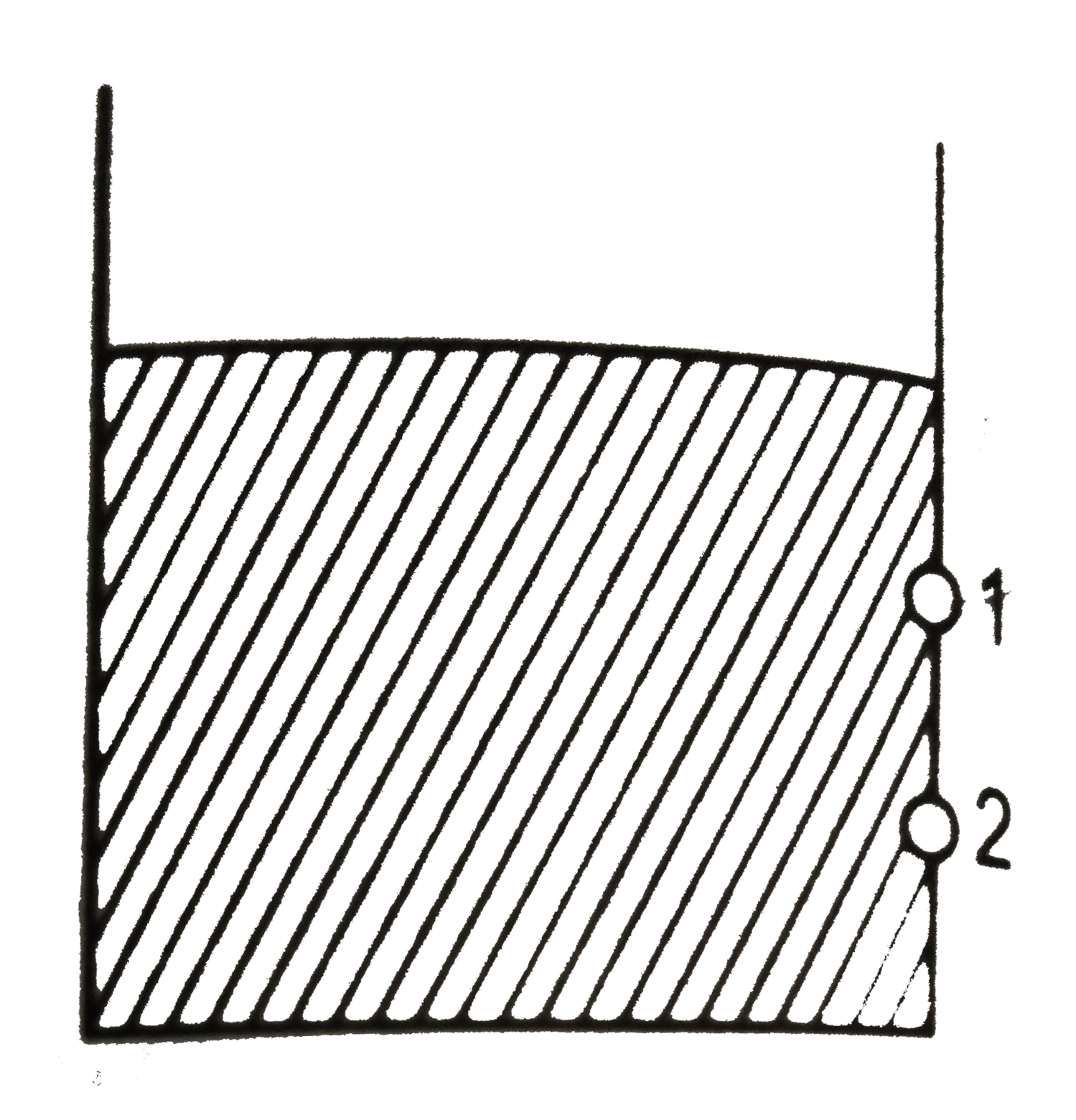
Two holes 1 and 2 are made at depths h a...

Two holes 1 and 2 are made at depths h and 16h reapectively. Both the holes are circular but radius of hole-1 is two times.

A

Initially equal volumes of liquid will flow from both the holes in unit time

B

Intially more volume of liquid will flow from hole-2 per unit time.

C

Afer some time more volume of liquid will flow from hole-1 per unit time.

D

After some time more volume of liquid will flow from hole-2 per unit time

Text Solution

Verified by Experts

The correct Answer is:

A, D

Initially
`(dV_(1))/(dt)=v_(1)a_(1)=(sqrt(2gh))(pi)(2R)^(2)` …(i)
`(dV_2)/(dt)=v_(1)a_(1)=(sqrt(2gh(16h)))(pi)(R )^(2)` …(ii)
From Eqs, (i) and (ii) we can see that
`(dV_(1))/(dt)=(dV_(2))/(dt)`
After some time `v_(1)` both will decrease, but decrease in the value of `v_(1)` is more dominating so,
`a_(1)v_(1)` or `dV_(1)/(dt), lta_(2)v_(2)` or `(dV_(2))/(dt)`.
Promotional Banner

Topper's Solved these Questions

  • FLUID MECHANICS

    DC PANDEY ENGLISH|Exercise Level 2 Comprehension Based|7 Videos
  • FLUID MECHANICS

    DC PANDEY ENGLISH|Exercise Subjective|24 Videos
  • FLUID MECHANICS

    DC PANDEY ENGLISH|Exercise Level 2 Single Correct|36 Videos
  • EXPERIMENTS

    DC PANDEY ENGLISH|Exercise Subjective|15 Videos
  • GENERAL PHYSICS

    DC PANDEY ENGLISH|Exercise INTEGER_TYPE|2 Videos

Similar Questions

Explore conceptually related problems

The area of two holes A and B are 2a and a , respectively, The holes are at height (H//3) and (2H//3) from the surface of water. Find the correct option(s):

The area of hole (1) is A_(1) and of hole (2) is A_(2) . The velocity of efflux and range of liquid is v_(1), v_(2) and x_(1), x_(2) for holes (1) and (2) respectively. The time taken by liquid, jet to reach the ground from holes (1) and (2) are t_(1) and t_(2) respectively. Cross section of tank is very very large compared to size of holes. {:(,"Column-I",,"Column-II"),((A),v_(1):v_(2),(p),2 : 1),((B),x_(1) : x_(2),(q),1 : 2),((C),t_(1) : t_(2),(r),1 : 1),((D),"if"A_(1) : A_(2) = 2 : 1",then"v_(1) : v_(2) =,(s),4 : 1):}

Equal volumes of two immiscible liquids of density 2rho and 4rho , respectively , are filled in the vessel as shown in the figure. Two small holes are punched at depth h/2 and 2h, respectively , from the surface of the lighter liquid. If v_1 and v_2 are the velocities of efflux at these holes, then the ratio of v_1/v_2 is

Two holes are made at depths h and 2h from the top. A liquid of density rho and height h is filled over another liquid of density 2rho . Speeds of liquid ejecting from two holes are say v_(1) and v_(2) . The ratio v_(1)/v_(2) will be

Two holes are made at depths h and 2h from the top. A liquid of density rho and height h is filled over another liquid of density 2rho . Speeds of liquid ejecting from two holes are say v_(1) and v_(2) . If density of lower liquid is increased

In a cylindrical vessel containing liquid of density rho there are two holes in the side walls at heights of h_(1) and h_(2) respectively such that the range of efflux at the bottom of the vessel is same. The height of a hole for which the range of efflux would be maximum, will be

A large open tank has two holes in the wall. One is a square hole of side L at a depth y from the top and the other is a circular hole of radius R at a depth 4y from the top. When the tank is completely filled with water, the quantities of water flowing out per second from both holes are the same. Then, R is equal to

A large open tank has two holes in the wall. One is square hole of side L at a depth y from the top and the other is a circular hole of radius R at a depth of 4y from the top. When the tank is completely filled with water, the quantities of water flowing out per second from both holes are the same. Then R is equal to

A squre hole of side length l is made at a depth of h and a circular hole is made at a depht of 4 h from the surface of water in a water tank kept on a horizontal surface (where l ltlt h). Find the radius r of the circular hole if equal amount of water comes out of the vessel through the holes per second.

A vessel completely filled with water has holes 'A' and 'B' at depths 'h' and '3h' from the top respectively. Hole 'A' is a square of side 'L' and 'B' is circle of radius 'r'. The water flowing out per second from both the holes is same. Then 'L' is equal to
