Home
Class 11
PHYSICS
S(1) and S(2) are two coherent sources o...

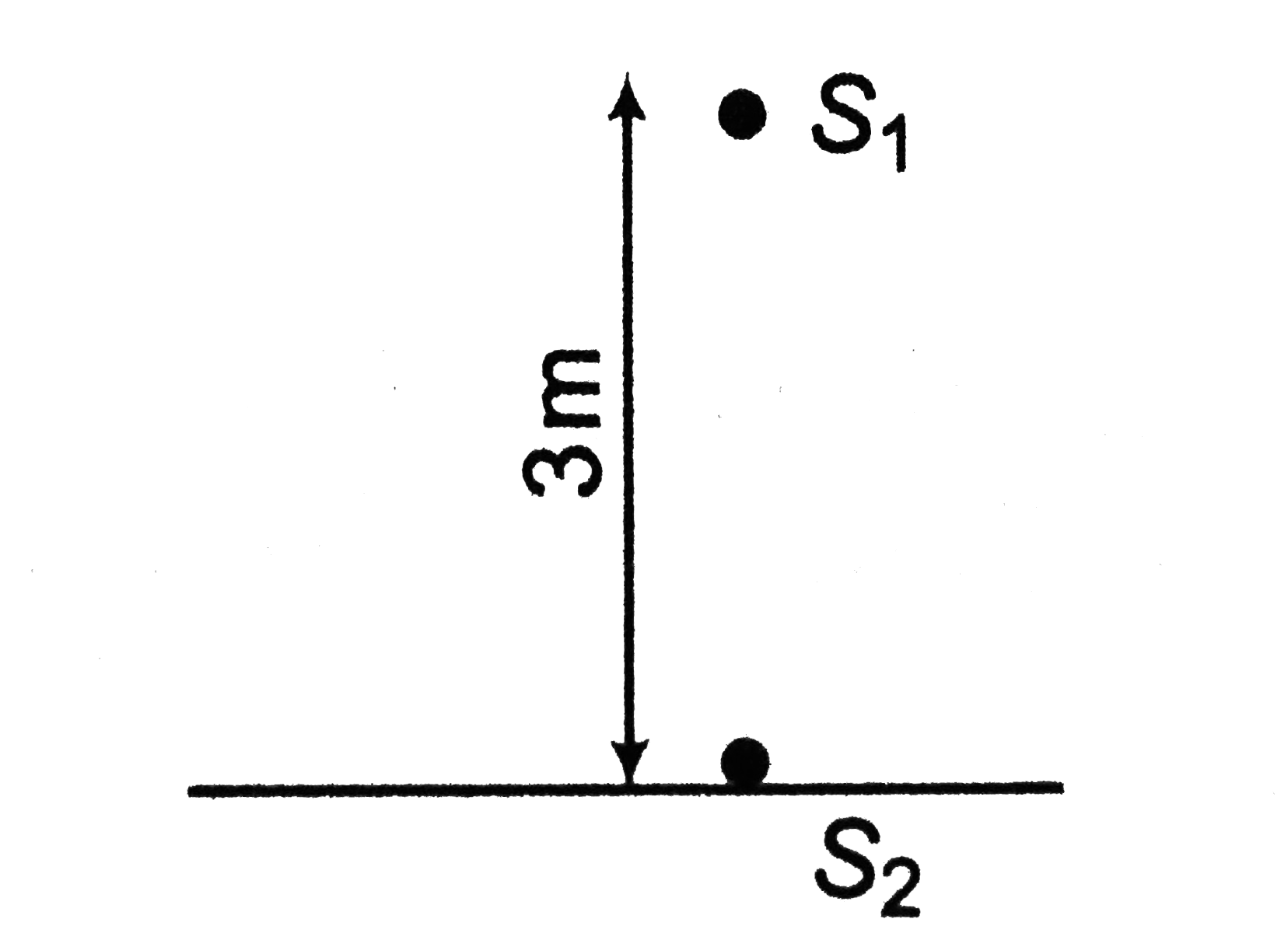
`S_(1)` and `S_(2)` are two coherent sources of sound having no intial phase difference. The velocity of sound is `330 m//s`. No maximum will be formed on the line passing through `S_(2)` and prependicular to the line joining `S_(1)` and `S_(2)`. If the frequency of both the sources is

A

`330 H_(Z)`

B

`120 H_(Z)`

C

`100 H_(Z)`

D

`220 H_(Z)`

Text Solution

Verified by Experts

The correct Answer is:

C

`Deltax_(max) = 3m = lambda`
:. `f = (nu)/(lambda) = (330)/(3) = 110 H_(Z)`. For frequencies less
than `100 H_(Z)`, `lambda` will be more than`3m` and no
maximum will be obtained.
Promotional Banner

Topper's Solved these Questions

  • SOUND WAVES

    DC PANDEY ENGLISH|Exercise Single correct option|1 Videos
  • SOUND WAVES

    DC PANDEY ENGLISH|Exercise Level 2 More Than One Correct|5 Videos
  • SOUND WAVES

    DC PANDEY ENGLISH|Exercise Subjective Questions|1 Videos
  • SOLVD PAPERS 2017 NEET, AIIMS & JIPMER

    DC PANDEY ENGLISH|Exercise Solved paper 2018(JIPMER)|38 Videos
  • SUPERPOSITION OF WAVES

    DC PANDEY ENGLISH|Exercise Level 2 Subjective|8 Videos

Similar Questions

Explore conceptually related problems

Two coherent point sources S_(1) and S_(2) vibrating in phase emit light of wavelength lambda . The separation between the sources is 2lambda . Consider a line passing through S_(2) and perpendicular to line S_(1) S_(2) . Find the position of farthest and nearest minima. .

Two coherent point sources S_1 " and "S_2 vibrating in phase light of wavelength lambda . The separation between the sources is 2lambda . The smallest distance from S_(2) on a line passing through S_2 and perpendicular to s_(1)s_(2) where a minimum of intensity occurs is

S_(1) and S_(2) are two coherent sources of sound of frequency 110Hz each they have no initial phase difference. The intensity at a point P due to S_(1) is I_0 and due to S_2 is 4I_0 . If the velocity of sound is 330m//s then the resultant intensity at P is

The coherent point sources S_(1) and S_(2) vibrating in same phase emit light of wavelength lambda . The separation between the sources is 2lambda . Consider a line passing through S_(2) and perpendicular to the line S_(1)S_(2) . What is the smallest distance from S_(2) where a minimum of intensity occurs due to interference of waves from the two sources?

The coherent point sources S_(1) and S_(2) vibrating in same phase emit light of wavelength lambda . The separation between the sources is 2lambda . Consider a line passingh through S_(2) and perpendicular to the line S_(1)S_(2) . What is the smallest distance from S_(2) where a minimum of intensity occurs due to interference of waves from the two sources?

Two coherent point sources S_1 and S_2 emit light of wavelength lambda . The separation between sources is 2lambda . Consider a line passing through S_2 and perpendicular to the line S_(1)S_(2) . What is the smallest distance on this line from S_2 where a minimum of intensity occurs?

S_(1) and S_(2) are two sources of sound emitting sine waves. The two sources are in phase. The sound emitted by the two sources interfers at point F . The waves of wavelength :

S_(1)S_(2) are two coherent cources (having initial phase difference zero) of sound located along x -axis separated by 4 lambda where lambda is wavelength of sound emitted by them. Number of maxima located on the ellopical boundry around it will be.

S_1 and S_2 are two coherent sources of radiations separated by distance 100.25 lambda , where lambda is the wave length of radiation. S_1 leads S_2 in phase by pi//2 .A and B are two points on the line joining S_1 and S_2 as shown in figure.The ratio of amplitudes of component waves from source S_1 and S_2 at A and B are in ratio 1:2. The ratio of intensity at A to that of B (I_A/I_B) is

S_1 and S_2 are two coherent sources of radiations separated by distance 100.25 lambda , where lambda is the wave length of radiation. S_1 leads S_2 in phase by pi//2 .A and B are two points on the line joining S_1 and S_2 as shown in figure.The ratio of amplitudes of component waves from source S_1 and S_2 at A and B are in ratio 1:2. The ratio of intensity at A to that of B (I_A/I_B) is
