Home
Class 11
PHYSICS
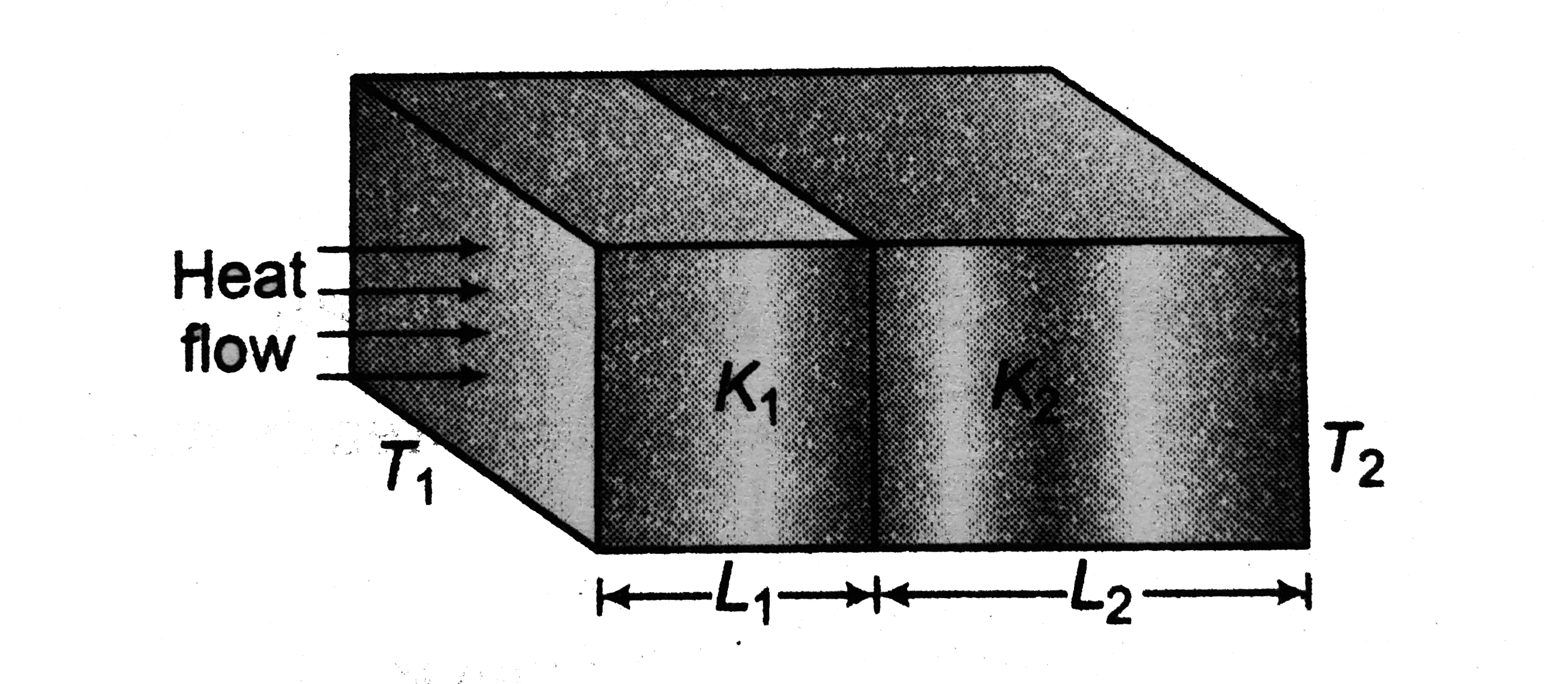
Two plates eachb of area A, thickness L1...

Two plates eachb of area A, thickness `L_1 and L_2` thermal conductivities `K_1 and K_2` respectively are joined to form a single plate of thickness `(L_1+L_2)`. If the temperatures of the free surfaces are `T_1 and T_2`. Calculate.

(a) rate of flow of heat
(b) temperature of interface and
(c) equivalent thermal conductivity.

Text Solution

Verified by Experts

The correct Answer is:

A, B

(a) If the thermal resistance of the two plates are `R_1 and R_2` respectively. Plates are
in series.
`R_s = R_1 + R_2 = (L_1/(AK_1)) + (L_2/(AK_2))`
as `R = L/(KA)`
and so `H = (dQ)/(dt) = (DeltaT)/R`
`= ((T_1-T_2)/(R_1+R_2)) = (A(T_1 -T_2))/[(L_1/K_1) + (L_2/K_2)]`
(b) If T is the common temperature of interface, then as in series rate of flow of heat remains
same, i.e. `H = H_1 (=H_2)`
`((T_1 - T_2)/(R_1 + R_2)) = (T_1 - T)/R_1`
i.e. `T = ((T_1R_2 + T_2R_2)/(R_1 + R_2))`
or ` T = ( [T_1 L_2/K_2] + T_2[L_1/K_1])/([L_1/K_1 + L_2/K_2] ) (as R = L/(KA))`
(c) If K is the equivalent conductivity of composite slab, i.e. slab of thickness `L_1 + L_2` and cross - sectional area A, then as in series.
`R_S = R_1 + R_2 or (L_1+L_2)/(AK_(eq)) = R_1 + R_2`
i.e. `K_(eq) = (L_1 + L_2)/(A(R_1 + R_2)) = (L_1 + L_2)/([L_1/K_1 + L_2/K_2])` (as `R = L/(KA)` ).
Promotional Banner

Topper's Solved these Questions

  • CALORIMETRY & HEAT TRANSFER

    DC PANDEY ENGLISH|Exercise Exercise 22.1|7 Videos
  • CALORIMETRY & HEAT TRANSFER

    DC PANDEY ENGLISH|Exercise Exercise 22.2|7 Videos
  • CALORIMETRY & HEAT TRANSFER

    DC PANDEY ENGLISH|Exercise Example Type 4|4 Videos
  • BASIC MATHEMATICS

    DC PANDEY ENGLISH|Exercise Exercise|13 Videos
  • CALORIMETRY AND HEAT TRANSFER

    DC PANDEY ENGLISH|Exercise Medical entrance s gallery|38 Videos

Similar Questions

Explore conceptually related problems

Two walls of thickness d_(1) and d_(2) and thermal conductivites K_(1) and K_(2) are in contact. In the steady state, if the temperature at the outer surfaces are T_(1) and T_(2) the temperature at the common wall is

Two materials having coefficients of thermal conductivity '3k' and 'k' and thickness 'd' and '3d' respectively, are joined to form a slab as shown in the figures. The temperatures of the outer surfaces are theta_(2) and theta_(1) respectively (theta_(2) gt theta_(2)) . The temperature at the interface is :

IF two metallic plates of equal thickness and thermal conductivities K_(1) and K_(2) are put together face to face anda common plate is constructed, then the equivalent thermal conductivity of this plate will be

Two identical plates with thermal conductivities K and 3K are joined together to form a single plate of double thickness. The equivalent thermal conductivity of one composite plate so formed for the flow of heat through its thickness is.

Two rods P and Q of equal lengths have thermal conductivities K_(1) and K_(2) and cross-sectional areas A_(1) and A_(2) respectively. If the temperature difference across the ends of each rod is the same, then the condition for which the rate of flow of heat through each of them will be equal, is

Two parallel plates A and B are joined together to form a compound plate . The thicknesses of the plate are 4.0cm and 2.5cm respectively and the area of cross section is 100cm^(2) for each plate. The thermal conductivities are K_(A)=200Wm^(-1) C^(-1) for plate A and K_(B)=400Wm^(-1) C^(-1) for the plate B. The outer surface of the plate A is maintained at 100^(@)C and the outer surface of the plate B is maintained at 0^(@)C . Find (a) the rate of heat flow through any cross section, (b) the temperature at the interface and (c) the equivalent thermal conductivity of the compound plate.

Two walls of thickness in the ratio 1:3 and thermal conductivities in the ratio 3:2 form a composite wall of a building. If the free surfaces of the wall be at temperatures 30^@C and 20^@C , respectively, what is the temperature of the interface?

Consider a compound slab consisting of two different material having equal thickness and thermal conductivities K and 2K respectively. The equivalent thermal conductivity of the slab is

Consider a compound slab consisting of two different material having equal thickness and thermal conductivities K and 2K respectively. The equivalent thermal conductivity of the slab is

Two identical plates of different metals are joined to form a single plate whose thickness is double the thickness of each plate. If the coefficients of conductivity of each plate are 2 and 3 respectively, Then the conductivity of composite plate will be
