Home
Class 11
PHYSICS
Three rods of material x and three of ma...

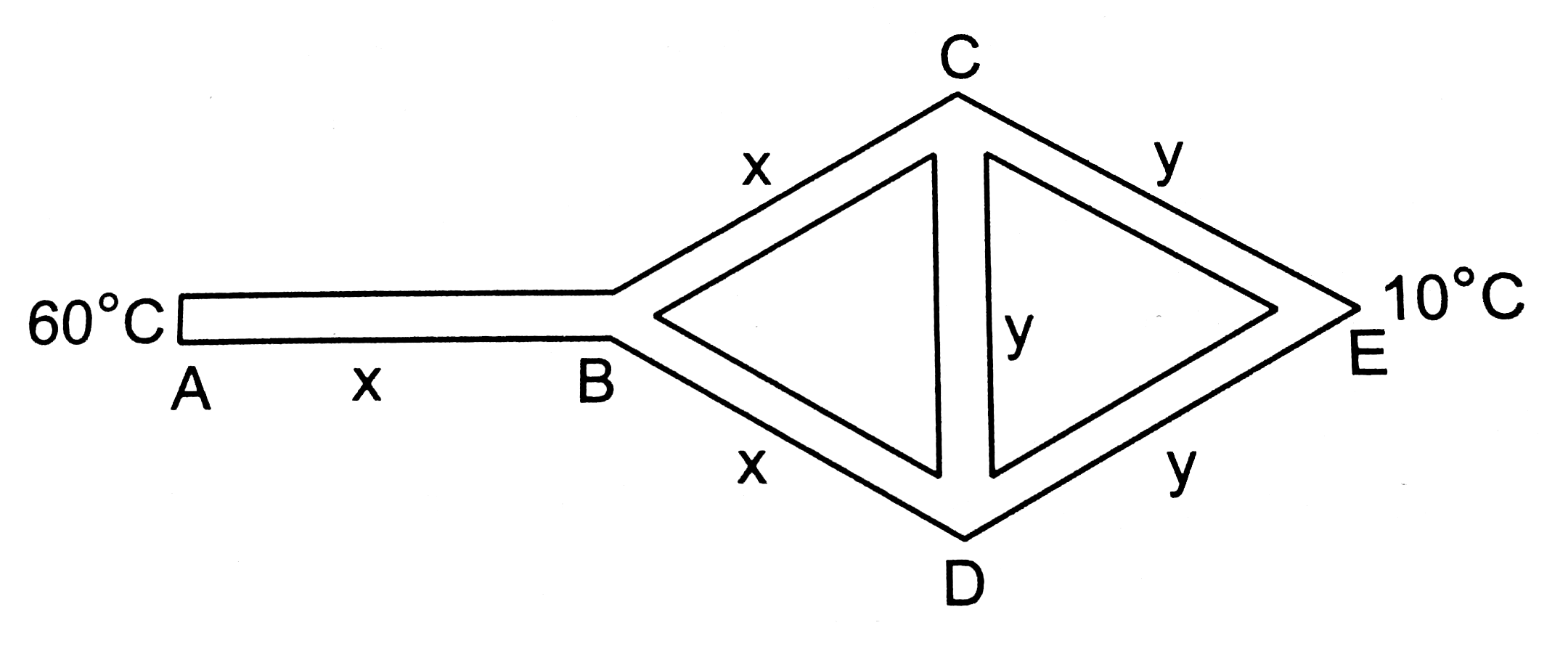
Three rods of material `x` and three of material `y` are connected as shown in figure. All the rods are identical in length and cross sectional area. If the end `A` is maintained at `60^(@)C` and the junction `E` at `10^(@)C` , calculate the temperature of the junction `B`. The thermal conductivity of `x` is `800Wm^(-1).^(@)C^(-1)` and that of `y` is `400Wm^(-1).^(@)C^(-1)` .

Text Solution

Verified by Experts

The correct Answer is:

B, C, D

Thermal resistance, `R = l/(KA)`
`R_x/R_y = K_y/ K_x ` (as `l_x = l_y` and `A_x = A_y`)
`=0.46/0.92`
`=1/2`
So, if `R_x = R` then` R_y = 2R`
CEDB forms a balanced wheatstone bridge, i.e. `T_C - T_D` and no heat flows through CD.
`:. 1/R_(BE) = 1/(R+R) + 1/(2R + 2R)`
or `R_(BE) = 4/3 R`
The total resistance between A and E will be
`R_(AE) = R_(AB) + R_(BE) = 2R + 4/3R = 10/3R`
`:.` Heat current between A and E is
`H = ((DeltaT)_(AE))/R_(AE) = (60-10)/((10//3)R) = 15/R`
Now, if `T_B` is the temperature at B,
`H_(AB) = ((DeltaT)_(AB))/R_(AB)`
or `15/R = (60 - T_(B))/(2R)`
or `T_(B) = 30^@C`
Further,
`H_(AB) = H_(BC) + H_(BD)`
or `15/R = (30-T_(C))/R + (30-T_(D))/(2R) [T_C = T_D = T(say)]`
or `15 = (30-T) + (30-T)/2`
Solving this, we get `T=20^@C`
or `T_C = T_D = 20^@C`
Promotional Banner

Topper's Solved these Questions

  • CALORIMETRY & HEAT TRANSFER

    DC PANDEY ENGLISH|Exercise Exercise 22.1|7 Videos
  • CALORIMETRY & HEAT TRANSFER

    DC PANDEY ENGLISH|Exercise Exercise 22.2|7 Videos
  • CALORIMETRY & HEAT TRANSFER

    DC PANDEY ENGLISH|Exercise Example Type 4|4 Videos
  • BASIC MATHEMATICS

    DC PANDEY ENGLISH|Exercise Exercise|13 Videos
  • CALORIMETRY AND HEAT TRANSFER

    DC PANDEY ENGLISH|Exercise Medical entrance s gallery|38 Videos

Similar Questions

Explore conceptually related problems

Three rods of material X and three rods of material Y are connected as shown in the figure. All the rods are of identical length and cross-sectional area. If the end A is maintained at 60^@C and the junction E at 10^@C . Calculate the temperature of the junction B, C and D. The thermal conductivity of X is 0.92cal//sec-cm^@C and that of Y is 0.46cal//sec-cm-^@C .

Seven identical rods of material of thermal conductivity k are connected as shown in Fig. All the rods are of identical length l and cross sectional area A If the one end A is kept at 100^@C and the other end is kept at 0^@C what would be the temperatures of the junctions C, D and E(theta_C , theta)D and theta_E ) in the steady state?

Figure shows a copper rod joined to a steel rod. The rods have equal length and and the equal cross sectional area. The free end of the copper rod is kept at 0^(@)C and that of the steel rod is kept at 100^(@)C . Find the temperature at the junction of the rods. conductivity of copper =390WM^(-1).^(@)C^(-1) and that of steel =46Wm^(-1).^(@)C^(-1) .

Figure shows a copper rod joined to a steel rod. The rods have equal length and and the equal cross sectional area. The free end of the copper rod is kept at 0^(@)C and that of the steel rod is kept at 100^(@)C . Find the temperature at the junction of the rods. conductivity of copper =390Wm^(-1)C^(-1) and that of steel =46Wm^(-1)C^(-1) .

The ends of copper rod of length 1m and area of cross section 1cm^(2) are maintained at 0^(@)C and 100^(@)C . At the centre of rod, there is a source of heat of 32W . The thermal conductivity of copper is 400W//mK

Two identical metal rods A and B are joined end to end. The free end of A is kept at 27°C and the free end of B at 37°C. Calculate the temperature of the interface. Thermal conductivity of A = 385 "Wm"^(-1) "K"^(-1) , that of B 110 "Wm"^(-1) "K"^(-1) .

A rod AB is 1m long. The temperature of its one end A is maintained at 100^(@) C and other end B at 10^(@) C, the temperature at a distance of 60 cm from point B is

Four rods of material X and three rods of material Y are connected as shown in figure. All the rods are of identical lengths and cross-sectional area. Given thermal resistance of rod of material X, R_(x) = R and thermal conductivities of materials are related by relation K_(Y) = 2K_(X) . {:(,"Column-I",,"Column-II"),((A),"Thermal resistance between B and E" ,(p),(500)/(13).^(@)C ),((B),"Thermal resistance between A and F" ,(q),(700)/(13).^(@)C ),((C),"Temperature of junction B" ,(r),(2R)/(3)), ((D),"Temperature of junction D" ,(s),(13R)/(6)):}

Three identical rods have been joined at a junction to make it a Y shape structure. If two free ends are maintained at 45^(@)C and the end is at 0^(@)C , then what is the junction temperature T?

Three rods of equal length, area of cross section and thermal conductivity are connected as shown in the figure. There is no heat loss through lateral surface of the rods and temperature of ends are T_(A)=100^(@)C, T_(B)=70^(@)C and T_(C)=50^(@)C . Find the temperature of junction.
