Home
Class 12
PHYSICS
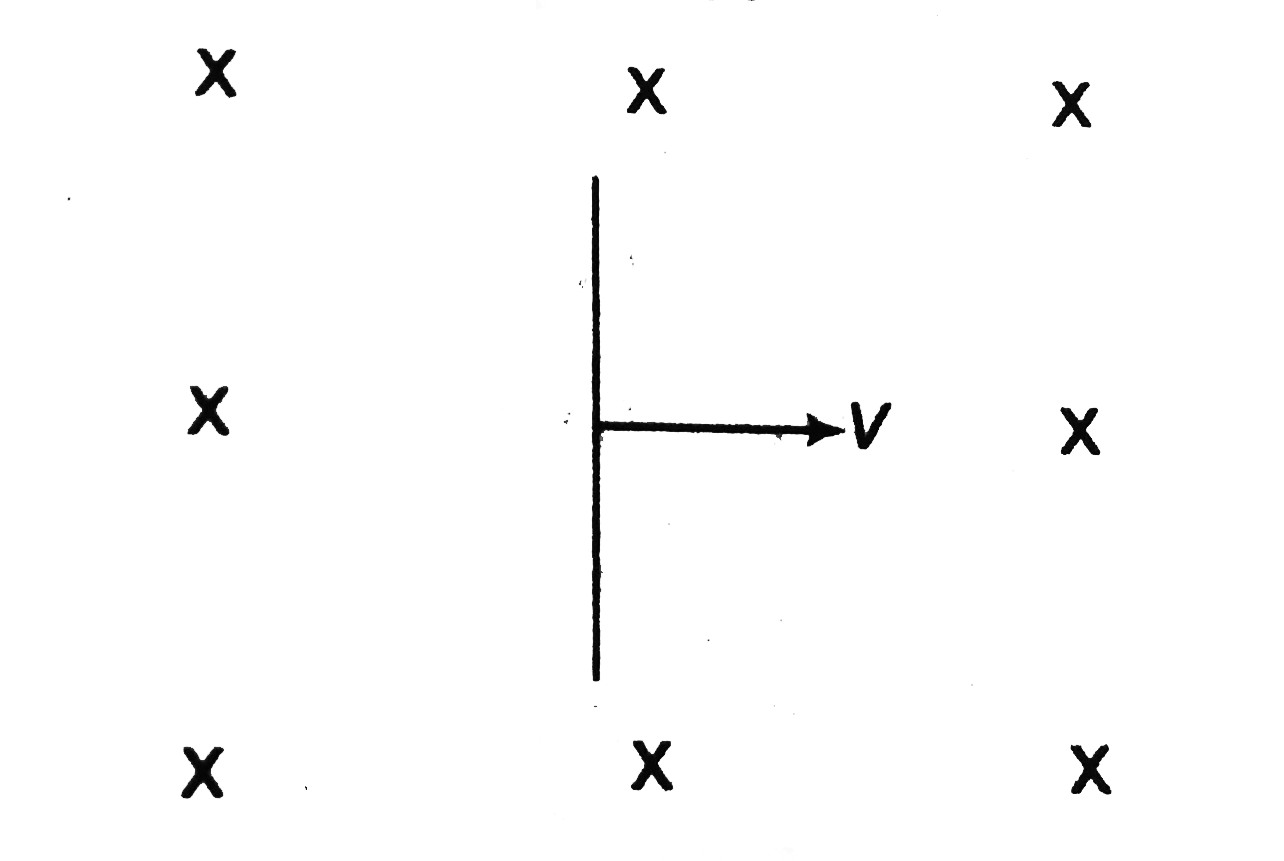
As the bar shown in figure moves in a di...

As the bar shown in figure moves in a direction perpendicular to the field, is an external force required to keep it moving with constant speed.

Text Solution

Verified by Experts

Circuit is not closed. So, current is zero or magnetic force is zero.
Promotional Banner

Topper's Solved these Questions

  • ELECTROMAGNETIC INDUCTION

    DC PANDEY ENGLISH|Exercise Exercise 27.3|4 Videos
  • ELECTROMAGNETIC INDUCTION

    DC PANDEY ENGLISH|Exercise Exercise 27.4|3 Videos
  • ELECTROMAGNETIC INDUCTION

    DC PANDEY ENGLISH|Exercise Exercise 27.1|8 Videos
  • CURRENT ELECTRICITY

    DC PANDEY ENGLISH|Exercise Medical entrances gallery|97 Videos
  • ELECTROMAGNETIC WAVES

    DC PANDEY ENGLISH|Exercise Sec C|22 Videos

Similar Questions

Explore conceptually related problems

Is force needed to keep a moving body in motion ?

Figure shows a wire sliding on two parallel, conducting rails placed at a separation L . A magnetic field B exists in a direction perpendicular to the plane of the rails. What force is necessary to keep the wire moving at a constant velocity V ?

Minimum force F required to move the block

A rectangle loop with a sliding connector of length l=1.0 m is situated in a uniform magnetic field B=2T perpendicular to the plane of loop. Resistance of connector is r=2Omega . Two resistance of 6Omega and 3Omega are connected as shown in figure. the external force required to keep the connector moving with a constant velocity v=2m//s is

A20 kg block is initally at rest. A 75 N force is required to set the block in motion. After the motion starts, a force of 60 N is required to keep the block moving with constant speed. The coefficient of static friction is

In the figure shown the four rods have lambda resistance per unit length . The arrangement is kept in a magnetic field of constant magnitude B and directed perpendicular to the plane of the figure and direction inwards . Initially the sides as shown form a square . Now each wire starts moving with constant velocity v towards opposite wire . Find as a function of time . Force required on each wire to keep its velocity constant .

In the figure shown the four rods have lambda resistance per unit length . The arrangement is kept in a magnetic field of constant magnitude B and directed perpendicular to the plane of the figure and direction inwards . Initially the sides as shown form a square . Now each wire starts moving with constant velocity v towards opposite wire . Find as a function of time . Total power required to maintain constant velocity .

A 20 kg block is initially at rest. A 75 N force is required to set the block in motion. After the motion a force of 60 N is applied to keep the block moving with constant speed. The coefficient of static friction is

in fig. The four rods have lambda resistance per unit length. The arrengement is kept in a magnetic field of constant magnitude B and directed perpendicular to the plane of the figure and directing in ward. Initially, the sides as shown form a square. Now each wire starts moving with constant velocity v toward the opposite wire. Find as a function of time: (a) induced emf in the circuit. (b) induced current in the circuit with direction. ( c ) force required on each wire to keep its velocity consatnt. (d) total power required to maintain constant velocity. (e) thermal power developed in the circuit.

A uniform but time varying magnetic field exists in a cylindrical region as shown in the figure. The direction of magnetic field is into the plane of the paper and its magnitude is decreasing at a constant rate of 2xx10^-3T//s . A particle of charge 1muC is moved slowly along circle of radius 1m by an external force as shown in figure. The plane of the circle of radius 1m by an external force as shown in figure. The plane of he circle lies in the plane of the paper and it is concentric with the cylindrical region. The work done by the external force in moving this charge along the circle will be
