Home
Class 12
PHYSICS
Magnetic field in cylindrical region of ...

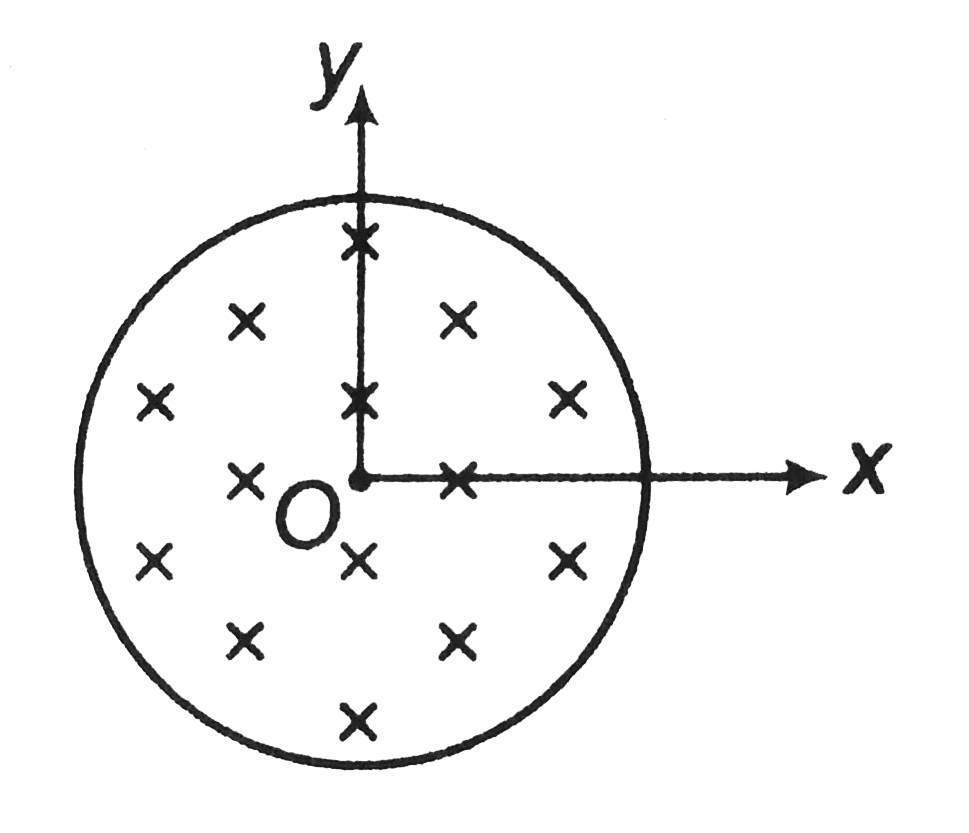
Magnetic field in cylindrical region of radius `R` in inward direction is as shown in figure.

A

an electron will expereince no force kept is `(2R,0,0)` if magnetic field increases with time

B

in the above situation, electron will experience the force in negative y-axis

C

if a proton is kept at `(0, R/2,0)` and magnetic field is decreasing then it will experience the force in positive x-direction

D

if a proton is kept at `(-R,0,0)` and magnetic field is increasing then it will experience force in negative y-axis

Text Solution

Verified by Experts

The correct Answer is:

B, C, D

If `ox` magnetic field increases, then induced electric lines are anti clockwie. If `ox` magnetic field decreases, then induced electric lines are clockwise (both inside and outside the cylindrical region).
On positive charge, force is the is in the direction of `E`. On negative chare, force is in the opposite.
Promotional Banner

Topper's Solved these Questions

  • ELECTROMAGNETIC INDUCTION

    DC PANDEY ENGLISH|Exercise Level 2 Comprehension Based|13 Videos
  • ELECTROMAGNETIC INDUCTION

    DC PANDEY ENGLISH|Exercise SUBJECTIVE TYPE|1 Videos
  • ELECTROMAGNETIC INDUCTION

    DC PANDEY ENGLISH|Exercise Level 2 Single Correct|37 Videos
  • CURRENT ELECTRICITY

    DC PANDEY ENGLISH|Exercise Medical entrances gallery|97 Videos
  • ELECTROMAGNETIC WAVES

    DC PANDEY ENGLISH|Exercise Sec C|22 Videos

Similar Questions

Explore conceptually related problems

A unifrom magnetic field B exists in a cylindrical region of radius 1 cm as shown in figure. A uniform wire of length 16 cm and resistance 4.0 Omega is bent into a square frame and is placed with one side along a diameters of the cylindrical region. If the magnetic field increaes at a constant rate of 1 T/s find the current induced in the frame.

In a region of space, magnetic field exists in a cylindrical region of radius a centred at origin with magnetic field along negative z-direction. The field is given by vecB=-B_(0)thatk . The force experienced by a stationary charge q placed at (r, 0, 0), where r gt a is

Magnetic field B in a cylindrical region of radius r varies according to the law B = B_(0)t as shown in the figure. A fixed conducting loop ABCDA of resistance R is lying in the region as show . The current flowing through the loop is

A uniform but time varying magnetic field B=(2t^3+24t)T is present in a cylindrical region of radius R =2.5 cm as shown in figure. In the previous problem, the direction of circular electric lines at t=1 s is

A uniform but time varying magnetic field B=(2t^3+24t)T is present in a cylindrical region of radius R =2.5 cm as shown in figure. The variation of electric field at any instant as a function of distance measured from the centre of cylinder in first problem is

A uniform but time varying magnetic field B=(2t^3+24t)T is present in a cylindrical region of radius R =2.5 cm as shown in figure. The force on an electron at P at t=2.0 s is

A time varying magnetic field B = Kr^(3)t is existing in a cylindrical region of radius 'R' as shown (where k is a constant). The induced electric field 'E' at r (R )/(2) is

A uniform but time varying magnetic field B(t) exist in a circular region of radius a and is directed into the plane of the paper as shown. The magnitude of the induced electric field at point P at a distance r form the centre of the circular region.

A uniform but time-varying magnetic field B(t) exists in a circular region of radius a and is directed into the plane of the paper, as shown. The magnitude of the induced electric field at point P at a distance r from the centre of the circular region

A uniform but time varying magnetic field exists in a cylindrical region as shown in the figure. The direction of magnetic field is into the plane of the paper and its magnitude is decreasing at a constant rate of 2xx10^-3T//s . A particle of charge 1muC is moved slowly along circle of radius 1m by an external force as shown in figure. The plane of the circle of radius 1m by an external force as shown in figure. The plane of he circle lies in the plane of the paper and it is concentric with the cylindrical region. The work done by the external force in moving this charge along the circle will be
