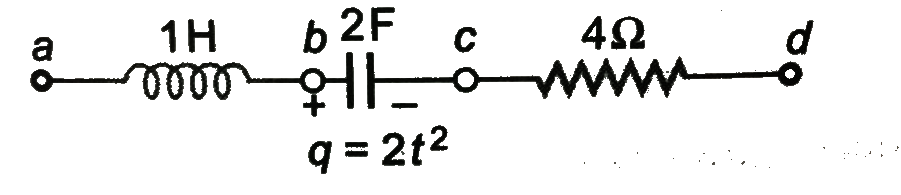
A
B
C
D
Text Solution
Verified by Experts
The correct Answer is:



Topper's Solved these Questions
ELECTROMAGNETIC INDUCTION
DC PANDEY ENGLISH|Exercise Level 2 Comprehension Based|13 VideosELECTROMAGNETIC INDUCTION
DC PANDEY ENGLISH|Exercise SUBJECTIVE TYPE|1 VideosELECTROMAGNETIC INDUCTION
DC PANDEY ENGLISH|Exercise Level 2 Single Correct|37 VideosCURRENT ELECTRICITY
DC PANDEY ENGLISH|Exercise Medical entrances gallery|97 VideosELECTROMAGNETIC WAVES
DC PANDEY ENGLISH|Exercise Sec C|22 Videos
Similar Questions
Explore conceptually related problems
DC PANDEY ENGLISH-ELECTROMAGNETIC INDUCTION-Level 2 More Than One Correct
- The loop shown moves with a velocity v in a uniform magnetic field of ...
Text Solution
|
- An infinitely long wire is placed near a square loop as shown in figur...
Text Solution
|
- Choose the correct options
Text Solution
|
- In the circuit shown in figure, circuit is closed at time t=0. At time...
Text Solution
|
- Two circular coils are placed adjacent to each other. Their planes are...
Text Solution
|
- A coil of area 2m^2 and resistane 4Omega is placed perpendicular to a ...
Text Solution
|
- In L − C oscillations
Text Solution
|
- Magnetic field in cylindrical region of radius R in inward direction i...
Text Solution
|
- In the figure shown q is in coulomb and t in second. At time t=1 s
Text Solution
|
- An equilateral triangular conducting frame is rotated with angular vel...
Text Solution
|