Home
Class 12
PHYSICS
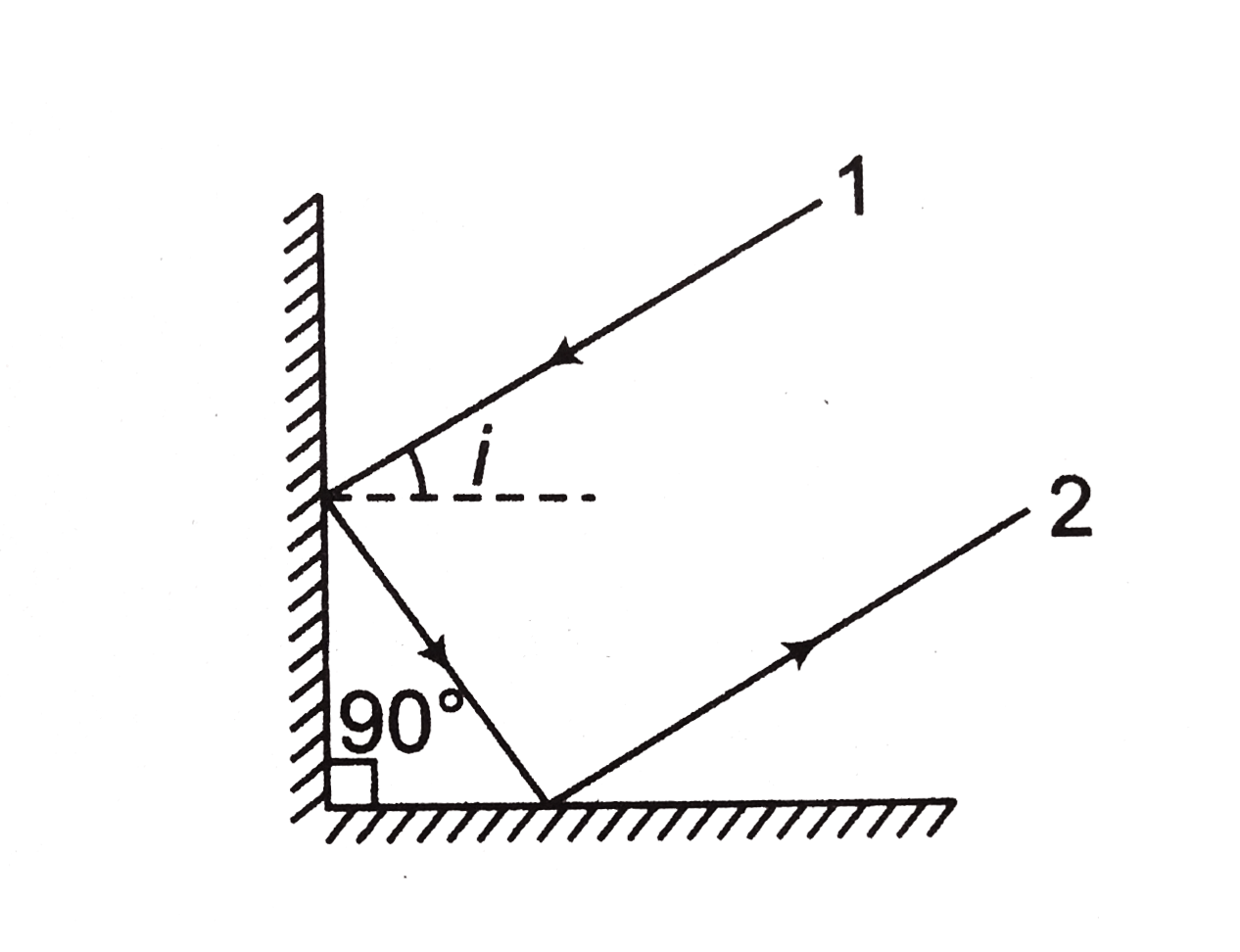
Prove that for any value of angle i, ray...

Prove that for any value of angle i, rays `1 and 2` are parallel

Text Solution

Verified by Experts

PQ and MN are mutually parallel . Rays 1 and 2 are making equal angles`(=/_i)`
from PQ and MN. So, they are muttually parallel.
Important result -two plane mirror kept at `90^(@)` deviate each ray of light by `180^(@)` from its orignal path.
(##DCP_V05_C30_S01_002_S01##)
Promotional Banner

Topper's Solved these Questions

  • REFLECTION OF LIGHT

    DC PANDEY ENGLISH|Exercise Type-2|2 Videos
  • REFLECTION OF LIGHT

    DC PANDEY ENGLISH|Exercise Example Type 2|1 Videos
  • RAY OPTICS

    DC PANDEY ENGLISH|Exercise Medical entrance gallary|76 Videos
  • REFRACTION OF LIGHT

    DC PANDEY ENGLISH|Exercise Level 2 Subjective|21 Videos

Similar Questions

Explore conceptually related problems

Two plane mirrors are arranged at right angles to each other as shown in figure.A ray of light is incident on the horizontal mirror at an angle theta . For what value of theta the ray emerges parallel to the incoming ray after reflection from the vertical mirror ?

Prove that if the two arms of an angle are parallel to the two arms of another angle, then the angles are either equal or supplementary.

The sides of an isosceles right prism are coated with a reflecting coating. A ray of light falls on the hypotenuse at an arbitrary angle i. For what value of i the ray leaving the prism is parallel to the incident ray ?

Figure, shown two converging lenses. Incident rays are parallel to the principal axis. What should be the value of d so that final rays are also parallel? Here, the diameter of ray beam become wider.

A B ,C D are two parallel lines and a transversal l intersects A B at X and C D at Y Prove that the bisectors of the interior angles form a parallelogram, with all its angles right angles i.e., it is a rectangle.

A B ,C D are two parallel lines and a transversal l intersects A B at X and C D at Y Prove that the bisectors of the interior angles form a parallelogram, with all its angles right angles i.e., it is a rectangle.

A transversal intersects two parallel lines. Prove that the bisectors of any pair of corresponding angles so formed are parallel.

Prove that the bisectors of opposite angles of a parallelogram are parallel.

Prove that any angle subtended by a minor arc in the alternate segment is acute and any angle subtended by a major arc in the alternate segment is obtuse.

Prove that the limiting angle of incidence of a ray that can be transmitted by an equilateral prism of mu = sqrt(7//3) will be 30^@ .
