Home
Class 12
PHYSICS
Light is incident at an angle i on one p...

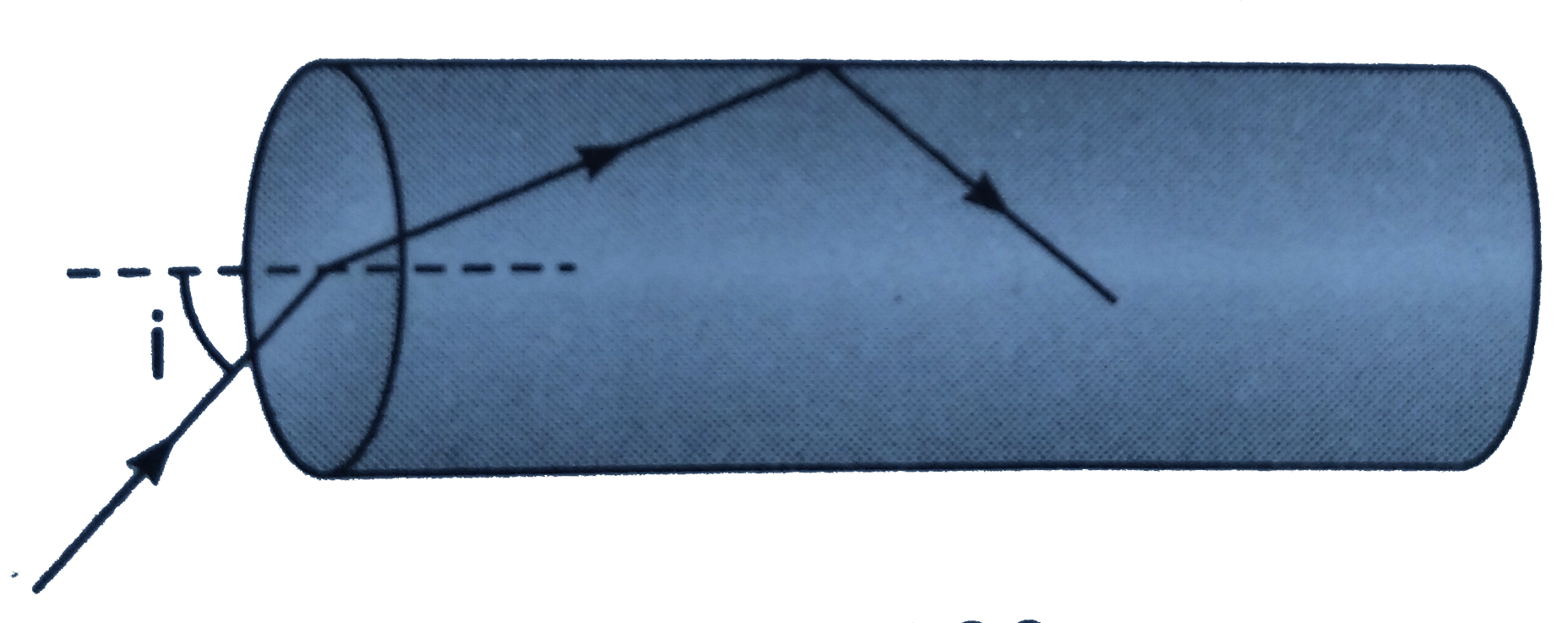
Light is incident at an angle i on one planer end of a transparent cylinderical rod of refractive index `mu.` Find the least value of `mu` so that the light entering the rod does not emerge from the curved surface of the rod irrespective of the value of `i.`

Text Solution

Verified by Experts

The correct Answer is:
B

`ABC` can be treated as a prism with angle of prism `A = 90^(@)`. Condition of no emerage is

`A ge `2theta_(C)`
or `sintheta_(C) lt sin ((A)/(2))`
or `(1)(mu) le sin 45^(@)`
or `(1)/(mu) le (1)/(sqrt(2))`
`:. mu ge sqrt(2)`
Promotional Banner

Topper's Solved these Questions

  • REFRACTION OF LIGHT

    DC PANDEY ENGLISH|Exercise Exercise 31.4|1 Videos
  • REFRACTION OF LIGHT

    DC PANDEY ENGLISH|Exercise Exercise 31.5|5 Videos
  • REFRACTION OF LIGHT

    DC PANDEY ENGLISH|Exercise Exercise 31.2|2 Videos
  • REFLECTION OF LIGHT

    DC PANDEY ENGLISH|Exercise Subjective|9 Videos
  • SEMICONDUCTORS

    DC PANDEY ENGLISH|Exercise Subjective|12 Videos

Similar Questions

Explore conceptually related problems

What should be the value of refractive index n of a glass rod placed in air, so that the light entering through the flat surface of the rod does not cross the curved surface of the rod?

Light enters at an angle of incidence in a transparent rod of refractive index n. For what value of the refractive index of the material of the rod the light once entered into it will not leave it through its lateral face whatsoever be the value of angle of incidence.

Light enters at an angle of incidence in a transparent rod of refractive index n. For what value of the refractive index of the material of the rod the light once entered into it will not leave it through its lateral face whatsoever be the value of angle of incidence.

A ray of light is incident on a glass sphere of refractive index 3/2. What should be the angle of incidence so that the ray which enters the sphere does not come out of the sphere ?

Unpolarised light is incident from air on a plane surface of a material of refractive index mu . At a particular angle of incidence i , it is found that the reflected and refracted rays are perpendicular to each other. Which of the following options is correct for this situation?

Unpolarised light is incident from air on a plane surface of a material of refractive index .mu. . At a particular angle of incidence .I., it is found that the reflected and refracted rays are perpendicular to each other. Which of the following options is correct for this situation?

Find the distance of object placed in the slab of refractive index mu from point P of the curved surface of radius R so that image is formed at infinity:

The outer surface of a transparent glass slab of refractive index mu_(S)=1.5 is coated by a thin layer of transparent medium of refractive index mu_(C)=1.6 . Orange light of wavelength 6400Å falls normally on the coating. The reflected light at the upper surface and at the lower surface of the coat interfere destructively. If thickness of the coat is 5Kxx10^(-8) m, calculate the minimum value of K.

A ray of light is incident on one face of a transparent slab of thickness 15 cm. The angle of incidence is 60^(@) . If the lateral displacement of the ray on emerging from the parallel plane is 5sqrt(3) cm, the refractive index of the material of the slab is

A point source of light is placed at a depth of h below the surface of water of refractive index mu . A floating opaque disc is placed on the surface of water so that light from the source is not visible from the surface. The minimum diameter of the disc is

