Home
Class 12
PHYSICS
A beam of light parallel to central line...

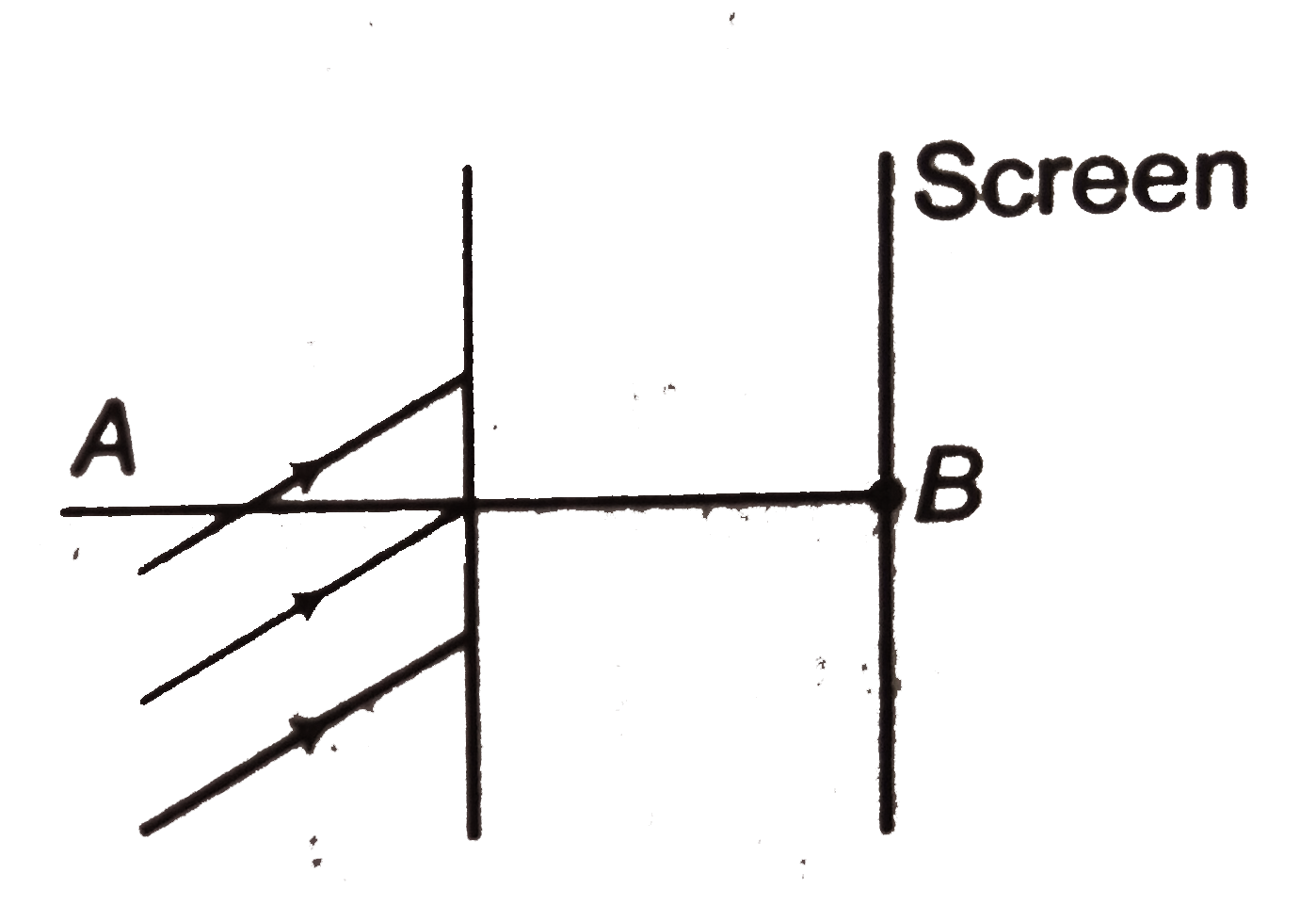
A beam of light parallel to central line AB is incident on the plane of slits. The number of minimum, obtained on the large screen is `n_1`. Now if the beam is tilted by some angle `(!= 90^@)` as shown in figure, then the number of minima obtained is `n_2`. Then,

A

`n_1 =n_2`

B

`n_1gtn_2`

C

`n_2gtn_1`

D

`n_2` will be zero.

Text Solution

Verified by Experts

The correct Answer is:

A

Only fringe pattern will shift. Number of fringes
on screen will remain unchanged.
Promotional Banner

Topper's Solved these Questions

  • INTERFERENCE AND DIFFRACTION OF LIGHT

    DC PANDEY ENGLISH|Exercise Level 1Subjective|22 Videos
  • INTERFERENCE AND DIFFRACTION OF LIGHT

    DC PANDEY ENGLISH|Exercise Subjective Questions|5 Videos
  • INTERFERENCE AND DIFFRACTION OF LIGHT

    DC PANDEY ENGLISH|Exercise Level 1 Objective|11 Videos
  • GRAVITATION

    DC PANDEY ENGLISH|Exercise All Questions|135 Videos
  • MAGNETIC FIELD AND FORCES

    DC PANDEY ENGLISH|Exercise Medical entrance s gallery|59 Videos

Similar Questions

Explore conceptually related problems

In figure, if a parallel beam of white light is incident on the plane of the slit, then the distance of the nearest white spot on the screen form O is [assume d lt lt D, lambda lt lt D ]

Light of wavelength 5000 Å is incident on a slit of width 0.1 mm. Find out the width of the central bright line on a screen distance 2m from the slit?

In the figure , if a parallel beam of white light is incident on the plane of the slits S_1 and S_2 then the distance of the nearest white spot on the screen from O is [ Assume D gtgtd, d gtgtlamda ]

A coherent parallel beam of light of wavelength 5000 A is incident normally on the plane of slits. The slit S_(1) is covered with a slab of refractive index mu_(s) = 1.5 and thickness t = 4 xx 10^(-5)m as shown. The separation between the slits is d = 1 mm and the separtion between the plane of slits and screen is D = 1m . Then the position of the central maxima formed on the screen is

In Young's double slit experiment parallel monochromatic light is incident on both the slits at an angle as shown in the figure. To obtain the central maxima at on the screen we can

Light of wavelength 6000A^(0) is incident on a single slit. The first minimum of the diffraction pattern is obtained at 4 mm from the centre. The screen is at a distance of 2m from the slit. The slit width will be

A coherent parallel beam of microwaves of wavelength lambda = 0.5 mm falls on aYoung's double- slit apparatus. The separation between the slits is 1.0 mm. The intensity of microwaves is measured on a screen placed parallel to the plane of the slits at a distance of 1.0 m from it as shown in Fig. 2.42. If the incident beam makes an angle or 30^(@) with the x-axis (as in the dotted arrow shown in the figure), find the y-coordinates of the first minima on either side of the central maximum.

A parallel beam of light of wavelength 600 nm is incident normally on a slit of width d. If the distance between the slits and the screen is 0.8 m and the distance of 2^(nd) order maximum from the centre of the screen is 15 mm. The width of the slit is

A monochromatic light of wavelength 500 nm is incident normally on a single slit of width 0.2 nm of produce a diffraction pattern. Find the angular width of the central maximum obtained on the screen. Estimate the number of fringes obtained in Young's double slit experimental with fringe width 0.5 mm , which can be accommodated within the region of total angular spread of the central maximum due to single slit.

In figure, parallel beam of light is incident on the plane of the slits of a Young's double-slit experiment. Light incident on the slit S_(1) passes through a medium of variable refractive index mu = 1 + ax (where 'x' is the distance from the plane of slits as shown), up to distance 'I' before falling on S_(1) . Rest of the space is filled with air. If at 'O' a minima is formed. then the minimum value of the positive constant a (in terms of l and wavelength lambda in air) is
