Home
Class 11
PHYSICS
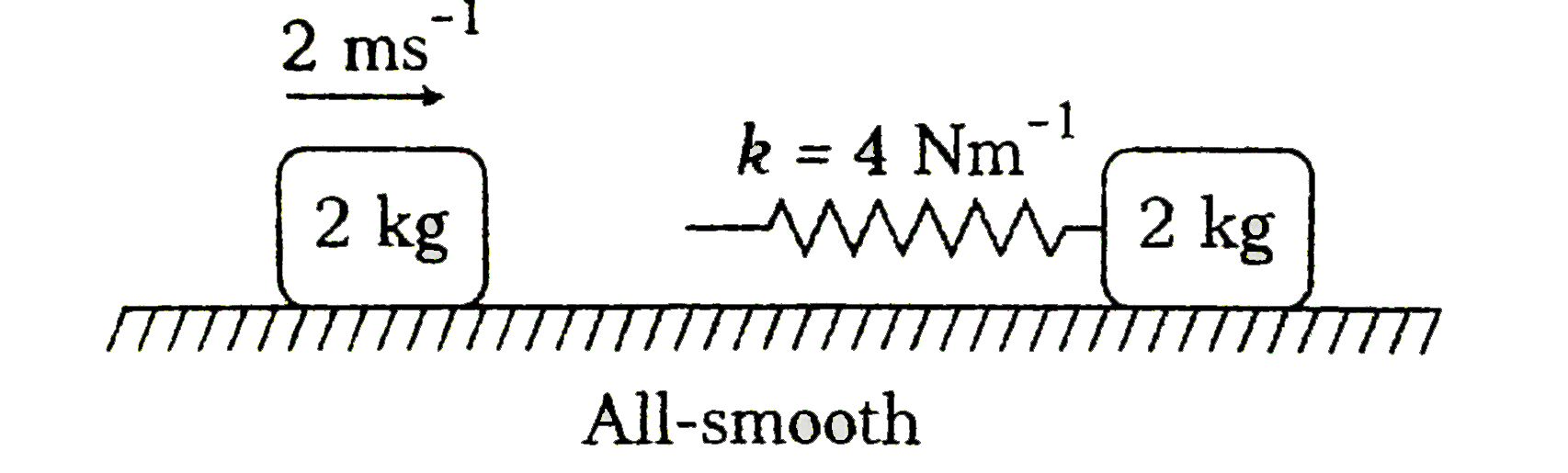
In the arrangement shown in figure match...

In the arrangement shown in figure match the following

`{:("column1","column2"),("A Velocities of center of mass","P 2SI unit"),("B Velocity of combined mass when compression in the spring is maximum","Q 1 SI unit"),("C Maximum compression in the spring","R 4 SIunit"),("D Maximum potential energy stored in the spring","S 0.5SI unit"):}`

Text Solution

Verified by Experts

The correct Answer is:

A `rightarrow`q, B `rightarrow`q, C`rightarrow`q, D `rightarrow`p

`v_(CM)=(m_(1)v_(1) + m_(2)v_(2)) = 1ms^(-1)`
During maximum compression also, velocity of combined mass is `ms^(-1)`.
Now, `U_(max) = K_(1) - K_(2)`
`1/2KX_(max)^(2) = 2J`
We have, `X_(max) = 1m`
Promotional Banner

Topper's Solved these Questions

  • CENTRE OF MASS

    DC PANDEY ENGLISH|Exercise Medical entrances gallery|27 Videos
  • CENTRE OF MASS

    DC PANDEY ENGLISH|Exercise Assertion and reason|21 Videos
  • CALORIMETRY AND HEAT TRANSFER

    DC PANDEY ENGLISH|Exercise Medical entrance s gallery|38 Videos
  • CENTRE OF MASS, IMPULSE AND MOMENTUM

    DC PANDEY ENGLISH|Exercise Comprehension type questions|15 Videos

Similar Questions

Explore conceptually related problems

In a two block system in figure match the following. {:("Column1","Column2"),("A Velocity of center of mass","P Keep on changing all the time"),("B Momentum of center of mass","Q First decreases then become zero"),("C Momentum of 1kg block","R Zero"),("D Kinetic energy of 2kg block","S Constant"):}

In the diagram shown in figure, match the following columns (take g=10 ms^(-2) ) {:("Column I","Column II"),("(A) Normal reaction","(p) 12 SI unit"),("(B) Force of friction","(q) 20 SI unit"),("(C) Acceleration of block","(r) zero"),(,"(s) 2 SI unit"):}

A block of mass m moving with velocity v_(0) on a smooth horizontal surface hits the spring of constant k as shown. The maximum compression in spring is

In the diagram shown in figure, match the following (g=10 m//s^(2)) {:(,"Column-I",,,"Coloumn-II"),((A),"Acceleration of 2kg block",,(P), "8 Si unit"),((B),"Net force on 3kg block",,(Q),"25 SI unit"),((C),"Normal reaction between 2 kg and 1kg",,(R),"2 SI unit"),((D),"Normal reaction between 3 kg and 2kg " ,,(S)," 45 SI unit"),(,,,(T)," None"):}

. In the figure shown, AB = BC = 2m . Friction coefficient everywhere is mu=0.2. Find the maximum compression of the spring.

A block of mass m held touching the upper end of a light spring of force constant K as shown in figure. Find the maximum potential energy stored in the spring if the block is released suddenly on the spring.

A block of mass m is suddenly released from the top of a spring of stiffness constant k. a. Find the acceleration of block just after release. b. What is the compression in the spring at equilibrium. c. What is the maximum compression in the spring. d. Find the acceleration of block at maximum compression in the spring.

In an ideal pulley particle system, mass m_2 is connected with a vertical spring of stiffness k . If mass m_2 is released from rest, when the spring is underformed, find the maximum compression of the spring.

For the arrangement shown in figure, the spring is initially compressed by 3 cm . When the spring is released the block collides with the wall and rebounds to compress the spring again. (a) If the coefficient of restitution is (1)/sqrt(2) , find the maximum compression in the spring after collision. (b) If the time starts at the instant when spring is released, find the minimum time after which the block becomes stationary.

A block of mass 5 kg is released from rest when compression in spring is 2m . Block is not attached with spring and natural length of the spring in 4m . Maximum height of block from ground is :(g=10m//s^(2))
