Home
Class 11
PHYSICS
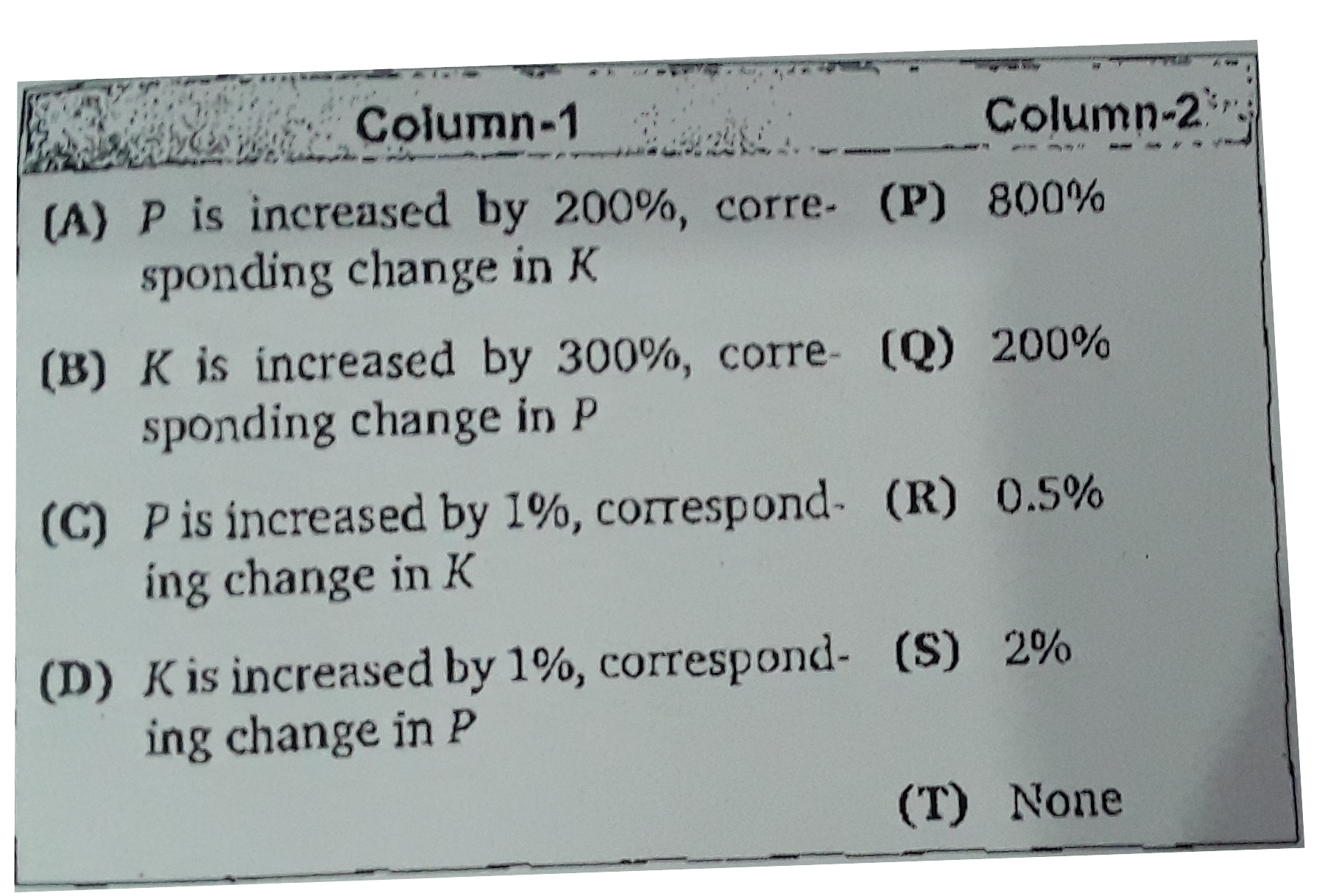
Match the following: (P = momentum of pa...

Match the following: (P = momentum of particle, K = kinetic energy of particle)

Text Solution

Verified by Experts

The correct Answer is:

(a `rightarrow`p, B`rightarrow`q, C `rightarrow`s, D `rightarrow` r

(a) `K=p^(2)/(2m)`
`rArr (3p^(2))/(2m) = 9(p^(2)/(2m) = 9K`
`therefore` % increase in K = 80%`
(b) `p=sqrt(2Km)`
`p^(') = sqrt(2(4K)m) = 2sqrt(2Km) = 2p
`therefore %` increase in p = 100%`.
(c) `p = sqrt(2Km) = (2Km)^(1/2)`
`rArr K6(') = (101/100)^(2)p/2m = 2%`
(d) % increase in `p =1/2` (%Increase in K) = 0.5%`
Promotional Banner

Topper's Solved these Questions

  • CENTRE OF MASS

    DC PANDEY ENGLISH|Exercise Medical entrances gallery|27 Videos
  • CENTRE OF MASS

    DC PANDEY ENGLISH|Exercise Assertion and reason|21 Videos
  • CALORIMETRY AND HEAT TRANSFER

    DC PANDEY ENGLISH|Exercise Medical entrance s gallery|38 Videos
  • CENTRE OF MASS, IMPULSE AND MOMENTUM

    DC PANDEY ENGLISH|Exercise Comprehension type questions|15 Videos

Similar Questions

Explore conceptually related problems

For a moving particle (mass m, velocity v) having a momentum p, which one of the following correctly describes the kinetic energy of the particle?

Cooling decreases the kinetic energy of particles.

When the linear momentum of a particle is increased by 1% its kinetic energy increases by x%. When the kinetic energy of the particle is increased by 300%, its linear momentum increases by y%. The ratio of y to x is

If the linear momentum of a prticle is known can you find its kinetic energy? If the kinetic energy of a particle is known can you find its linear momentum?

Consider a collision between two particles one of which is at rest and the other strikes it head on with momentum P_(1) . Calculate the energy of reaction Q in terms of the kinetic energy of the particles before and they collide.

A particle of mass m , kinetic energy K and momentum p collides head on elastically with another particle of mass 2 m at rest. After collision, : {:(,"Column I",,"Column II",),((A),"Momentum of first particle",(p),3//4 p,),((B),"Momentum of second particle",(q),-K//9,),((C ),"Kinetic energy of first particle",(r ),-p//3,),((D),"Kinetic energy of second particle",(s),(8K)/(9),),(,,(t),"None",):}

Consider the following two statements: A. Linear momentum of a system of particles is zero. B. Kinetic energy of a system of particles is zero.

On decreasing the heat, the kinetic energy of particles also decreases.

De-Broglie wavelengths of the particle increases by 75% then kinetic energy of particle becomes.

Consider the following two statements: A The linear momentum of a particle is independent of the frame of reference. B. The kinetic energy of a particle is independent of the frame of reference
