Home
Class 11
PHYSICS
A ball moving with a speed of 9 m s^(-1)...

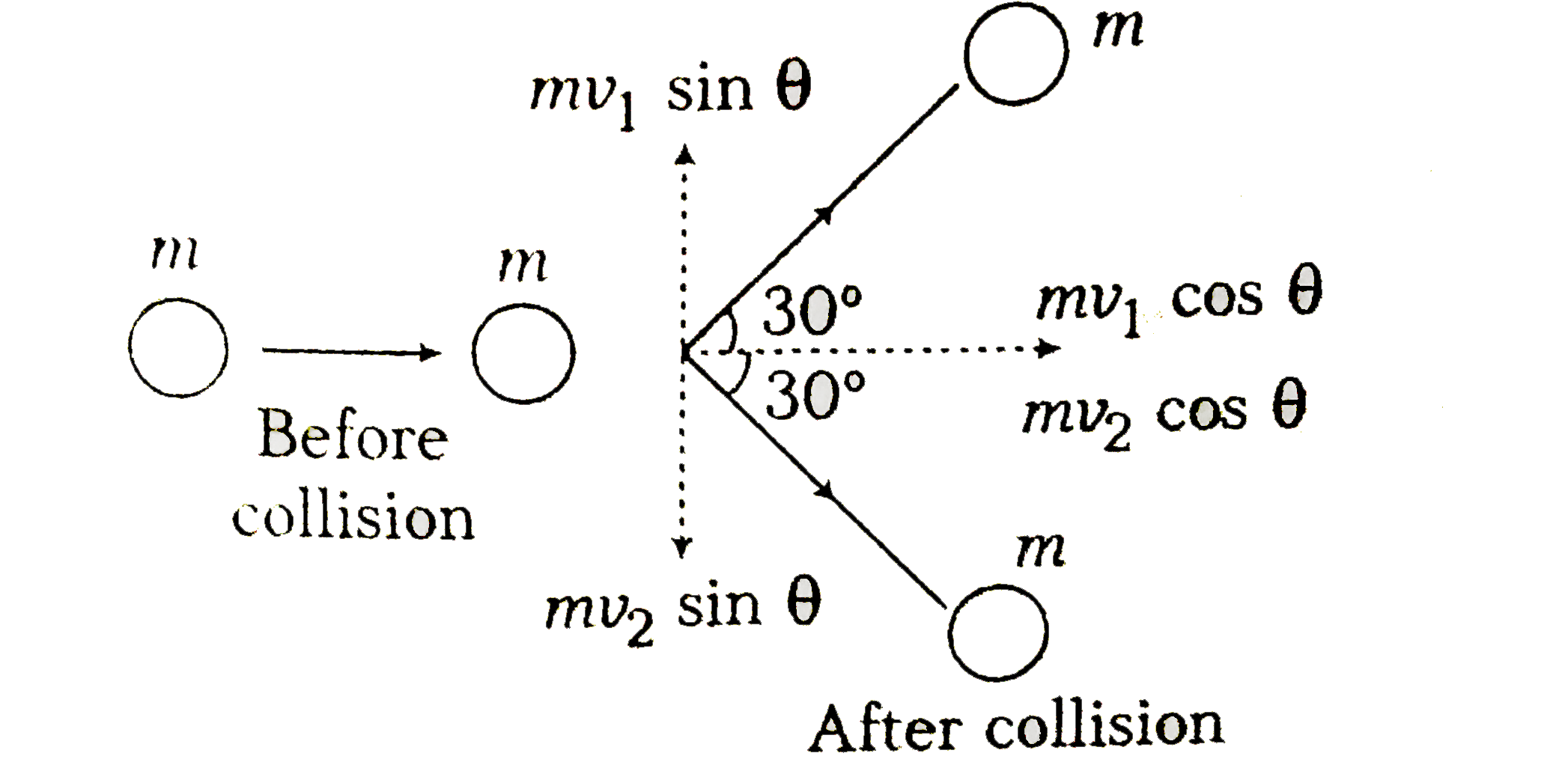
A ball moving with a speed of `9 m s^(-1)` strikes an identical stationary ball such that after the collision the direction of each ball makes an angle of `30^@` with the original line of motion. The speeds of two balls after the collision is

A

`5.2 ms^(-1)`

B

`0.52 ms^(-1)`

C

`52 ms^(-1)`

D

`26 ms^(-1)`

Text Solution

Verified by Experts

The correct Answer is:
A

The given conditionis can be shwon as
After collision, `mv_(1)sintheta = mv_(2)sintheta`
`rArr v_(1)=v-(2)=v`
`rArr 2mv cos 30^(@) = 9`
`rArr v=(9/sqrt(3)) = 3sqrt3) = 5.2ms^(-1)`
Promotional Banner

Topper's Solved these Questions

  • CENTRE OF MASS

    DC PANDEY ENGLISH|Exercise Match the coloumns|9 Videos
  • CALORIMETRY AND HEAT TRANSFER

    DC PANDEY ENGLISH|Exercise Medical entrance s gallery|38 Videos
  • CENTRE OF MASS, IMPULSE AND MOMENTUM

    DC PANDEY ENGLISH|Exercise Comprehension type questions|15 Videos

Similar Questions

Explore conceptually related problems

A ball , moving with a speed of 10 sqrt(3) m//s , strikes an identical stationary ball such that after the collision , the direction of each ball makes an angle of 30^(@) with the original line of motion. The speeds of two balla after the collision are , respectively.

A billiard ball moving at a speed of 6.6 ms–1 strikes an identical stationary ball a glancingblow. After the collision, one ball is found to be moving at a speed of 3.3, ms–1 in a direction making an angle of 60º with the original line of motion. The velocity of the other ball is

A moving 2 kg ball with a speed of 2 ms^(-1) hits obliquely a stationary identical ball inelastically as shown. If the first ball move away with angle alpha = 30^(@) to the original path, find the total kinetic energy lost after the collision

A ball A moving with a velocity 5 m/s collides elastically with another identical ball at rest such that the velocity of A makes an angle of 30^(@) with the line joining the centres of the balls. Then consider following statements : (A) Balls A an B move at right angles after collision (B) kinetic energy is conserved (C) speed of A after collision is (5/2) m/s (D) speed of B after collision is ( 5sqrt(3)//2 ) m/s Select correct alternative :-

A ball of mass 1 kg moving with a velocity of "0.4 ms"^(-1) collides with another stationary ball. After the collision, the first ball moves with a velocity of 0.3ms^(1) in a direction making an angle of 90^(@) with its initial direction. The momentum of the second ball after the collision will be (in kg ms^(-1) )

Two identical billiard balls undergo an oblique elastic collision. Initially, one of the balls is stationary. If the initially stationary ball after collision moves in a direction which makes an angle of 37^(@) with direction of initial motion of the moving ball, then the angle through which initially moving ball will be deflected is

A ball weighing 4 kg and moving with velocity of 8 m/sec. Collides with a stationary ball of mass 12 kg. After the collision, the two balls move together. The final velocity is

A smooth ball 'A' moving with velocity 'V' collides with another smooth identical ball at rest. After collision both the balls move with same speed with angle between their velocities 60^(@) . No external force acts on the system of balls. The speed of each ball after the collision is

An iron ball A collides with another stationary iron ball B If the ratio of radii of the balls is n = 2, find the ratio of their speeds just after the collision (e = 0.5)

A ball moving on a horizontal frictionless plane hits an identical ball at rest with a velocity of 0.5m//s . If the collision is elastic, calculate the speed imparted to the target ball, if the speed of projectile after the collision is 30cm//s .

DC PANDEY ENGLISH-CENTRE OF MASS-Medical entrances gallery
  1. A ball of mass M falls from a height h on a floor which the coefficien...

    Text Solution

    |

  2. Three particles of masses 0.50 kg, 1.0 kg and are placed at the corner...

    Text Solution

    |

  3. A large number of particles are placed around the origin, each at a di...

    Text Solution

    |

  4. A circular disc of radius R rolls without slipping along the horizonta...

    Text Solution

    |

  5. The linear momentum of a particle varies with time t as p= a +bt + ct^...

    Text Solution

    |

  6. A body of mass (4m) is laying in xy-plane at rest. It suddenly explode...

    Text Solution

    |

  7. The position of center of mass of a system of particles does not depen...

    Text Solution

    |

  8. A bullet is fired from the gun. The gun recoils, the kinetic energy of...

    Text Solution

    |

  9. An explosion blows a rock into three parts. Two parts go off at right ...

    Text Solution

    |

  10. The linear momentum is conserved in

    Text Solution

    |

  11. Three charges +q,-q, and +2q are placed at the verticles of a right an...

    Text Solution

    |

  12. A ball of mass 'm' moving with a horizontal velocity 'v' strikes the b...

    Text Solution

    |

  13. In an inelastic collision

    Text Solution

    |

  14. A body of mass m(1) moving with uniform velocity of 40 m/s collides w...

    Text Solution

    |

  15. Two spheres A and B of masses m(1) and m(2) respectively collide. A is...

    Text Solution

    |

  16. Two perons of masses 55 kg and 65 kg respectively, are at the opposite...

    Text Solution

    |

  17. A ball moving with a speed of 9 m s^(-1) strikes an identical stationa...

    Text Solution

    |

  18. A body of mass 0.25 kg is projected with muzzle velocity 100ms^(-1) fr...

    Text Solution

    |

  19. A particle of mass m(1) = 4 kg moving at 6hatims^(-1) collides perfect...

    Text Solution

    |

  20. A mass of 10 g moving horizontally with a velocity of 100 cm^(-1) stri...

    Text Solution

    |

