Home
Class 11
PHYSICS
From the fixed pulley, masses 2kg, 1kg a...

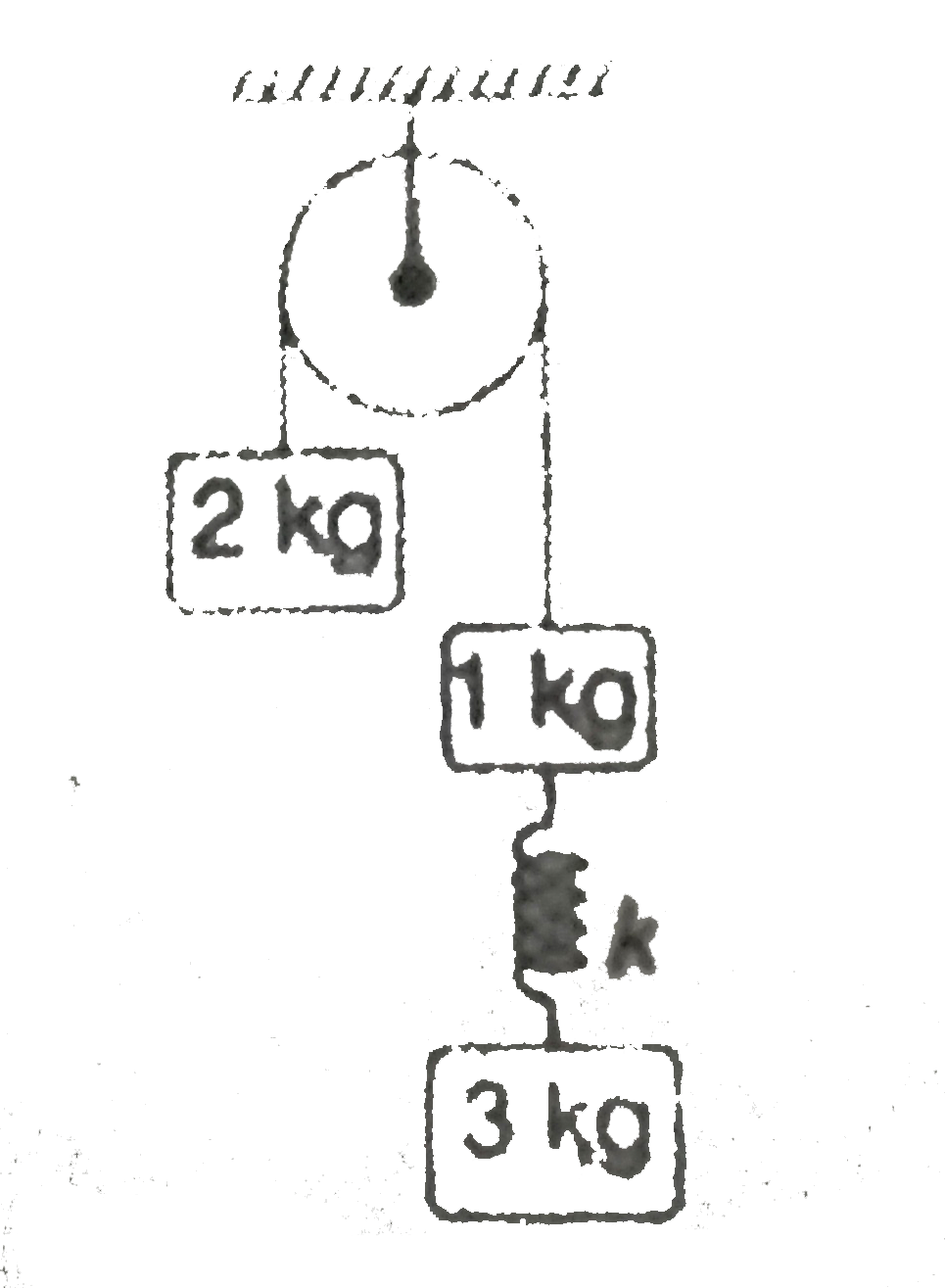
From the fixed pulley, masses 2kg, 1kg and 3kg are suspended as shown in the figure. Find the extension in the spring if `k=100 N//m`. (Neglect oscillations due to spring)

A

0.1m

B

0.2m

C

0.3m

D

0

Text Solution

Verified by Experts

The correct Answer is:

B
Promotional Banner

Topper's Solved these Questions

  • WORK, POWER AND ENERGY

    DC PANDEY ENGLISH|Exercise A Only One Option is Correct|42 Videos
  • WORK, POWER AND ENERGY

    DC PANDEY ENGLISH|Exercise B More than One Option is Correct|26 Videos
  • WORK, ENERGY AND POWER

    DC PANDEY ENGLISH|Exercise MEDICAL ENTRACES GALLERY|33 Videos

Similar Questions

Explore conceptually related problems

From the fixed pulley, masses 2 kg, 1 kg and 3 kg are suspended as shown is figure. Find the extension in the spring when acceleration of 3 kg and 1 kg is same if spring constant of the spring k = 100 N/m. (Take g = 10 ms^(-2) )

A block of mass m=5kg is placed on the wedge of mass M=32kg as shown in the figure. Find the acceleration of wedge with respect to ground. (Neglect any type of friction. Spring and pulley are ideal)

Same spring is attached with 2kg , 3kg and 1kg blocks in three different cases as shown in figure. If x_(1) , x_(2) and x_(3) be the extensions in the spring in these cases then (Assume all the block s to move with uniform acceleration).

Two blocks of mass 2kg and 5kg are given speed as shown in the figure. System is lying on a frictionless surface and the blocks are connected by a massless spring if spring constant 35 N/m . Find the maximum compression in the spring.

In the adjacent figure, masses of A,B and C are 1kg ,3kg and 2kg respectively. Find (a) the acceleration of the system and (b) tension in the strings. Neglect friction. (g=10m//s^(2))

Two block of mass 4 kg and 5 kg attached a light spring are suspended by a string as shown in figure. Find acceleration of block 5 kg and 4 kg just after the string is cut.

A block of mass 20 kg is hung with the help of ideal string, pulleys and spring (Spring constant k = 1000 N/m) as shown in figure. If block is in equilibrium position then extension in the spring will be (g = 10 ms^-2)

A light pulley is suspended at the lower end of a spring of constant k_(1) , as shown in figure. An inextensible string passes over the pulley. At one end of string a mass m is suspended, the other end of the string is attached to another spring of constant k_(2) . The other ends of both the springs are attached to rigid supports, as shown. Neglecting masses of springs and any friction, find the time period of small oscillations of mass m about equilibrium position.

A block of mass 1kg is dropped on a spring - mass system as shown in the figure. The block traves 100 meters in the air before strinking the 3 kg mass. Calculate maximum compression in the spring, if both the blocks move together after the collision. Spring constant of the string k=1.25xx10^(6) .

A body of mass m is suspended from three springs as shown in figure. If mass m is displaced slightly then time period of oscillation is
