Home
Class 11
PHYSICS
A body is moved from rest along a straig...

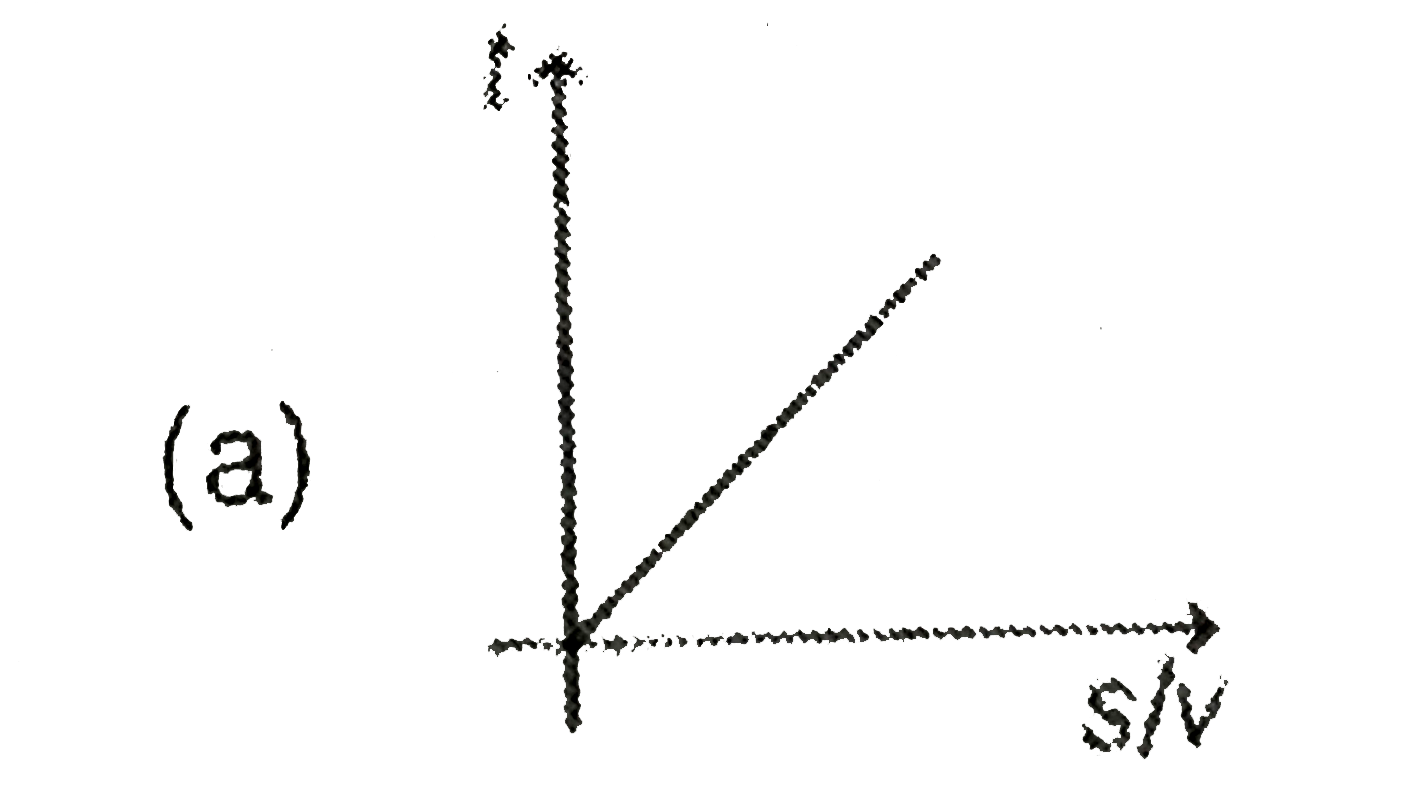
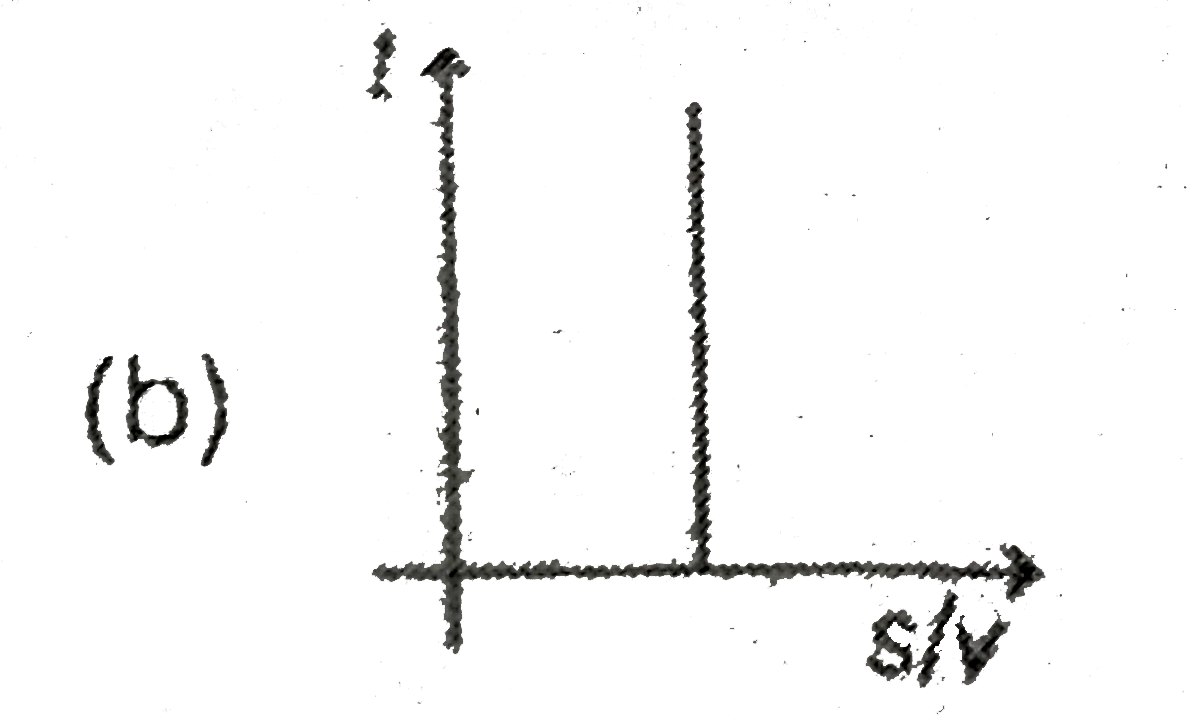
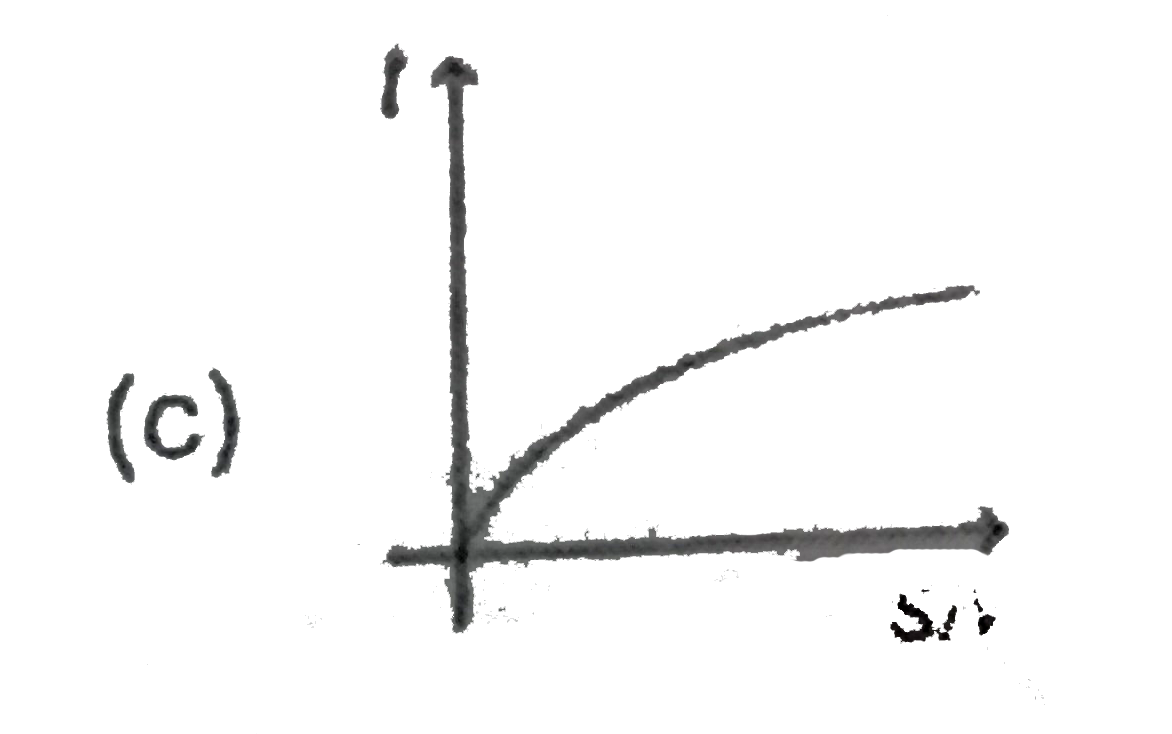
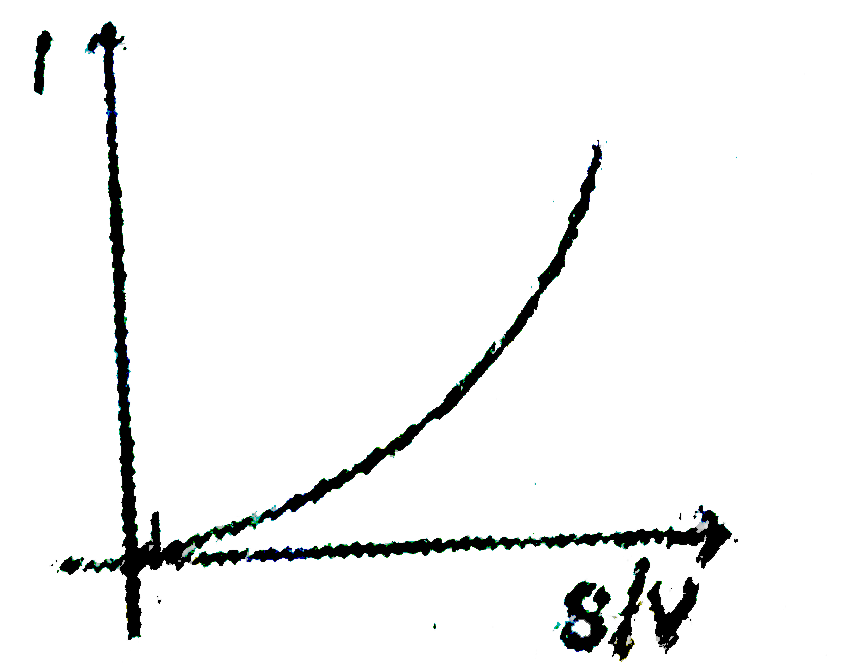
A body is moved from rest along a straight line by a machine delivering constant power. The ratio of displacement and velocity `(s//v)` varies with time `t` as

A

B

C

D

Text Solution

AI Generated Solution

The correct Answer is:

To solve the problem step by step, we will derive the relationship between displacement (s), velocity (v), and time (t) when a body is moved from rest by a machine delivering constant power. ### Step 1: Understand the relationship between power, work, and time Power (P) is defined as the rate of doing work. Mathematically, it can be expressed as: \[ P = \frac{W}{t} \] Where \( W \) is the work done and \( t \) is the time taken. Rearranging gives us: \[ W = P \cdot t \] This is our Equation (1). ### Step 2: Apply the work-energy theorem According to the work-energy theorem, the work done on an object is equal to the change in its kinetic energy. Since the body starts from rest, the initial kinetic energy is zero. Thus, the work done can be expressed as: \[ W = \Delta KE = \frac{1}{2} m v^2 - 0 = \frac{1}{2} m v^2 \] This is our Equation (2). ### Step 3: Equate the two expressions for work From Equations (1) and (2), we can set them equal to each other: \[ \frac{1}{2} m v^2 = P \cdot t \] Rearranging this gives: \[ v^2 = \frac{2Pt}{m} \] Taking the square root of both sides, we find: \[ v = \sqrt{\frac{2Pt}{m}} \] This is our Equation (A). ### Step 4: Relate displacement to time Velocity (v) is defined as the rate of change of displacement (s) with respect to time (t): \[ v = \frac{ds}{dt} \] Substituting Equation (A) into this gives: \[ \frac{ds}{dt} = \sqrt{\frac{2P}{m}} \cdot t^{1/2} \] Rearranging gives: \[ ds = \sqrt{\frac{2P}{m}} \cdot t^{1/2} dt \] ### Step 5: Integrate to find displacement Integrating both sides, we have: \[ s = \int ds = \int \sqrt{\frac{2P}{m}} \cdot t^{1/2} dt \] The constant can be factored out: \[ s = \sqrt{\frac{2P}{m}} \cdot \int t^{1/2} dt \] The integral of \( t^{1/2} \) is: \[ \int t^{1/2} dt = \frac{2}{3} t^{3/2} \] Thus, we have: \[ s = \sqrt{\frac{2P}{m}} \cdot \frac{2}{3} t^{3/2} \] This is our Equation (B). ### Step 6: Find the ratio of displacement to velocity Now we need to find the ratio \( \frac{s}{v} \): Using Equations (B) and (A): \[ \frac{s}{v} = \frac{\sqrt{\frac{2P}{m}} \cdot \frac{2}{3} t^{3/2}}{\sqrt{\frac{2P}{m}} \cdot t^{1/2}} \] The \( \sqrt{\frac{2P}{m}} \) terms cancel out: \[ \frac{s}{v} = \frac{2}{3} t^{3/2 - 1/2} = \frac{2}{3} t^{1} \] Thus, we find: \[ \frac{s}{v} = \frac{2}{3} t \] ### Conclusion The ratio of displacement to velocity \( \frac{s}{v} \) varies linearly with time \( t \).
Promotional Banner

Topper's Solved these Questions

  • WORK, POWER AND ENERGY

    DC PANDEY ENGLISH|Exercise B More than One Option is Correct|26 Videos
  • WORK, POWER AND ENERGY

    DC PANDEY ENGLISH|Exercise C Comprehension Type Questions|18 Videos
  • WORK, POWER AND ENERGY

    DC PANDEY ENGLISH|Exercise E Integer Type Questions|11 Videos
  • WORK, ENERGY AND POWER

    DC PANDEY ENGLISH|Exercise MEDICAL ENTRACES GALLERY|33 Videos

Similar Questions

Explore conceptually related problems

A body is moved along a straight line by a machine delivering constant power . The distance moved by the body is time t is proptional to

A body is moved along a straight line by a machine delivering constant power . The distance moved by the body is time t is proptional to

A body is moved along a straight line by a machine delivering constant power . The distance moved by the body is time t is proptional to

A body is moved along a straight line by a machine delivering a power proportional to time (P prop t) . Then, match the following.

A car drives along a straight level frictionless road by an engine delivering constant power. Then velocity is directly proportional to

A body starting from rest moves along a straight line with a constant acceleration. The variation of speed (v) with distance (s) is represented by the graph:

A particle starting from rest moves along a straight line with constant acceleration for this velocity displacement graph will have the form-

A particle of mass m is driven by a machine that delivers a constant power k watts. If the particle starts from rest the force on the particle at time t is

A particle moves along a straight line its velocity dipends on time as v=4t-t^(2) . Then for first 5 s :

A motor drives a body along a straight line with a constant force. The power P developed by the motor must vary with time t as

DC PANDEY ENGLISH-WORK, POWER AND ENERGY-A Only One Option is Correct
  1. A body is displaced from (0,0) to (1 m, 1m) along the path x = y by a ...

    Text Solution

    |

  2. A self-propelled vehicle of mass m, whose engine delivers a constant p...

    Text Solution

    |

  3. A body is moved from rest along a straight line by a machine deliverin...

    Text Solution

    |

  4. A forceF = (2hat(i)+5hat(j)+hat(k))N is acting on a particle. The part...

    Text Solution

    |

  5. A vertical spring of force cosntant 100 N//m is attached with a hangin...

    Text Solution

    |

  6. A partical is realeased from the top of two inclined rought surface of...

    Text Solution

    |

  7. System shown in figure is released from rest . Pulley and spring is ma...

    Text Solution

    |

  8. Force acting on a particale is (2hat(i)+3hat(j))N. Work done by this f...

    Text Solution

    |

  9. An object of mass m slides down a hill of arbitrary shape and after tr...

    Text Solution

    |

  10. A block of mass m slides down a rough inclined plane of inclination th...

    Text Solution

    |

  11. A 1.5-kg block is initially at rest on a horizontal frictionless surfa...

    Text Solution

    |

  12. In the above problem, the maximum positive displacement x is

    Text Solution

    |

  13. A block of mass 1 kg is attached to one end of a spring of force const...

    Text Solution

    |

  14. Two block of masses m(1) and m(2) connected by a light spring rest on ...

    Text Solution

    |

  15. A block of mass m is attached with a massless spring of force constant...

    Text Solution

    |

  16. The potential energy of a particle of mass m is given by U=(1)/(2)kx^(...

    Text Solution

    |

  17. A body of mass 2 kg is moved from a point A to a point B by an externa...

    Text Solution

    |

  18. A block of mass m = 0.1 kg is released from a height of 4m on a curved...

    Text Solution

    |

  19. A system consists of two cubes of mass m(1), and m(2) respectively con...

    Text Solution

    |

  20. A block mass m = 2 kg is moving with velocityv(0) towards a mass less ...

    Text Solution

    |
