Home
Class 11
PHYSICS
System shown in figure is released from ...

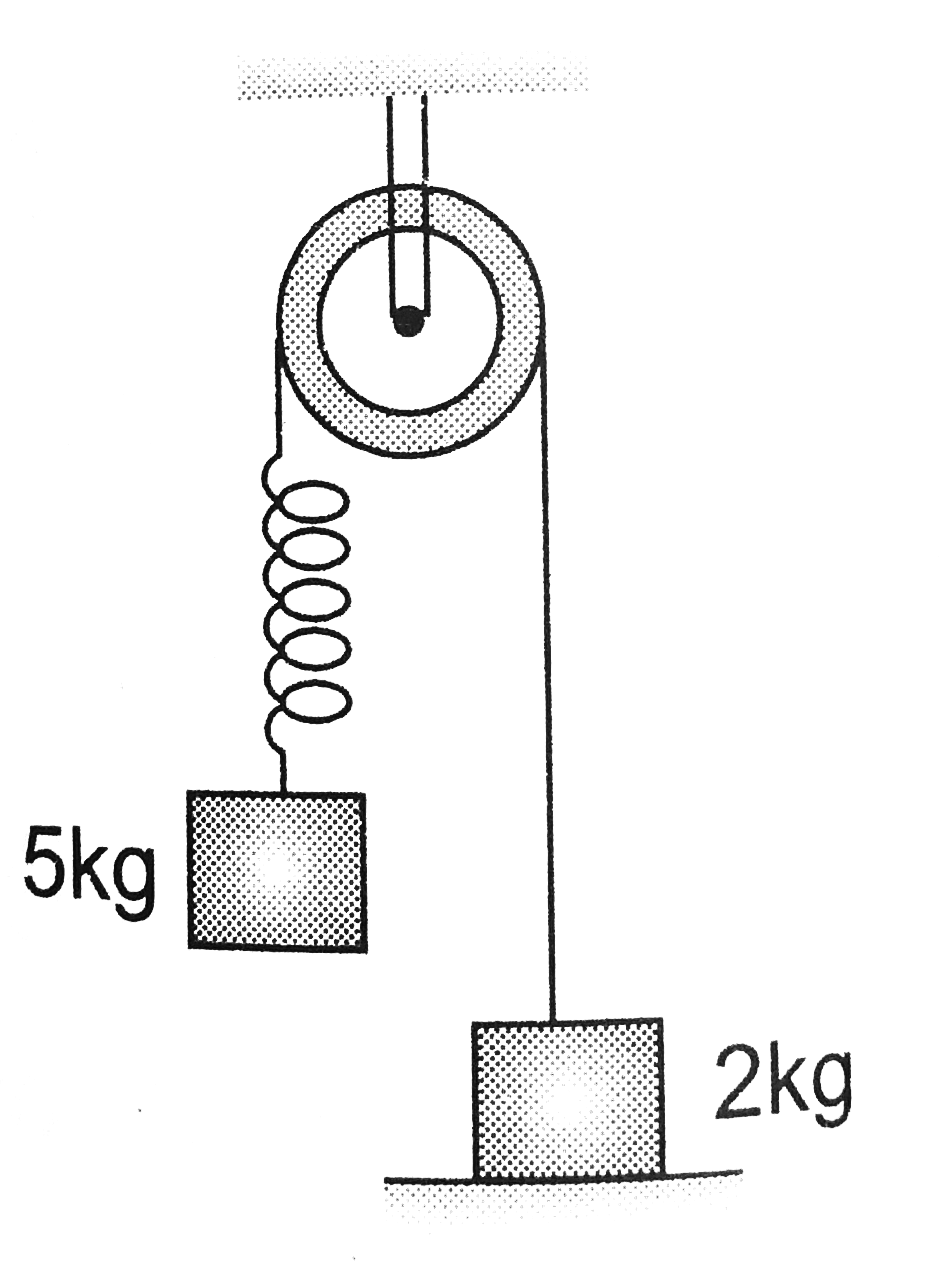
System shown in figure is released from rest . Pulley and spring is mass less and friction is absent everywhere. The speed of `5 kg` block when `2 kg` block leaves the constant of with ground is (force constant of spring `k = 40 N//m and g = 10 m//s^(2))`

A

`sqrt(2)m//s`

B

`2sqrt(2)m//s`

C

`2m//s`

D

`4sqrt(2) m//s`

Text Solution

Verified by Experts

The correct Answer is:

B
Promotional Banner

Topper's Solved these Questions

  • WORK, POWER AND ENERGY

    DC PANDEY ENGLISH|Exercise B More than One Option is Correct|26 Videos
  • WORK, POWER AND ENERGY

    DC PANDEY ENGLISH|Exercise C Comprehension Type Questions|18 Videos
  • WORK, POWER AND ENERGY

    DC PANDEY ENGLISH|Exercise E Integer Type Questions|11 Videos
  • WORK, ENERGY AND POWER

    DC PANDEY ENGLISH|Exercise MEDICAL ENTRACES GALLERY|33 Videos

Similar Questions

Explore conceptually related problems

In the figure, block A is released from rest when the spring is its natural length for the block B of mass m to leave contact with the ground at some stage what should be the minimum mass of block A? .

From the fixed pulley, masses 2 kg, 1 kg and 3 kg are suspended as shown is figure. Find the extension in the spring when acceleration of 3 kg and 1 kg is same if spring constant of the spring k = 100 N/m. (Take g = 10 ms^(-2) )

The system is released from rest with both the springs in unstretched positions. Mass of each block is 1 kg and force constant of each spring is 10 N//m . Extension of horizontal spring in equilibrium is

A block of mass 10 kg is placed on a horizontal surface as shown in the figure and a force F = 100 N is applied on the block as shown, in the figure. The block is at rest with respect to ground. If the contact force between block and ground is 25n (in Newton) then value of n is : (Take g = 10 m//s^(2))

A planck of mass 5kg is placed on a frictionless horizontal plane. Further a block of mass 1kg is placed over the plank. A massless spring of natural length 2m is fixed to the plank by its one end. The other end of spring is compressed by the block by half of spring's natural length. They system is now released from the rest. What is the velocity of the plank when block leaves the plank? (The stiffness constant of spring is 100N//m )

A plank of mass 5kg is placed on a frictionless horizontal plane. Further a block of mass 1kg is placed over the plank. A massless spring of natural length 2m is fixed to the plank by its one end. The other end of spring is compressed by the block by half of spring's natural length. They system is now released from the rest. What is the velocity of the plank when block leaves the plank? (The stiffness constant of spring is 100N//m )

A planck of mass 5kg is placed on a frictionless horizontal plane. Further a block of mass 1kg is placed over the plank. A massless spring of natural length 2m is fixed to the plank by its one end. The other end of spring is compressed by the block by half of spring's natural length. They system is now released from the rest. What is the velocity of the plank when block leaves the plank? (The stiffness constant of spring is 100N//m )

A block of mass m is released from rest at point A. The compression in spring (force constant k) when the speed of block is maximum is found to be (nmg cos theta)/(4k) . What should be the value of n?

A block of mass m is attached to a cart of mass 4m through spring of spring constant k as shown in the figure. Friction is absent everywhere. The time period of oscillations of the system, when spring is compressed and then released, is

The system is released from rest with both the springs in unstretched positions. Mass of each block is 1 kg and force constant of each spring is 10 N//m . In the equilibrium position, speed of the block placed horizontally is

DC PANDEY ENGLISH-WORK, POWER AND ENERGY-A Only One Option is Correct
  1. A vertical spring of force cosntant 100 N//m is attached with a hangin...

    Text Solution

    |

  2. A partical is realeased from the top of two inclined rought surface of...

    Text Solution

    |

  3. System shown in figure is released from rest . Pulley and spring is ma...

    Text Solution

    |

  4. Force acting on a particale is (2hat(i)+3hat(j))N. Work done by this f...

    Text Solution

    |

  5. An object of mass m slides down a hill of arbitrary shape and after tr...

    Text Solution

    |

  6. A block of mass m slides down a rough inclined plane of inclination th...

    Text Solution

    |

  7. A 1.5-kg block is initially at rest on a horizontal frictionless surfa...

    Text Solution

    |

  8. In the above problem, the maximum positive displacement x is

    Text Solution

    |

  9. A block of mass 1 kg is attached to one end of a spring of force const...

    Text Solution

    |

  10. Two block of masses m(1) and m(2) connected by a light spring rest on ...

    Text Solution

    |

  11. A block of mass m is attached with a massless spring of force constant...

    Text Solution

    |

  12. The potential energy of a particle of mass m is given by U=(1)/(2)kx^(...

    Text Solution

    |

  13. A body of mass 2 kg is moved from a point A to a point B by an externa...

    Text Solution

    |

  14. A block of mass m = 0.1 kg is released from a height of 4m on a curved...

    Text Solution

    |

  15. A system consists of two cubes of mass m(1), and m(2) respectively con...

    Text Solution

    |

  16. A block mass m = 2 kg is moving with velocityv(0) towards a mass less ...

    Text Solution

    |

  17. In a projectile motion, if we plot a graph between power of the force ...

    Text Solution

    |

  18. Potential energy of a particle moving along x-axis under the action of...

    Text Solution

    |

  19. Acceleration of a particle moving in x-y plane varies with time t as. ...

    Text Solution

    |

  20. A small mass slides down an inclined plane of inclination theta with t...

    Text Solution

    |
