Home
Class 11
PHYSICS
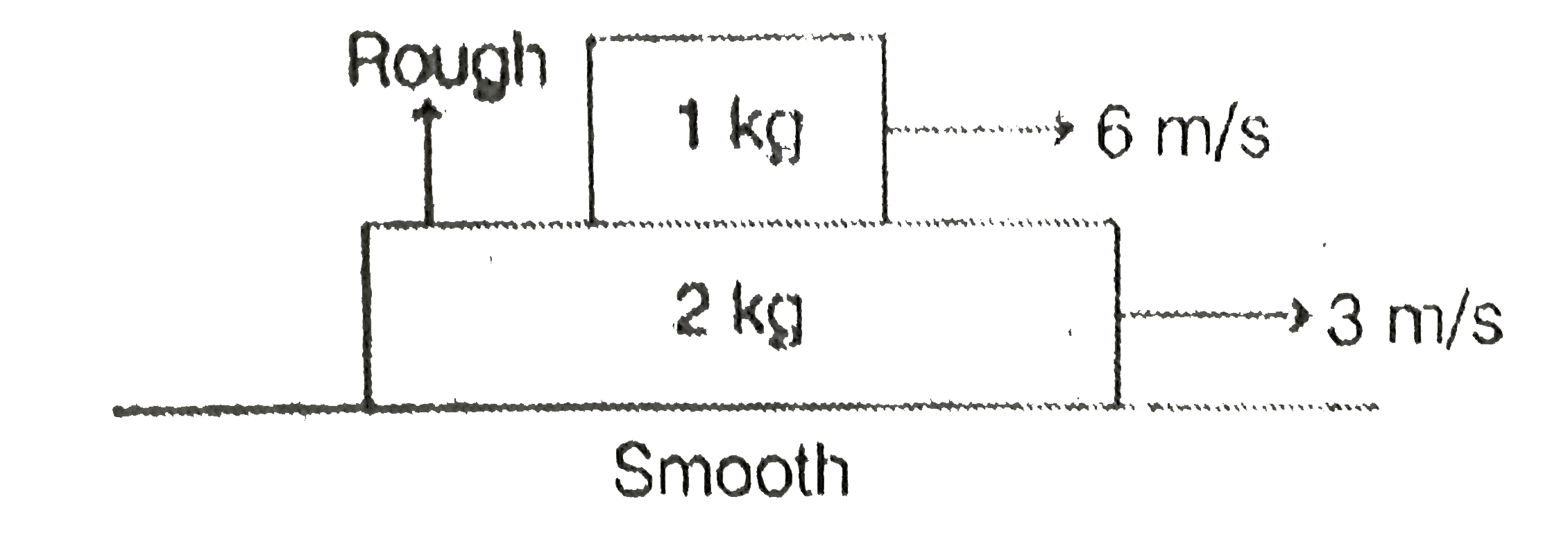
In the figure shown, upper block is give...

In the figure shown, upper block is given a velocity of `6 m//s` and lower block. `3 m//s`. When relative motion between them is stopped

A

Work done by friction on upper block is `-10 J`

B

Work done by friction on lower block `+10 J`

C

Net work done by friction is zero

D

All of the above

Text Solution

Verified by Experts

The correct Answer is:

A
Promotional Banner

Topper's Solved these Questions

  • WORK, POWER AND ENERGY

    DC PANDEY ENGLISH|Exercise D Matrix Matching Type Questions|10 Videos
  • WORK, POWER AND ENERGY

    DC PANDEY ENGLISH|Exercise E Integer Type Questions|11 Videos
  • WORK, POWER AND ENERGY

    DC PANDEY ENGLISH|Exercise B More than One Option is Correct|26 Videos
  • WORK, ENERGY AND POWER

    DC PANDEY ENGLISH|Exercise MEDICAL ENTRACES GALLERY|33 Videos

Similar Questions

Explore conceptually related problems

Coefficient of friction between two block shown in figure ia mu = 0.4 . The blocks are given velocities of 2 m//s and 8 m//s in the directions figure. Find (a) The time when relative motion between them will stop (b) the common velocities of blocks upto that instant. (c) Displacement of 1 kg and 2 kg block upto that instant (g = 10 m//s^(2)) .

coefficient of friction between two blocks shown in figure is mu =0.6 . The blocks are given velocities in the direction shown in figure. Find (a) the time when relative motion between them is stopped. (b) the common velocity of the two blocks. (c) the displacement of 1kg and 2kg blocks upto that instant. (Take g =10m//s^(2))

Three blocks of masses m , m and M are kept on a frictionless floor as shown in the figure .The leftmost block is given velocity v towards the right . All the collision between the blocks are perfectly inelastic . The loss in kinetic energy after all the collision is 5//6th of initial kinetic energy. The ratio of M//m will be

Block A of mass 5kg is placed on long block B having a mass of 5kg . The coefficient of friction between two block is 0.4 . There is no friction between the ground and lower block. The upper block is given a sudden velocity of 10m//s . The upper block slides toward right, so friction force acting on it will be toward left. Its reaction wall act on the lower block, which will act forward . The friction force absorbs x mechanical energy from upper block but supply only y mechanical energy to lower block. Due to friction the velocity of upper block reduces and velocity of lower block increases. This will continue till velocity of both the block get equal. Which curve shows the correct variation of velocity of each block v//s time?

Block A of mass 5kg is placed on long block B having a mass of 5kg . The coefficient of friction between two block is 0.4 . There is no friction between the ground and lower block. The upper block is given a sudden velocity of 10m//s . The upper block slides toward right, so friction force acting on it will be toward left. Its reaction wall act on the lower block, which will act forward . The friction force absorbs x mechanical energy from upper block but supply only y mechanical energy to lower block. Due to friction the velocity of upper block reduces and velocity of lower block increases. This will continue till velocity of both the block get equal. The net energy loss due to friction in the entire process is

A block of mass 2kg lying on ice when given a velocity of 6ms^(-1) is stopped by friction in 5s. The coefficient of friction between the block and ice is (g=10 ms^(-2) )

In the given arrangement the maximum value of F for which there is no relative motion between the blocks

In the figure shown co-efficient of friction between the block B and C is 0.4. There is no friction between the block C and hte surface on which it is placed. The system of blocks is released from rest in the shown situation. Find the distance moved by the block C when block A descends through a distance 2m. Given masses of the blocks are m_(A)=3 kg, m_(B)=5 kg and m_(C)=10 kg .

The coefficient of friction between the two blocks shown in the figure is mu = 0.4 and between the lower block and the ground is zero. The blocks are given velocities of 2 ms^(-1) and 8 ms^(-1) respectively in the direction shown in the figure. In how much time (in seconds) the slipping between the blocks will stops ?

In the figure shown the man of mass 60kg is lowering a block of mass 10kg with an acceleration of 2m//s^2 . Find the reading of the machine.

DC PANDEY ENGLISH-WORK, POWER AND ENERGY-C Comprehension Type Questions
  1. A ball is released from point A as shown in figure. The ball leaves th...

    Text Solution

    |

  2. A ball is released from point A as shown in figure. The ball leaves th...

    Text Solution

    |

  3. In the figure shown, upper block is given a velocity of 6 m//s and low...

    Text Solution

    |

  4. In the figure shown, upper block is given a velocity of 6 m//s and low...

    Text Solution

    |

  5. A ball is released from the bottom of a tank filled with water up to 2...

    Text Solution

    |

  6. A ball is released from the bottom of a tank filled with water up to 2...

    Text Solution

    |

  7. The system is released from rest with both the springs in unstretched ...

    Text Solution

    |

  8. The system is released from rest with both the springs in unstretched ...

    Text Solution

    |

  9. In a conservative force field we can find the radial component of forc...

    Text Solution

    |

  10. In a conservative force field we can find the radial component of forc...

    Text Solution

    |

  11. In a conservative force field we can find the radial component of forc...

    Text Solution

    |

  12. In a conservative force field we can find the radial component of forc...

    Text Solution

    |

  13. In the figure, the variation of potential energy of a particle of mass...

    Text Solution

    |

  14. In the figure, the variation of potential energy of a particle of mass...

    Text Solution

    |

  15. In the figure the variation of potential energy of a particle of mass...

    Text Solution

    |

  16. A block of mass 10 kg is put gently on a belt-conveyor system of infin...

    Text Solution

    |

  17. A block of mass 10 kg is put gently on a belt-conveyor system of infin...

    Text Solution

    |

  18. A block of mass 10 kg is put gently on a belt-conveyor system of infin...

    Text Solution

    |
