Home
Class 11
PHYSICS
A block A of mass m kg lies on a block B...

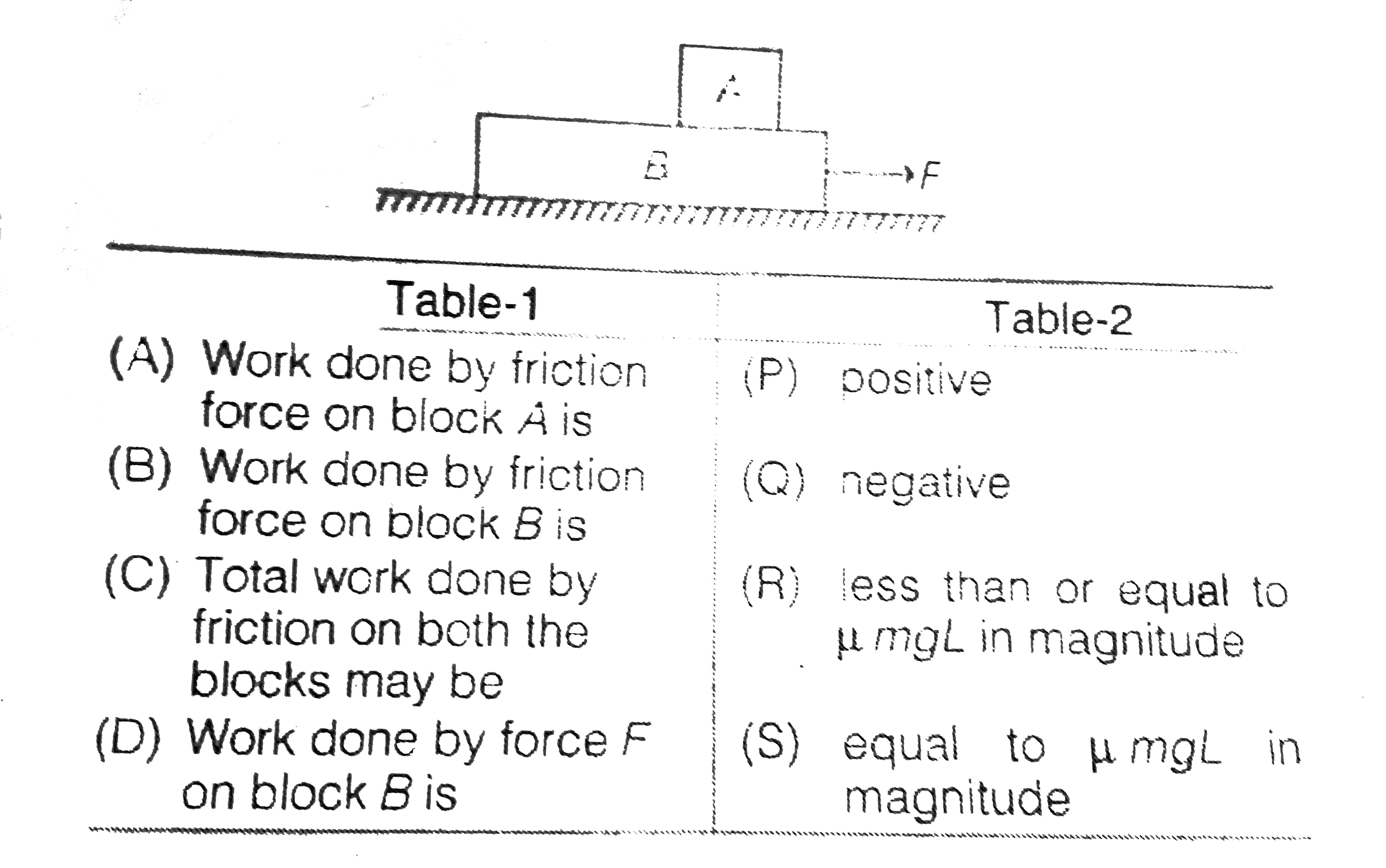
A block A of mass m kg lies on a block B of mass m kg. B in turn lies on smooth horizontal plane. The coefficient of friction between A and B is `mu`. Both the blocks are initially at rest. A horizontal force F is applied to lower block B at t = 0 till the lower block B undergoes a displacement of magnitude L. Match the statements in Table-1 with the results in Table-2.

Text Solution

Verified by Experts

The correct Answer is:

(A) PR, (B) QR, (C ) Q, (D) P
Promotional Banner

Topper's Solved these Questions

  • WORK, POWER AND ENERGY

    DC PANDEY ENGLISH|Exercise E Integer Type Questions|11 Videos
  • WORK, POWER AND ENERGY

    DC PANDEY ENGLISH|Exercise C Comprehension Type Questions|18 Videos
  • WORK, ENERGY AND POWER

    DC PANDEY ENGLISH|Exercise MEDICAL ENTRACES GALLERY|33 Videos

Similar Questions

Explore conceptually related problems

A block A of mass 2 kg rests on another block B of mass 8 kg which rests on a horizontal floor. The coefficient of friction between A and B is 0.2 while that between B and floor is 0.5 .When a horizontal floor F of 25 N is applied on the block B the force of friction between A and B is

A block A of mass 2 kg is placed over smooth block B of mass 4 kg which is placed over a smooth horizontal floor The coefficient of friction between A and B is 0.4 when a horizontal forces of magnitude 10 N is applied on A the acceleration of block of A and B are

A block of mass m is pulled by a force of constant power P placed on a rough horizontal plane. The friction coefficient between the block and the surface is mu . Then

A block of mass m is kept over another block of mass 2m. Coefficient of friction between two blocks is mu and that of between lower blood from the horizontal surface is zero. A horizontal force F=4/3 mu mg is applied on the block of mass 2m . Acceleration of lower block is

A block of mass m is placed on another block of mass M which itself is lying on a horizontal surface .The coefficient of friction between two blocks is mu_(1) and that between the block of mass M and horizontal surfece is mu_(2) What maximum horizontal force can be applied to the lower block move without separation?

A block of mass 3 kg rests on a rough inclined plane making an angle of 30^(@) . With the horizontal. The coefficient of static friction between the block and the plane is 0.7. The frictional force on the block is

A 3 kg block is placed over a 10 kg block and both are palced on a smooth horizontal surface. The coefficient of friction between the block is 0.2 . If a horizontal force of 20 N is applied to 3 kg block, accelerations of the two block in ms^(-2) are (take, g=ms^(-2) )

A 2 kg block iks placed over a 4 kg block and both are plced on a smooth horizontal surfae. The coefficient of friction between the blocks is 0.20. Find theacceleration of the two blocks if a horizontal force os 12 N is applied to a. the upper block, b. the lower block. Take g=10 m/s^2 .

A 2kg block is placed over a 5kg block and both are placed on a smooth horizontal surface. The coefficient of friction between the blocks is 0.10. Find the acceleration of the two blocks if a horizontal force of 14N is applied to the upper block (g = 10ms^(-2) ).

A small block of mass 20kg rests on a bigger block of mass 30kg , which lies on a smooth horizontal plane. Initially the whole system is at rest. The coefficient of friction between the blocks is 0.5 . The horizontal force F=50N is applied on the lower block. a. Find the work done by fricitonal force on upper block and on the lower block in t=2s . b. Is the magnitude of work done by the frictional force on upper and lower blocks same? c. Is the work done by the frictional force on the upper block converted to heat or mechanical energy or both?
