Home
Class 11
PHYSICS
A pendulum is released from point A as s...

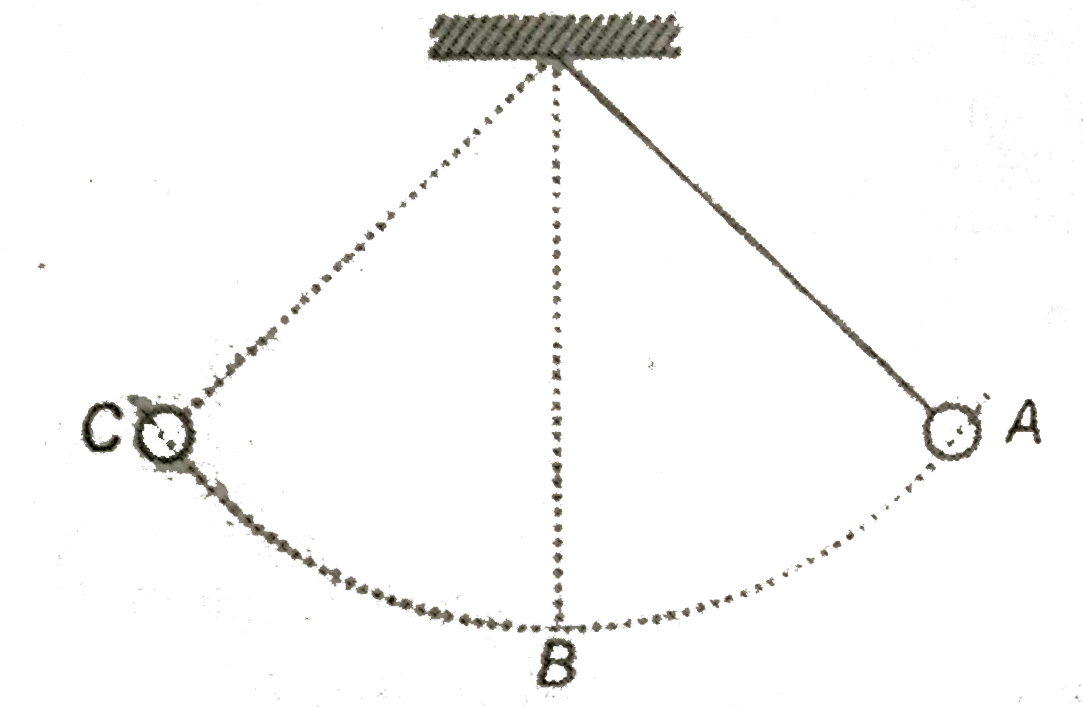
A pendulum is released from point A as shown in figure. At some instant net force one the bob is making an angle `theta` with the string. Then Match the following

`{:(,"Table-1",,"Table-2"),("(A)","For "theta=30^(@),"(P)","Particle may be moving along BA"),("(B)","For "theta=120^(@),"(Q)","Particle may be moving along CB"),("(C)","For "theta=90^(@),"(R)","Particle may be at A"),("(D)","For "theta=0^(@),"(S)","Particle is at B"),(,,"(T)","None"):}`

Text Solution

Verified by Experts

The correct Answer is:

(A)QP,(B)T,(C)R,(D)S
Promotional Banner

Topper's Solved these Questions

  • CIRCULAR MOTION

    DC PANDEY ENGLISH|Exercise Integer|7 Videos
  • CIRCULAR MOTION

    DC PANDEY ENGLISH|Exercise Check point|45 Videos
  • CIRCULAR MOTION

    DC PANDEY ENGLISH|Exercise Comprehension|13 Videos
  • CENTRE OF MASS, LINEAR MOMENTUM AND COLLISION

    DC PANDEY ENGLISH|Exercise Level 2 Subjective|21 Videos
  • COMMUNICATION SYSTEM

    DC PANDEY ENGLISH|Exercise Only One Option is Correct|27 Videos

Similar Questions

Explore conceptually related problems

A disc rolls on ground without slipping. Velocity of centre of mass is v . There is a point P on circumference of disc at angle theta . Suppose, v_(P) is the speed of this point. Then, match the following columns {:(,"Column-I",,"Column-II"),("(A)","If" theta=60^(@),"(p)",v_(P)=sqrt(2)v),("(B)","If" theta=90^(@),"(q)",v_(P)=v),("(C)","If" theta=120^(@),"(r)",v_(P)=2v),("D)","If" theta=180^(@),"(s)",v_(P)=sqrt(3)v):}

A vector has a magnitude x . If it is rotated by an angle theta then magnitude of change in vector is nx. Match the following two columns. {:(,"Column I ",,"Column II"),((A),theta=60^(@),(P),n=sqrt(3)),((B),theta=90^(@),(Q),n=1),((C), theta=120^(@),(r),n=sqrt(2)),((D), theta=180^(@),(s),n=2):}

A particle is projected from a point P with a velocity v at an angle theta with horizontal. At a certain point Q it moves at right angles to its initial direction. Then

A particle is projected from a point P with a velocity v at an angle theta with horizontal. At a certain point Q it moves at right angles to its initial direction. Then

The equation of one dimensional motion of the particle is described in column I. At t=0 , particle is at origin and at rest. Match the column I with the statement in Column II. {:(,"Column I",,,"Column II"),((A),x=(3t^(2)+2)m,,(p),"Velocity of particle at t=1s is "8 m//s),((B),v=8t m//s,,(q),"Particle moves with uniform acceleration"),((C),a=16 t,,(r),"Particle moves with variable acceleration"),((D),v=6t-3t^(2),,(s),"Particle will change its direction some time"):}

A particle of mass m=5.00kg is released from point A and it slides on the frictionless track shown in figure. Determine (a) the particle's speed at points B and C and (b) the net work done by the gravitational force as the particle moves from A to C.

Find the minimum speed at A so that the ball can reach at point B as shown in figure. Also discuss the motion of particle when T=0 , v=0 simultaneously at theta=90^@

A wedge of height 'h' is released from rest with a light particle P placed on it as shown. The wedge slides down an incline which makes an angle theta with the horizontal. All the surface are smooth, P will reach the surface of the incline in time:

A wedge of height 'h' is released from rest with a light particle P placed on it as shown. The wedge slides down an incline which makes an angle theta with the horizontal. All the surface are smooth, P will reach the surface of the incline in time:

A particle is moving with speed v= 2t^(2) on the circumference of a circle of radius R. Match the quantities given in Table-1 with corresponding results in Table-2 {:(,"Table-1",,"Table-2"),("(A)","Magnitude to tangential acceleration of particle","(P)","decreases with time"),("(B)","Magnitude of centripetal acceleration of particle","(Q)","increases with time"),("(C)","Magnitude of angular speed of particle with respect to centre of circle","(R)","remains constant"),("(D)","Angle between the total acceleration and centripetal acceleration of partilce","(S)","depends upon the value of radius R"):}
