Home
Class 11
PHYSICS
A horizontal ray of light passes through...

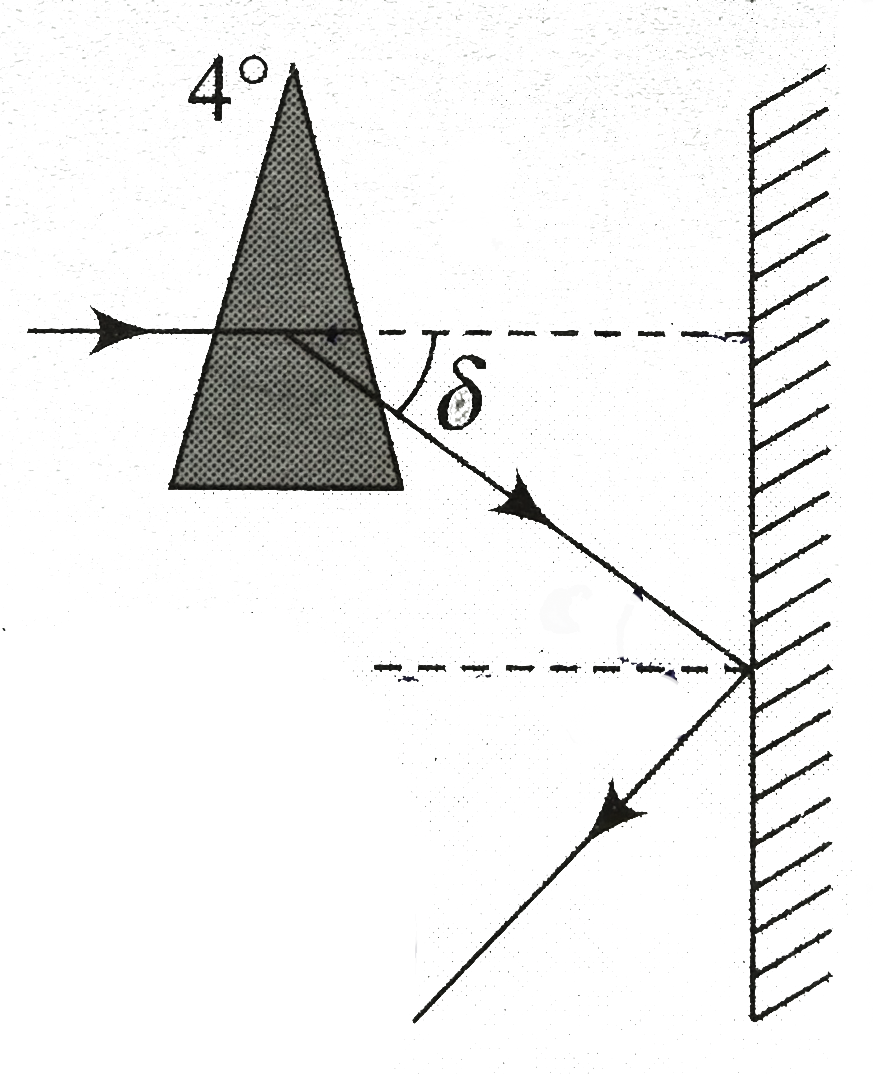
A horizontal ray of light passes through a prism whose apex angle is `4^@` and then strikes a vertical mirror M as shown in Figure. For the ray to become horizontal after reflection, Find the angle by which the mirror must be rotated.

A

`2^(@)`

B

`3^(@)`

C

`4^(@)`

D

`1^(@)`

Text Solution

Verified by Experts

The correct Answer is:

A, D
Promotional Banner

Topper's Solved these Questions

  • RAY OPTICS

    DC PANDEY ENGLISH|Exercise C. comprehension type question|14 Videos
  • RAY OPTICS

    DC PANDEY ENGLISH|Exercise Matrix matching type Q.|8 Videos
  • RAY OPTICS

    DC PANDEY ENGLISH|Exercise A. Only one option is correct (JEE Advance)|73 Videos
  • PROPERTIES OF MATTER

    DC PANDEY ENGLISH|Exercise Integer|8 Videos
  • ROTATION

    DC PANDEY ENGLISH|Exercise (C) Chapter Exercises|39 Videos

Similar Questions

Explore conceptually related problems

A horizontal ray of light passes through a prism of index 1.50 and apex angle 4^(@) and then strikes a vertical mirror , as shown in the figure. Through what angle must the mirror be rotated if after reflection the ray is to be horizontal?

A prism having an apex angle 4^(@) and refractive index 1.5 is located in front of a vertical plane mirror as shown in figure. Through what total angle is the ray is deviated after reflection from the mirror ?

A ray of light XY passes through a right angled isosceles prism as shown alongside. Which prism surface will behave as a mirror ?

A ray of light XY passes through a right angled isosceles prism as shown below: Which prism surface will behave as a mirror ?

A right-angled prism of apex angle 4^(@) and refractive index 1.5 is located in front of a vertical plane mirror as shown in figure. A horizontal ray of light is falling on the prism. Find the total deviation produced in the light ray as it emerges 2nd time from the prism.

In the figure given the angle between incident ray and the reflected ray is 70^@ Find the angle between the mirror and the incident ray.

A ray of light strikes a plane mirror at an angle of incidence 45^@ as shown in Figure . After reflection,l the ray passes through a prism of refractive indes 1.5 whos apex angle is 4^@ . Through what angle must the mirror be rotated it total deviation of the ray be 90^@ ?

A small angled prism of apex angle A=4^@ and refractive index mu=1.5 is placed in front of a vertical plane mirror as shown in figure. If the mirror is rotated through an angle theta, then the light ray becomes horizontal either after the mirror or after second time passing from the prism in opposite direction. The value theta is

A prism having an apex angle of 4^@ and refractive index of 1.50 is located in front of a vertical plane mirror as shown in the figure. A horizontal ray of light is incident on the prism. The total angle through which the ray is deviated is:

A horizontal light ray passes through a prism (mu=1.5) of angle 4^(@) .Further, it is incident on a plane mirror M , that has been placed verticall. By what angle the mirror is rotated so that the ray after reflection becomes horizontal?

DC PANDEY ENGLISH-RAY OPTICS-B. More than one option is correct
  1. A point object is placed at 30 cm from a convex glass lens (mu(g) = (3...

    Text Solution

    |

  2. For a concave mirror of focal length f, image is 2 times larger. Then ...

    Text Solution

    |

  3. For a concave mirror

    Text Solution

    |

  4. Focal length of a lens in air is f. Refractive index of the lens is mu...

    Text Solution

    |

  5. For what position of an object, a concave mirror forms a real image e...

    Text Solution

    |

  6. Refractive index of an equilateral prism is sqrt(2).

    Text Solution

    |

  7. Write laws of refraction. Explain the same with the help of ray diagra...

    Text Solution

    |

  8. A ray of light of wavelength u(0) and frequency v(0) enters a glass sl...

    Text Solution

    |

  9. There are three optical media 1,2 and 3 with the refractive indices mu...

    Text Solution

    |

  10. Parallel rays of light are falling on convex sphere surface of radius ...

    Text Solution

    |

  11. For a mirror linear magnification m comes out to +2. What conclusions ...

    Text Solution

    |

  12. A convex lens made of glass (mu(g)=3//2) has focal length f in air. Th...

    Text Solution

    |

  13. A converging lens is used to form an image on a screen. When the upper...

    Text Solution

    |

  14. A ray of light travelling in a transparent medium falls on a surface s...

    Text Solution

    |

  15. A horizontal ray of light passes through a prism whose apex angle is 4...

    Text Solution

    |

  16. The image formed by a concave mirror is twice the size of the object. ...

    Text Solution

    |

  17. Two refracting media are separated by a spherical interface as shown i...

    Text Solution

    |

  18. A small air bubble is trapped inside a transparent cube of size 12 cm...

    Text Solution

    |

  19. A plane mirror placed at the origin has hat(i) as the normal vector to...

    Text Solution

    |

  20. A ray of light moving along a vector (3sqrt(2) hat(i)-3 hat(j)-3 hat(k...

    Text Solution

    |
