Home
Class 11
PHYSICS
A particle of charge -q and mass m enter...

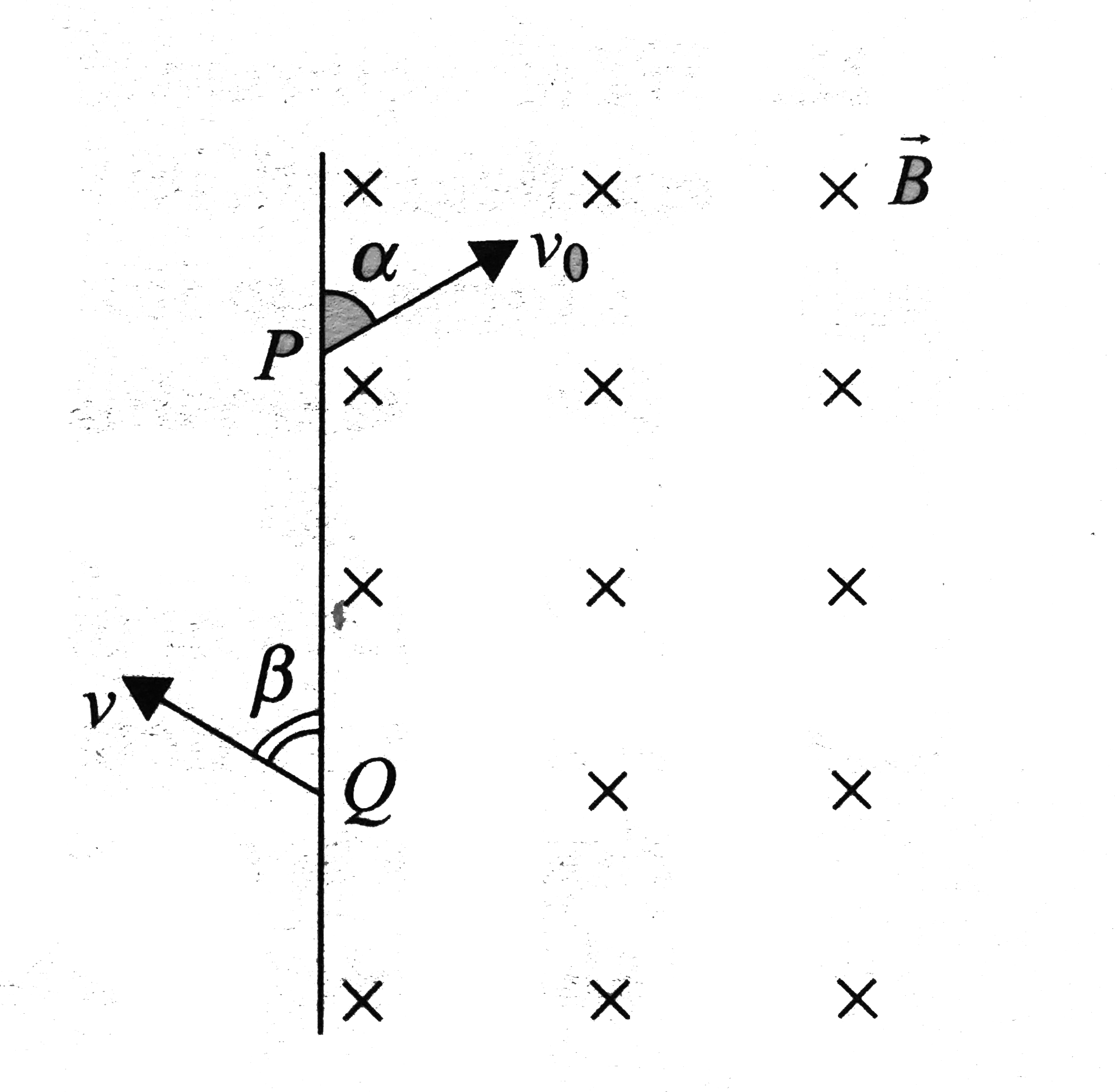
A particle of charge -q and mass m enters a uniform magnetic field `vecB` (perpendicular to paper inward) at P with a velocity `v_0` at an angle `alpha` and leaves the field at Q with velocity v at angle `beta` as shown in fig.

A

`alpha=beta`

B

`v=v_(0)`

C

`PQ=(2mv_(0)sinalpha)/(Bq)`

D

particle remains in the field for time `t=(2m(pi-alpha))/(Bq)`

Text Solution

Verified by Experts

The correct Answer is:

all
Promotional Banner

Topper's Solved these Questions

  • MAGNETIC EFFECT OF CURRENT AND MAGNETISM

    DC PANDEY ENGLISH|Exercise Comprehension type Questions|16 Videos
  • MAGNETIC EFFECT OF CURRENT AND MAGNETISM

    DC PANDEY ENGLISH|Exercise Matrix Matching type Questions|12 Videos
  • MAGNETIC EFFECT OF CURRENT AND MAGNETISM

    DC PANDEY ENGLISH|Exercise Only One Option is Correct|45 Videos
  • LAWS OF THERMODYNAMICS

    DC PANDEY ENGLISH|Exercise Level 2 Subjective|18 Videos
  • MEASUREMENT AND ERRORS

    DC PANDEY ENGLISH|Exercise Subjective|19 Videos

Similar Questions

Explore conceptually related problems

A charged particle enters a uniform magnetic field perpendicular to it. The magnetic field

A proton of charge +e and mass m enters a uniform magnetic Field vecB=hatB with an intial velocity vecv=v_(0x)hati+v_(0y)hatj . Find an expression in unit-vector notation for its velocity at any later time t.

A proton of charge e and mass m enters a uniform magnetic field B = Bi with an initial velocity v=v_xhati+v_yhatj . Find an expression in unit vector notation for its velocity at time t .

A particle of charge 'q' and mass 'm' enters a uniform magnetic field region vecB=-Bhatk at origin 'O' with a velocity vecv_(0)=6hati m/s and after some time it exist the magentic field region with a velocity vecv=(3hati+3sqrt(3)) m/s as shown. The time interval for which the particle has moved in the magnetic field region is

If a charged particle enters perpendicular in the uniform magnetic field then

A positive charge particle of charge q and mass m enters into a uniform magnetic field with velocity v as shown in Fig. There is no magnetic field to the left of PQ. Find (a) time spent, (b) distance travelled in the magnetic field, (c) impulse of magnetic force.

A positive charge particle of charge q and mass m enters into a uniform magnetic field with velocity v as shown in Fig. There is no magnetic field to the left of PQ. Find (a) time spent, (b) distance travelled in the magnetic field, (c) impulse of magnetic force.

A charge particle of charge 'q' and mass 'm' enters in a given magnetic field 'B' and perpendicular to the magnetic field as shown in the figure. It enters at an angle of 60^(@) with the boundary surface of magnetic field and comes out at an angle of 30^(@) with the boundary surface of the magnetic field as shown in the figure. Find width 'd' in which magnetic field exist.

In the figure shown a positively charged particle of charge q and mass m enters into a uniform magnetic field of strength B as shown in the figure.The magnetic field points inwards and is present only within a region of width d .The initial velocity of the particle is perpendicular to the magnetic field and phi=30^(@) .Find the time spent by the particle inside the magnetic field if d=0.2 m,B=1T,q=1C,m=1kg and v=1m//s .Use sin 45^(@)=0.7 if required .

A particle of mass m and charge q is lying at the origin in a uniform magnetic field B directed along x-axis. At time t = 0, it is given a velocity v_0 , at an angle theta with the y-axis in the xy-plane. Find the coordinates of the particle after one revolution.

DC PANDEY ENGLISH-MAGNETIC EFFECT OF CURRENT AND MAGNETISM-More than One Option is Correct
  1. Which of the following statement(s) is//are correct ?

    Text Solution

    |

  2. A rectangular loop of dimensions (axxb) carries a current i. A uniform...

    Text Solution

    |

  3. A charged particle with velocity hatv=xhati+yhatj moves in a magnetic ...

    Text Solution

    |

  4. Velocity and acceleration vector of a charged particle moving in a mag...

    Text Solution

    |

  5. A proton enters in a uniform electric and magnetic fields E and B resp...

    Text Solution

    |

  6. Two identical charged particles enter a uniform magnetic field with sa...

    Text Solution

    |

  7. A wire ABCDEF ( with each side of length L) bent as shown in figure an...

    Text Solution

    |

  8. A particle of charge -q and mass m enters a uniform magnetic field vec...

    Text Solution

    |

  9. A charged particle of specific charge alpha moves with a velocity vecv...

    Text Solution

    |

  10. A particle of charge +q and mass m moving under the influence of a un...

    Text Solution

    |

  11. A charged particle of unit mass and unit charge moves with velocity ve...

    Text Solution

    |

  12. A charged particle moves in a uniform magnetic field B=(2hati-3hatj) T

    Text Solution

    |

  13. Four infinitely long wires carring equal currents are placed parallel ...

    Text Solution

    |

  14. Velocity of a charged particle can remain unchanged. If

    Text Solution

    |

  15. Two identical coils are placed coaxially. They carry equal currents in...

    Text Solution

    |

  16. A wire B of finite length is kept on the right hand side of a long wir...

    Text Solution

    |

  17. An alpha-particle and a proton having same kineti energy enetrs in uni...

    Text Solution

    |

  18. In the given diagram, there are two semicircular parts one having radi...

    Text Solution

    |

  19. Choose the correct option: Consider a cube of side 'a' as shown. Eigh...

    Text Solution

    |

  20. Two infinitely long straight current carrying wires are placed paralle...

    Text Solution

    |
